- 9.44.1 MYTH: The benefits of a national popular vote can be achieved if one state or only a few states adopt the Voter Choice Ballot.
- 9.44.2 MYTH: The benefits of a national popular vote for President can be achieved by the Constant Two Plan.
9.44.1 MYTH: The benefits of a national popular vote can be achieved if one state or only a few states adopt the Voter Choice Ballot.
QUICK ANSWER:
- The Voter Choice Ballot (VCB) is proposed state legislation by which a state would award its electoral votes to the national popular vote winner—without the requirement (contained in the National Popular Vote Compact) that states possessing a majority of the electoral votes (270 of 538) have agreed to award their electoral votes in that manner.
- Enactment of the single-state version of the Voter Choice Ballot in any state that usually votes Republican in presidential elections would be politically preposterous (and vice versa for Democratic states).
Starting with Dale Read’s 1971 research paper at Duke University[1072] and his 1976 law review article entitled “Direct election of the president without a constitutional amendment,”[1073] there have been repeated suggestions that the benefits of a nationwide vote for President can be achieved through the action of a bloc of states possessing considerably less than a majority of the electoral votes.
This idea achieved a brief second life after the 2000 presidential election in the writings of several law professors (section 9.43.2).
A version of this idea resurfaced in 2019 under the name “Voter Choice Ballot” from an organization called “Making Every Vote Count” (MEVC).
Description of the Voter Choice Ballot
The Voter Choice Ballot (VCB) is proposed state legislation in which a state would award its electoral votes to the national popular vote winner—without the requirement (contained in the National Popular Vote Compact) that states possessing a majority of the electoral votes (270 of 538) must have agreed to award their electoral votes to the national popular vote winner.
Making Every Vote Count has proposed two distinct versions of the Voter Choice Ballot:
- Single state version: The Voter Choice Ballot legislation takes effect immediately after enactment by a single state.
- Paired state version: The Voter Choice Ballot legislation takes effect only after being enacted by two states with an equal number of electoral votes and with equal, but opposite, political orientation.
In both versions, voters would first vote for President in the usual way, and then vote on the following question:
“Do you want the candidate who receives the most votes in the nation to become the President? If you do, fill in the oval next to YES.”
The effect of voting “Yes” would be printed on each ballot:
“The state will count the votes for all those who filled in the YES oval as cast for the winner of the national popular vote for the purpose of appointing electors as otherwise provided by this state’s law.”
Figure 9.29 shows the Voter Choice Ballot.
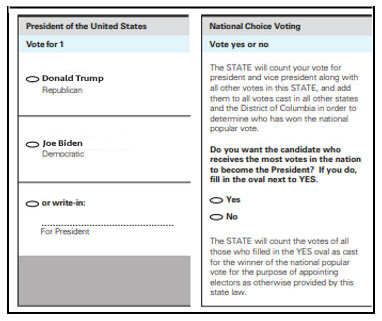
In other words, if a voter were to vote “Yes,” then the vote that the voter just cast for President would—for purposes of awarding the state’s electoral votes—be transferred from the voter’s preferred presidential candidate and added to the tally of the candidate who won the national popular vote. Then, after those transfers, the presidential candidate who has the most popular votes in the state would win all of the state’s electoral votes.
As an example, consider Michigan in 2020 when Democrat Joe Biden got 2,804,040 (51%) of the state’s popular votes, and the Republican Donald Trump got 2,649,852 (49%).
For the sake of argument, suppose that Trump had won the national popular vote and that 77,095 of Michigan’s 2,804,040 Biden voters (1.4% of the state’s voters) voted “Yes” on the Yes-No question.
Under the assumption that Trump won the national popular vote, 77,095 Democratic votes would then be subtracted from Biden—leaving Biden with only 2,726,945. Those 77,095 Biden votes would then be added to Trump’s tally—thus putting Trump in the lead in Michigan with 2,726,946 votes. The result would be that Trump (the assumed national popular vote winner) would receive all of Michigan’s electoral votes.
The Yes-No question on the Voter Choice Ballot is unusual in that it will appear to many voters to be a typical referendum question that requires a statewide majority of “Yes” votes in order to take effect. However, this is not the case. Instead, a voter may express support for the concept of a national popular vote for President only if the voter is willing to have the vote he or she just cast for President to be transferred from the voter’s preferred candidate to the national popular vote winner.
No ordinary referendum question requires a voter to surrender his or her vote for their chosen candidate in order to cast a vote on the referendum question.
In other words, a “Yes” vote is an authorization by an individual voter to transfer their vote from one candidate to another under the specified circumstances (specifically, that a certain candidate won the national popular vote).
Thus, a very modest percentage of a state’s voters (1.4% in the example above) would be sufficient to trigger the shift of a state’s electoral votes from one presidential candidate to another.
Speaking in favor of VCB at an August 13, 2020, conference, Mark Bohnhorst (a director of Making Every Vote Count at the time) said:
“The percentage of the ‘Yes’ votes that you would need in order to assure that one of the major-party candidates that won the national popular vote will win the state’s electors … are not particularly high, and in some cases, they are vanishingly small.”[1074] [Emphasis added]
Table 9.57 shows the percentage of voters voting “Yes” on VCB’s Yes-No question that would have been required in 2020 to shift a state’s electoral votes from one candidate to another:
- Columns 2 through 4 of this table show the 2020 presidential vote for each state.
- Column 6 shows the number of voters voting “Yes” on the Yes-No question that would have been needed in 2020 to switch the state’s electoral votes to the national popular vote winner.
- Column 7 expresses the number of voters in column 6 as a percentage of the state’s total popular vote for President. The table is sorted by the percentages in column 7.
Table 9.57 Percentage of voters needed to switch a state’s electoral votes under VCB in 2020
| State | Biden | Trump | Others | Total Vote | “Yes” votes needed to switch the state’s electoral votes | Percent of voters needed to switch the state’s electoral votes |
| Georgia | 2,473,633 | 2,461,854 | 62,229 | 4,997,716 | 5,890 | 0.1% |
| Arizona | 1,672,143 | 1,661,686 | 53,497 | 3,387,326 | 5,229 | 0.2% |
| Wisconsin | 1,630,866 | 1,610,184 | 56,991 | 3,298,041 | 10,342 | 0.3% |
| Pennsylvania | 3,458,229 | 3,377,674 | 79,380 | 6,915,283 | 40,278 | 0.6% |
| North Carolina | 2,684,292 | 2,758,775 | 68,422 | 5,511,489 | 37,242 | 0.7% |
| Nevada | 703,486 | 669,890 | 17,921 | 1,391,297 | 16,799 | 1.2% |
| Michigan | 2,804,040 | 2,649,852 | 85,392 | 5,539,284 | 77,095 | 1.4% |
| Florida | 5,297,045 | 5,668,731 | 101,680 | 11,067,456 | 185,844 | 1.7% |
| Texas | 5,259,126 | 5,890,347 | 165,583 | 11,315,056 | 315,611 | 2.8% |
| Minnesota | 1,717,077 | 1,484,065 | 67,308 | 3,268,450 | 116,507 | 3.6% |
| New Hampshire | 424,937 | 365,660 | 13,236 | 803,833 | 29,639 | 3.7% |
| Ohio | 2,679,165 | 3,154,834 | 88,203 | 5,922,202 | 237,835 | 4.0% |
| Iowa | 759,061 | 897,672 | 29,801 | 1,686,534 | 69,306 | 4.1% |
| Maine | 435,072 | 360,737 | 23,565 | 819,374 | 37,168 | 4.5% |
| Alaska | 153,778 | 189,951 | 13,840 | 357,569 | 18,087 | 5.1% |
| Virginia | 2,413,568 | 1,962,430 | 64,761 | 4,440,759 | 225,570 | 5.1% |
| New Mexico | 501,614 | 401,894 | 20,457 | 923,965 | 49,861 | 5.4% |
| South Carolina | 1,091,541 | 1,385,103 | 36,685 | 2,513,329 | 146,782 | 5.8% |
| Colorado | 1,804,352 | 1,364,607 | 88,021 | 3,256,980 | 219,873 | 6.8% |
| Kansas | 570,323 | 771,406 | 30,574 | 1,372,303 | 100,542 | 7.3% |
| Missouri | 1,253,014 | 1,718,736 | 54,212 | 3,025,962 | 232,862 | 7.7% |
| New Jersey | 2,608,335 | 1,883,274 | 57,744 | 4,549,353 | 362,531 | 8.0% |
| Indiana | 1,242,413 | 1,729,516 | 61,183 | 3,033,112 | 243,552 | 8.0% |
| Oregon | 1,340,383 | 958,448 | 58,401 | 2,357,232 | 190,968 | 8.1% |
| Montana | 244,786 | 343,602 | 15,252 | 603,640 | 49,409 | 8.2% |
| Mississippi | 539,398 | 756,764 | 17,597 | 1,313,759 | 108,684 | 8.3% |
| Illinois | 3,471,915 | 2,446,891 | 114,632 | 6,033,438 | 512,513 | 8.5% |
| Louisiana | 856,034 | 1,255,776 | 36,252 | 2,148,062 | 199,872 | 9.3% |
| Delaware | 295,933 | 200,327 | 7,421 | 503,681 | 47,804 | 9.5% |
| Nebraska | 374,583 | 556,846 | 20,283 | 951,712 | 91,132 | 9.6% |
| Washington | 2,369,612 | 1,584,651 | 106,116 | 4,060,379 | 392,481 | 9.7% |
| Connecticut | 1,080,831 | 714,717 | 28,309 | 1,823,857 | 183,058 | 10.0% |
| Utah | 560,282 | 865,140 | 62,867 | 1,488,289 | 152,430 | 10.2% |
| Rhode Island | 307,486 | 199,922 | 10,349 | 517,757 | 53,783 | 10.4% |
| New York | 5,230,985 | 3,244,798 | 115,574 | 8,591,357 | 993,094 | 11.6% |
| Tennessee | 1,143,711 | 1,852,475 | 57,665 | 3,053,851 | 354,383 | 11.6% |
| Alabama | 849,624 | 1,441,170 | 32,488 | 2,323,282 | 295,774 | 12.7% |
| Kentucky | 772,474 | 1,326,646 | 37,608 | 2,136,728 | 277,087 | 13.0% |
| South Dakota | 150,471 | 261,043 | 11,095 | 422,609 | 55,287 | 13.1% |
| Arkansas | 423,932 | 760,647 | 34,490 | 1,219,069 | 168,358 | 13.8% |
| California | 11,110,250 | 6,006,429 | 384,192 | 17,500,871 | 2,551,911 | 14.6% |
| Hawaii | 366,130 | 196,864 | 11,475 | 574,469 | 84,634 | 14.7% |
| Idaho | 287,021 | 554,119 | 26,091 | 867,231 | 133,550 | 15.4% |
| Oklahoma | 503,890 | 1,020,280 | 36,529 | 1,560,699 | 258,196 | 16.5% |
| North Dakota | 114,902 | 235,595 | 11,322 | 361,819 | 60,347 | 16.7% |
| Maryland | 1,985,023 | 976,414 | 56,482 | 3,017,919 | 504,305 | 16.7% |
| Massachusetts | 2,382,202 | 1,167,202 | 65,671 | 3,615,075 | 607,501 | 16.8% |
| Vermont | 242,820 | 112,704 | 11,904 | 367,428 | 65,059 | 17.7% |
| West Virginia | 235,984 | 545,382 | 13,365 | 794,731 | 154,700 | 19.5% |
| Wyoming | 73,491 | 193,559 | 7,976 | 275,026 | 60,035 | 21.8% |
| D.C. | 317,323 | 18,586 | 8,447 | 344,356 | 149,369 | 43.4% |
| Total | 81,268,586 | 74,215,875 | 2,740,538 | 158,224,999 |
As can be seen from the table, less than 10% of the voters in two-thirds of the states would be sufficient to trigger the shift of the state’s electoral votes from one presidential candidate to another.
Less than 2% of the voters in eight states would be sufficient to trigger the shift of the state’s electoral votes from one presidential candidate to another.
The two versions of the Voter Choice Ballot have very different characteristics.
A considerable amount of confusion can arise when justifications that support one version of a proposal are used to justify the other version.
In an article entitled “Ten Advantages of the Voter Choice Ballot Proposal to Achieve Urgently Needed Presidential Election Reform,” Making Every Vote Count intermixes the justifications for the two versions of VCB.
The “Ten Advantages” article states that one key advantage of VCB is:
“The reform can go into effect immediately without any other state taking action.”[1075] [Emphasis added]
This feature is particularly appealing to supporters of VCB, because the National Popular Vote Compact does not offer this immediacy. Instead, the Compact will not take effect until states possessing a majority of the electoral votes (270 of 538) agree to award their electoral votes to the national popular vote winner.
Immediacy is an attractive feature for the single-state version of VCB. However, as discussed shortly below, it is politically unsaleable, because enactment of the “single-state” version of VCB by a Democratic state would give the Republican candidate a one-sided partisan advantage, while not giving the Democrat an equivalent benefit (and vice versa for a Republican state). That is, this characteristic of the single-state version of VCB makes it unsaleable in both Democratic and Republican states.
To counter this criticism of the “single-state” version of VCB, the “Ten Advantages” article shifts to discussing the paired-state version:
“States can also adopt the voter choice ballot in contingent legislation, which would go into effect when another state that voted for the candidate of a different party in the previous election adopts reciprocal legislation (the “paired” approach).”[1076] [Emphasis added]
In discussing an “urgently needed presidential election reform,” Reed Hundt, the CEO of Making Every Vote Count, predicted in December 2020 that no Republican state would be receptive to the National Popular Vote Compact before 2024.[1077]
This prediction turned out to be accurate.
However, this prediction provides no justification for VCB. If no Republican state was going to be receptive to the concept of a national popular vote for President between 2020 and 2024, no Republican state was going to be available to create the politically balanced pair of states required to enact the paired-state version of VCB before 2024. Indeed, if a state does not favor the concept of a nationwide vote for President, it is certainly not going to favor accelerating its adoption.
In other words, the only version of VCB that could possibly be seriously considered (namely, the paired-state version) could not go into effect by 2024.
Enactment of the single-state version of the Voter Choice Ballot in any state that usually votes Republican in presidential elections would be politically preposterous (and vice versa for Democratic states).
It also would be politically preposterous for Republicans to support the single-state version of VCB in any state that regularly votes Republican in presidential elections.
For example, consider the reliably red state of South Carolina. As shown in table 9.57, if more than 6% of those who voted Republican for President were to vote “Yes” on the Yes-No question in South Carolina, and the Democratic candidate were to win the national popular vote, the Democrat would get all nine of South Carolina’s electoral votes. That is, the Democratic candidate winning the national popular vote would get nine electoral votes worth of protection against losing the Electoral College while winning the nationwide vote.
This would be a desirable and virtuous outcome, provided that the single-state version of VCB were to confer an equivalent benefit on the Republican presidential nominee.
However, it does not.
Instead, the Republican presidential nominee who wins the national popular vote would get zero electoral votes of protection against losing the Electoral College while winning the nationwide vote, because the Republican candidate was destined to win South Carolina’s electoral votes anyway.
That is, enactment of the single-state version of VCB would boomerang against the party (i.e., the Republican Party) that usually wins presidential elections in South Carolina and that controls both houses of the state legislature and the governorship.
That is, the single-state version of VCB would punish the party that has the power to enact it.
Similarly, unilateral enactment of the single-state version of VCB in any state that usually votes Democratic in presidential elections would put Democratic electoral votes at risk, while putting no Republican electoral votes at risk. It would give the Republican candidate a one-sided partisan advantage, while not giving the Democrat an equivalent benefit.
As shown in table 1.28, 36 states voted for the same party in the six presidential elections between 2000 and 2020. An additional nine states voted for the same party in all but one of those elections. Unilateral enactment of VCB makes no sense in any state that reliably votes for the same party in presidential elections.
Note the difference between VCB and the National Popular Vote Compact. An essential feature of the Compact is that it gives both parties equal protection against the possibility of losing the presidency if they win the national popular vote.
In other words, the Compact does not punish the party that has the power to enact it.
The National Popular Vote Compact operates in this bipartisan fashion because it contains the vital condition that it will not take effect until it is enacted by states possessing a majority of the electoral votes—that is, 270 out of 538. When the Compact takes effect, it will result in the appointment of at least 270 presidential electors nominated by the party whose presidential candidate won the most popular votes in all 50 states and the District of Columbia. That is, the Compact guarantees the national popular vote winner enough electoral votes to become President. Moreover, the Compact treats both parties equally. Both parties receive equal protection against the possibility of losing the Electoral College if they win the national popular vote.
Enactment of the paired state version of the Voter Choice Ballot would be exquisitely difficult to execute in practice.
In the previous section, we showed that the percentage of voters who would have to vote “Yes” on the Yes-No question in order to switch a state’s electoral votes is so small that the Yes-No question is superfluous. That is, enactment of the single-state version of VCB is essentially equivalent to a state just unilaterally awarding its electoral votes to the national popular vote winner.
We also showed above that it would be politically preposterous for Democrats in a state that usually votes Democratic in presidential elections (or for Republicans in a state that usually votes Republican) to unilaterally enact the “single-state” version of VCB, because it would perversely punish the party that enacts it.
Supporters of VCB respond to these valid criticisms of the single state version of VCB by advocating that it be simultaneously enacted by a politically balanced pair of states.
Pairing of states would be exquisitely difficult to execute in practice because of the difficulty of finding appropriate partners, and then finding legislative and gubernatorial support simultaneously in those particular states.
Each of the following five considerations severely reduces the chance of finding suitable pairs of states.
First, pairing only makes sense between states with an equal number of electoral votes. For any given number of electoral votes, there are only a few states (and sometimes no states) with the same number of electoral votes. For example, Maryland, Missouri, and Minnesota are the only states with 10 electoral votes. Virginia is also a singleton, because it is the only state with 13 electoral votes.
Second, “pairing” only makes sense between states whose partisanship is opposite. Ignoring the fact that Pennsylvania has 19 electoral votes, while Minnesota has only 10, Making Every Vote Count suggests:
“If only Minnesota and Pennsylvania, for example, paired up in adopting the ballot, both parties would be forced to campaign to win the national popular vote.”[1078]
However, this combination makes no sense, because both states voted Democratic in eight or nine of the nine presidential elections between 1992 and 2020. The net effect of a Minnesota–Pennsylvania partnership would be, in almost all elections, to put 29 Democratic electoral votes at risk, while putting no Republican electoral votes at risk.
Similarly, it would make no sense for Maryland and Minnesota to enter into a “pairing” arrangement, because both regularly vote Democratic in presidential elections. That pairing would put 20 almost certain Democratic electoral votes at risk, while putting no Republican electoral votes at risk.
Third, pairing only makes sense between states whose partisanship is not merely opposite but of equal intensity. For example, it would also make no sense for Michigan and Georgia to enter into a “pairing” arrangement (even if they had the same number of electoral votes), because Republicans hold a 7.9% edge in base party strength in Georgia, compared to a Democratic edge of 1.8% in Michigan.[1079]
Fourth, pairing only makes sense between states whose equal and opposite partisanship is stable. Unless VCB were enacted on a temporary basis for just the immediately upcoming election, it would make no sense for a state with relatively stable demographics and politics (e.g., Michigan) to pair itself with a state with rapidly changing demographics and politics (e.g., Georgia).
Fifth, Making Every Vote Count claims that the character of a presidential campaign would be changed if only one state, or a few states, adopt VCB. However, this could only happen if VCB were adopted by a large number of states together possessing a hefty number of electoral votes.
In 1971, Dale Read (the attorney who originated the idea of states unilaterally passing legislation tying their electoral votes to the national popular vote in his Duke University paper[1080] and in a 1976 Washington Law Review article)[1081] estimated that between 108 and 135 electoral votes would be needed to make his idea work.
Northwestern University Law School Dean Robert Bennett made a similar behavioral prediction in his 2006 book:
“If states with 100 to 125 electoral votes—more or less evenly balanced in partisan terms—were to bind themselves initially, the dynamics of campaigning would shift dramatically toward concern with the nationwide vote.”[1082], [1083], [1084] [Emphasis added]
Neither Bennett nor Read provided any justification for their estimates (100, 108, 126, or 135). There is no way to know exactly what number of carefully paired states would be sufficient to change the behavior of presidential candidates.
The important point is that neither Read nor Bennett is talking about one state, or a few states, changing the character of a presidential campaign. They a talking about a substantial bloc of electoral votes.
In 2019, Making Every Vote Count introduced a bill in the Maryland Senate that would have potentially paired Maryland (with 10 electoral votes) to either Minnesota (10) or Missouri (10). This bill did not include VCB.[1085]
Making Every Vote Count’s 2019 Maryland bill was nowhere near as complex as VCB.
MEVC first announced VCB in 2020.[1086] However, MEVC has yet to present actual statutory language for VCB. Additional analysis of VCB will remain impossible until MEVC provides actual proposed statutory language.
The Voter Choice Ballot would fizzle in any election (such as 2016 and 2020) in which one candidate adopts a strategy aimed only at winning the Electoral College.
The Voter Choice Ballot is based on the unsupported behavioral prediction that presidential candidates feel compelled to conduct a 50-state campaign because of enactment of VCB by a few states with a modest number of electoral votes.
In 2018, Reed Hundt, the President of Making Every Vote Count, wrote:
“If even a few states allocated even a few electors to the national winner, then both campaigns would seek national pluralities.”[1087]
Hundt also wrote in December 2018:
“What our great lawyers and statisticians discovered is that if only a few states enact laws allocating some or all electors to the winner of the national vote, then the campaigns would be impelled to seek a national victory. Both parties would send their nominees everywhere, asking everyone for their vote. Both parties would listen to all Americans when drafting their platform, selecting their nominees down ballot, shaping their agendas. The true center of American opinion would call for the candidates to act in accordance with the wishes of most Americans.”[1088], [1089][Emphasis added]
To see why Hundt’s prediction is too good to be true, let’s start by clarifying what VCB actually does, and does not do.
If VCB were enacted in a single state (say, Michigan with 15 electoral votes), it would not instantly and automatically create a nationwide popular election for President.
Instead, its immediate political effect would be to replace the state of Michigan (which has 10 million people) with a new “electoral district” with 330 million people and 15 electoral votes.
Winning the 15 electoral votes belonging to this new “electoral district” would be based on the number of votes cast nationwide for President (which was 158,224,999 in 2020).
The presidential campaigns would carefully evaluate the costs and benefits of trying to win these particular 15 electoral votes in comparison to the costs and benefits of winning electoral votes elsewhere.
Specifically, the campaign strategists would compare this new opportunity to their chances of winning the electoral votes of the existing closely divided battleground states.
In 2020, there were 11 battleground states (other than Michigan) with a total of 145 electoral votes in which the presidential candidates campaigned extensively (table 1.6).
In 2020, neither the Trump campaign nor the Biden campaign thought, for a minute, that Trump could win, would win, or was even trying to win, the national popular vote.
Trump conducted his 2020 presidential campaign patterned after the way he had won in 2016—that is, his campaign was aimed only at winning the Electoral College. Polls throughout the year showed Biden leading in the national popular vote (which he eventually won by over seven million votes).
Thus, both campaigns would have quickly concluded that the new “electoral district” created by Michigan’s enactment of VCB was just another place in which one candidate (Biden, in this case) was safely ahead, and the other (Trump) was hopelessly behind.
Presidential candidates do not campaign in such places, for the simple reason that they have nothing to gain or lose by doing so. Thus, both campaigns would have ignored the new “electoral district” created by Michigan’s enactment of VCB. Biden would have won these 15 electoral votes without bothering to campaign—just like he won New York, California, Illinois, Massachusetts, and numerous other spectator states.
That is, VCB would have totally fizzled in 2020 in terms of motivating candidates to run a 50-state campaign.[1090]
In short, VCB can lead a horse to water, but it can’t make him drink.
As will be seen in the next section, even when the national popular vote is closely divided, VCB would not be successful in making the horse drink.
The most efficient way for a candidate to win electoral votes under VCB is to redouble efforts to win popular votes in existing battleground states—not to campaign nationwide.
VCB is based on the unsupported behavioral prediction that presidential candidates will be compelled to conduct a 50-state campaign merely because of its enactment by one state, or a few states, with a modest number of electoral votes.
The major reason why VCB would not motivate presidential candidates to campaign outside of the usual dozen-or-so battleground states is thatit is simply not necessary—or advantageous—to campaign in 38 spectator states (and the District of Columbia) in order to increase a candidate’s national popular vote total.
Instead of bothering to campaign in the 38 spectator states (and the District of Columbia), candidates could far more efficiently increase their national popular vote total simply by winning additional popular votes in the dozen-or-so battleground states.
Spending money and campaign time trying to win additional popular votes in the existing closely divided battleground states would give a candidate a bite at two apples. Winning additional popular votes in a battleground state would count toward winning both the battleground state’s electoral votes (under that state’s existing winner-take-all rule) and would simultaneously count toward winning the electoral votes tethered to the national popular vote by VCB.
In contrast, campaigning among the 215,000,000 people in the 38 spectator states (and the District of Columbia) would give a candidate a bite at only one apple, namely the possibility of winning the relatively small number of electoral votes tethered to the national popular vote by VCB.[1091]
In fact, the perverse political effect of VCB would be to increase the already outsized political importance of the dozen-or-so closely divided battleground states. Each battleground state would retain 100% control over its own electoral votes—while acquiringpartialcontrol over the electoral votes of the state(s) enacting VCB. This transfer of political power would be a one-way street, because voters in the VCB state(s) would not acquire any compensating influence over the electoral votes of battleground states.
Note the critical difference between VCB and the National Popular Vote Compact. The Compact contains the vital condition that it will only go into effect when enacted by states with a majority of the electoral votes (270 of 538). As a result, the National Popular Vote Compact does not have VCB’s undesirable asymmetric transfer of power in favor of the battleground states. Under the Compact, no state is asked to unilaterally become a selfless donor that gets nothing in return.
Even under generous hypothetical assumptions, VCB would not create a meaningful nationwide campaign.
As just explained, VCB would not create any motivation for presidential candidates to expand their campaigns into the spectator states.
However, purely for the sake of argument, let’s assume that VCB actually motivated presidential candidates to conduct a 50-state campaign. That is, suppose that presidential candidates were to make the illogical decision to expand their campaign into the spectator states rather than the rational decision to simply redouble efforts to win popular votes in the battleground states.
Under that assumption, the obvious question would be” how much effort should a candidate make to win the electoral votes of the new “electoral district” created by VCB?
For this discussion, let’s suppose that Michigan had enacted VCB in time for the 2016 election.[1092]
Table 9.58 shows the 12 battleground states of 2016 (including Michigan), with their combined 153 electoral votes and 95 million people.
- Column 1 shows the Republican percentage of the two-party vote.
- Column 2 shows the number of general-election campaign events.
- Column 10 shows the state’s population.
Table 9.58 The 12 battleground states of 2016
| Trump % | Events | State | Trump | Clinton | R-Margin | D-Margin | R-EV | D-EV | Population |
| 55% | 21 | Iowa | 800,983 | 653,669 | 147,314 | 6 | 3,053,787 | ||
| 54% | 48 | Ohio | 2,841,006 | 2,394,169 | 446,837 | 18 | 11,568,495 | ||
| 52% | 55 | North Carolina | 2,362,631 | 2,189,316 | 173,315 | 15 | 9,565,781 | ||
| 52% | 10 | Arizona | 1,252,401 | 1,161,167 | 91,234 | 11 | 6,412,700 | ||
| 51% | 71 | Florida | 4,617,886 | 4,504,975 | 112,911 | 29 | 18,900,773 | ||
| 50% | 14 | Wisconsin | 1,405,284 | 1,382,536 | 22,748 | 10 | 5,698,230 | ||
| 50% | 54 | Pennsylvania | 2,970,733 | 2,926,441 | 44,292 | 20 | 12,734,905 | ||
| 50% | 22 | Michigan | 2,279,543 | 2,268,839 | 10,704 | 16 | 9,911,626 | ||
| 49.8% | 21 | New Hampshire | 345,790 | 348,526 | 2,736 | 4 | 1,321,445 | ||
| 49% | 17 | Nevada | 512,058 | 539,260 | 27,202 | 6 | 2,709,432 | ||
| 47% | 19 | Colorado | 1,202,484 | 1,338,870 | 136,386 | 9 | 5,044,930 | ||
| 47% | 23 | Virginia | 1,769,443 | 1,981,473 | 212,030 | 13 | 8,037,736 | ||
| 51% | 375 | 22,360,242 | 21,689,241 | 125 | 32 | 94,959,840 |
Clearly candidates are not going to drop everything in order to win the 16 electoral votes that Michigan possessed in 2016.
The opportunity to win the 16 electoral votes from the new nationwide “electoral district” with 310 million people would be evaluated along with the opportunity to win the 137 electoral votes available from the 11 remaining battleground states of 2016.
It is a fact that Michigan received 22 general-election campaign events in 2016 (out of 399 events nationally).
Thus, 22 campaign events (and the customary millions of dollars of accompanying advertising and the customary supporting ground game and other activity) are a reasonable estimate of what it is worth to win the new nationwide “electoral district” created by Michigan’s enactment of VCB.
There is plenty of evidence of how presidential candidates conduct their campaigns when they encounter a situation in which every vote is equal, and the candidate receiving the most votes wins. Candidates distribute their campaign events closely in proportion to population (as discussed in detail in chapter 8 and section 9.7).
So, let’s see how the presidential candidates would likely distribute these 22 events.
A 22-event campaign distributed among 310,000,000 people means one campaign event for every 14,090,000 people.
Thus, the campaign in the 38 spectator states would look something like the following:
- California (population 37 million) would probably get three of the 22 events.
- Texas (population 25 million) would probably get two events.
- New York (population 19 million) would probably get one event.
- Illinois (population 13 million) would probably get one event.
- Louisiana (population five million), Alabama (population five million) and Mississippi (population three million) might get one event.
- The remaining 14 campaign events would be distributed in a similar manner among the remaining spectator states.
In short, the 22-event VCB-induced campaign would be barely noticeable in the context of a general-election campaign involving 399 campaign events.
The 377 events concentrated in the 11 remaining battleground states (with 137-or-so electoral votes) would still constitute the bulk of the campaign.
Thus, the above calculation—as well as common sense—suggests that the real-world effect of a small number of electoral votes on the overall campaign would, well, be small.
VCB is based on magical thinking that asserts that a tiny number of electoral votes will somehow cause presidential candidates to drop everything in pursuit of the tiny number of electoral votes tethered to the nationwide popular vote.
The bottom line is that there is no quick shortcut, involving state(s) with a tiny number of electoral votes that can create a nationwide presidential campaign in which every vote is equal, and in which every voter in every state is politically relevant in every presidential election. Candidates will campaign nationally only if winning the national popular vote actually yields the White House.
If a battleground state enacted VCB, it would be exchanging its current high level of attention for considerably less attention than its population warrants.
MEVC claims that closely divided battleground states will find VCB attractive.
Let’s consider Michigan—a state that had 16 electoral votes in 2016.[1093]
What, specifically, would have happen if it had enacted VCB in 2016?
The effect of enacting VCB would be that Michigan would have become a very small part—just 3%—of a new nationwide electoral district with 310,000,000 people and 16 electoral votes.
As previously discussed, we know the value of 16 electoral votes in the 2016 presidential campaign. Michigan received 22 general-election campaign events in 2016 (out of a nationwide total of 399).[1094]
A 22-event campaign in this new virtual nationwide electoral district with 310,000,000 people would mean one campaign event for every 14,090,000 people.
With 10,000,000 people, Michigan does not have sufficient population to be absolutely guaranteed that it would receive even one campaign event. However, for the sake of argument, let’s say that Michigan would receive one.
Thus, if Michigan enacted VCB, it would be exchanging its current outsized amount of attention (22 events) for a very small amount of attention (one event).[1095]
One campaign event out of 399 is far less than the amount of attention that Michigan’s population warrants.
In a nationwide campaign in which every vote is equal, 399 events would correspond to one event for every 777,000 people. That means that Michigan would warrant about 13 campaign events in a nationwide campaign in which every voter in the country is treated equally. Thirteen events are almost exactly one event for each of the 14 congressional districts that Michigan had in 2016.
Thus, if Michigan had enacted VCB in 2016, it would have been exchanging more attention than its population warrants (22 events) for considerably less attention than its population warrants (one event).
Therefore, no battleground state is likely to enact VCB.[1096]
VCB would not come close to making every vote equal.
VCB is based on the claim that its enactment by a few states, with a small number of electoral votes, will somehow make every vote equal throughout the country.
The fourth advantage in MEVC’s list of “10 Advantages of the Voter Choice Ballot Proposal” is:
“By becoming effective in only a few states by 2024, every vote across the country would count and count equally.”[1097] [Emphasis added]
This statement is totally misleading.
Enactment of VCB in 2016 in a state (say, Michigan with 16 electoral votes), would make every vote equal in terms of deciding that particular bloc of 16 electoral votes, but it certainly would not make every vote equal in the overall presidential election.
Earlier in this sub-section, we did a hypothetical calculation of the maximum amount of effort that presidential candidates might make to win Michigan’s electoral votes if Michigan had enacted VCB, and candidates made the illogical decision to expand their campaign into the spectator states—as opposed to the rational decision to double down on the battleground states. That maximum effort was one general-election campaign event for every 14,090,000 people in the country.
We also previously noted that, under the National Popular Vote Compact, there would be one general-election campaign event for every 777,000 people (chapter 8).
In other words, enactment of VCB would not even come close to achieving one of the most important benefits guaranteed by the National Popular Vote Compact—that every vote throughout the United States would be equally important in presidential elections.
The reason why the National Popular Vote Compact can deliver the benefit of making every vote equal is that it contains the vital condition that it will only go into effect when enacted by states with a majority of the electoral votes (270 of 538). Once candidates know that the national popular vote will determine which candidate becomes President, then every voter throughout the United States becomes equally valuable. The National Popular Vote Compact would make every voter in every state equally valuable in every presidential election. VCB cannot accomplish this.
VCB would not come close to guaranteeing the presidency to the national popular vote winner.
Another example of the flawed thinking on which VCB is based concerns its ability to prevent the election of a President who did not win the national popular vote.
Biden’s margin of victory in the Electoral College in 2020 was 74 electoral votes (specifically, 302 to 232).
Trump’s margin in 2016 was, by coincidence, 74 electoral votes.
Obama’s margin in 2012 was 126 electoral votes.
The average margin of victory in the Electoral College in the nine presidential elections from 1988 to 2020 was 138 electoral votes.
Manifestly, enactment of VCB (say, by Michigan with 16 electoral votes in 2016) would not have come close to accomplishing the goal of protecting against the possibility of electing a President who lost the national popular vote.
This goal can be achieved by the National Popular Vote Compact, because it contains the vital condition that it will not take effect until it is enacted by states possessing a majority of the electoral votes—that is, 270 out of 538.
There simply is no shortcut, involving one state or a few states, that can achieve the goal of guaranteeing the presidency to the candidate who receives the most popular votes in all 50 states and the District of Columbia.
The polling supporting VCB was not constructed so as to accurately measure voter sentiment.
“Americans Want the National Choice Ballot” is the title of Making Every Vote Count’s description of its poll on VCB.[1098]
However, an examination of the poll indicates that it was not constructed so as to accurately measure what “Americans want.”
The key question in Making Every Vote Count’s poll was:
“Some people want the person who wins the national popular vote to become president. One way to make that likely is to be able to cast your vote as you normally would and then choose, if you select this option, to have the national vote winner counted as your choice for president in your state. Do you want to have that choice on the ballot?” [Emphasis added]
As can be seen, this poll question is loaded with:
- three occurrences of the word “choice” or “choose,”
- one occurrence of the word “option,” and
- two references to “national popular vote.”
Of course, most people are in favor of “choice.” Most people are in favor of “options.” Most people are in favor of a national popular vote for President.
This question was not the only loaded question that was shown to poll respondents. The following Yes-No question appeared on the Voter Choice Ballot that was shown to poll respondents:
“Do you want the candidate who receives the most votes in the nation to become the President? If you do, fill in the oval next to YES.”[1099]
The consequences of voting “Yes” on this appealingly worded question are only hinted at by the opaque wording “for the purpose of appointing electors as otherwise provided by this state’s law” that appears after the voter has voted on the Yes-No question:
“The state will count the votes for all those who filled in the YES oval as cast for the winner of the national popular vote for the purpose of appointing electors as otherwise provided by this state’s law.”[1100] [Emphasis added]
It is likely that many participants in the poll failed to realize that if the voter were to vote “Yes,” their vote for President would be subtracted from their preferred presidential candidate and added to the opposing candidate—if (1) the voter’s preferred choice for President is ahead in the voter’s own state, and (2) the opposing candidate is ahead nationally.
This Yes-No question appears to be a referendum on a general question of public policy that would take effect if it were to receive a majority vote. Thus, it is also likely that many participants in the poll failed to realize that a “Yes” vote could immediately authorize the state to count the vote that they just cast for President in favor of the candidate that individual voter just voted against.
In summary, Making Every Vote Count’s poll provided no convincing evidence that “Americans want the National Choice Ballot.”
Footnotes
[1072] Read, Dale Jr. 1971. Electoral College Reform: Direct Popular Vote Without a Constitutional Amendment. Independent Research Paper. Duke University Law School. https://www.nationalpopularvote.com/1971dalereadpaper
[1073] Read, Dale Jr. 1976. Direct election of the president without a constitutional amendment: A call for state action. Washington Law Review. Volume 51. Number 2. Pages 321–349. https://digitalcommons.law.uw.edu/cgi/viewcontent.cgi?article=2109&context=wlr
[1074] Bohnhorst, Mark. 2020 Presidential Election Reform 2020 & Beyond Conference. August 13, 2020. Slide 2 at timestamp 2:07 of video. https://www.crowdcast.io/e/electoralcollegereform2020
[1075] Making Every Vote Count blog. 2020. Ten Advantages of the Voter Choice Ballot Proposal to Achieve Urgently Needed Presidential Election Reform. August 31, 2020. https://www.makingeveryvotecount.com/mevc/2020/8/31/ten-advantages-of-the-voter-choice-ballot-proposal-to-achieve-urgently-needed-presidential-election-reform
[1076] Making Every Vote Count blog. 2020. Ten Advantages of the Voter Choice Ballot Proposal To Achieve Urgently Needed Presidential Election Reform. August 31, 2020. https://www.makingeveryvotecount.com/mevc/2020/8/31/ten-advantages-of-the-voter-choice-ballot-proposal-to-achieve-urgently-needed-presidential-election-reform
[1077] Hundt, Reed. 2020. Reaction to the Critique of the Voter Choice Ballot. December 5, 2020. https://www.makingeveryvotecount.com/research-whitepapers-library Accessed December 28, 2020.
[1078] Making Every Vote Count blog. 2020. Ten Advantages of the Voter Choice Ballot Proposal To Achieve Urgently Needed Presidential Election Reform. August 31, 2020. https://www.makingeveryvotecount.com/mevc/2020/8/31/ten-advantages-of-the-voter-choice-ballot-proposal-to-achieve-urgently-needed-presidential-election-reform
[1079] Ballenger, Bill. 2021. Georgia is still way more Republican than most states. The Ballenger Report. January 20, 2021. https://www.theballengerreport.com/georgia-republicans-never-should-have-lost-those-two-u-s-senate-seats-georgiais-still-way-more-republican-than-most-states/
[1080] Read, Dale Jr. 1971. Electoral College Reform: Direct Popular Vote Without a Constitutional Amendment. Independent Research Paper. Duke University Law School. https://www.nationalpopularvote.com/1971dalereadpaper
[1081] Read, Dale Jr. 1976. Direct election of the president without a constitutional amendment: A call for state action. Washington Law Review. Volume 51. Number 2. Pages 321–349. https://digitalcommons.law.uw.edu/cgi/viewcontent.cgi?article=2109&context=wlr
[1082] Bennett, Robert W. 2006. Electoral College Reform is Heating Up and Posing Some Tough Choices. Northwestern University School of Law Public Law and Legal Theory Papers. Paper No. 45. Page 15. http://law.bepress.com/nwwps/plltp/art45
[1083] Bennett, Robert W. 2001. Popular election of the president without a constitutional amendment. Green Bag. Volume 4. Number 2. Posted on April 19, 2001. Pages 241–245. http://www.greenbag.org/v4n3/v4n3_articles_bennett.pdf
[1084] Bennett, Robert W. 2006. Taming the Electoral College. Stanford, CA: Stanford University Press.
[1085] For additional details on Making Every Vote Count’s 2019 Maryland bill, see https://www.nationalpopularvote.com/state/md
[1086] Cohen, Thea. 2020. New MEVC Poll: Americans Want the National Choice Ballot. March 6, 2020. Accessed July 21, 2020. https://www.makingeveryvotecount.com/mevc/2019/11/21/listen-to-mevc-board-member-james-glassman-discuss-the-national-popular-vote-bmxkd-smmyt-59jcw-zxcc2
[1087] Hundt, Reed. 2018. Making Every Vote Count Blog. December 27, 2018.
[1088] Hundt, Reed. 2018. Making Every Vote Count press release. December 13, 2018.
[1089] There is a substantial amount of additional discussion of the Voter Choice Ballot at https://www.makingeveryvotecount.com/mevc—particularly in 2020.
[1090] Trump’s 2020 goal of winning a majority in the Electoral College, while losing the national popular vote, almost worked. If 21,847 voters had changed their minds (5,229 in Arizona, 5,890 in Georgia, and 10,342 in Wisconsin), Trump would have won the 37 electoral votes from these states, and there would have been a 269-269 tie in the Electoral College. Trump would have been re-elected, because, when there is a tie in the Electoral College, the newly elected U.S. House of Representatives picks the President on a one-state-one-vote basis, and the Republicans had a majority of the delegations in the 2021 House of Representatives.
[1091] The argument for ignoring the spectator states is especially clear in the special case of a sitting President seeking re-election (or a retiring President desiring to aid his preferred successor). Sitting Presidents have unique additional tools at their disposal, such as the ability to award vote-getting government contracts, highway improvements, waivers, exemptions, or distribution of medical supplies to particular states. Under VCB, a sitting president would continue to focus this “presidential pork” on battleground states, because every vote gained in those states would help him win their electoral votes and simultaneously help him win the electoral votes tethered to the national popular vote by VCB. Given a choice between awarding a job-creating and vote-getting tank production contract to a factory in Lima, Ohio, versus a factory in a spectator state such as Democratic Illinois or Republican Indiana, then-President Trump awarded the contract to the factory in Ohio (which was then a battleground state). He would have no reason to give that contract to Illinois, because a few additional popular votes in Illinois would not get him the safely Democratic electoral votes of Illinois, and failing to get a few more popular votes in Indiana would not cause him to lose the safely Republican electoral votes of Indiana. Indeed, campaigning in spectator states cannot help any candidate win any additional electoral votes.
[1092] In this section concerning the 2016 election, we use data from the applicable 2010 census, namely a nationwide population of 310 million people, and 95 million people living in the 12 battleground states of 2016.
[1093] Michigan was a closely divided battleground state in 2016 and 2020 (although it was almost totally ignored in the 2012 general-election campaign and 2008 campaign).
[1094] In 2020, Michigan received 21 general-election campaign events in the COVID-constrained 2020 campaign (out of a smaller-than-usual total of 212 events).
[1095] The calculation that Michigan would receive one campaign event under VCB is overly generous. In practice, candidates would double down on their efforts to win the non-VCB battleground states. Winning popular votes in a non-VCB battleground state would count toward winning both that state’s electoral votes and simultaneously count toward winning the electoral votes of states tethered to the national popular vote by VCB. Thus, spending money and campaign time trying to win additional popular votes in a non-VCB battleground state would give a candidate a bite at two apples. Thus, if Michigan had enacted VCB, it would be all but pointless for a presidential candidate to spend any time, money, or effort in Michigan.
[1096] Battleground states admittedly have not been early adopters of changes in the winner-take-all method of awarding electoral votes. However, experience shows that battleground states can be receptive to the idea of National Popular Vote based on the fairness principle and (to be a little more political) because battleground status is fleeting and fickle. The fleeting nature of battleground status is demonstrated by Michigan and Pennsylvania, which were both almost totally ignored in 2012 (when they only received one and five general-election campaign events, respectively). Neither President Obama nor Vice President Biden campaigned there after being nominated in 2012. In contrast, under the National Popular Vote Compact, each state can rely on always getting the attention that its population warrants—regardless of whether candidate support in the state is in the narrow 46%–54% to 47%–53% range that makes a state worthwhile. The National Popular Vote Compact guarantees that every voter in every state will be politically relevant in every presidential election.
[1097] Making Every Vote Count blog. 2020. Ten Advantages of the Voter Choice Ballot Proposal To Achieve Urgently Needed Presidential Election Reform. August 31, 2020. https://www.makingeveryvotecount.com/mevc/2020/8/31/ten-advantages-of-the-voter-choice-ballot-proposal-to-achieve-urgently-needed-presidential-election-reform
[1098] Cohen, Thea. 2020. New MEVC Poll: Americans Want the National Choice Ballot. March 6, 2020. Accessed July 21, 2020. https://www.makingeveryvotecount.com/mevc/2019/11/21/listen-to-mevc-board-member-james-glassman-discuss-the-national-popular-vote-bmxkd-smmyt-59jcw-zxcc2
[1099] Making Every Vote Count. Voter Choice Ballot: Summary And Coordinated Strategy To Achieve National Popular Vote For President Reform. July 1, 2020. Accessed July 21, 2020. https://www.makingeveryvotecount.com/mevc/2020/7/1/voter-choice-ballot-summary-and-coordinated-strategy-to-achieve-national-popular-vote-for-president-reform
[1100] Making Every Vote Count’s web site. See Voter Choice Ballot: Summary And Coordinated Strategy To Achieve National Popular Vote For President Reform. July 1, 2020. Accessed July 21, 2020. https://www.makingeveryvotecount.com/mevc/2020/7/1/voter-choice-ballot-summary-and-coordinated-strategy-to-achieve-national-popular-vote-for-president-reform
9.44.2 MYTH: The benefits of a national popular vote for President can be achieved by the Constant Two Plan.
QUICK ANSWER:
- The Constant Two Plan is state legislation that would award two of a state’s electoral votes to the national popular vote winner. This state legislation would go into effect as soon as a single state enacts it, regardless of whether any other state enacts a similar law.
- Even if all 50 states and the District of Columbia enacted the Constant Two Plan, awarding 102 electoral votes (out of 538) to the national popular vote winner would not guarantee the presidency to the candidate receiving the most popular votes nationwide under various politically plausible scenarios.
- Because 81% of the electoral votes under the Constant Two Plan (that is, 436 of 538) would continue to be awarded on a state-by-state winner-take-all basis, presidential candidates would continue to concentrate on the small number of closely divided battleground states. Moreover, a small number of votes in a small number of states would continue to regularly decide the presidency—thereby fueling post-election controversies that threaten democracy.
- Because the Constant Two Plan retains all existing features of the current Electoral College, all five of the current system’s sources of inequality would remain.
Jay Wendland describes a novel system for electing the President in his 2024 book, The Constant Two Plan: Reforming the Electoral College to Account for the National Popular Vote.[1101]
The Constant Two Plan is state legislation that would award two of the state’s electoral votes to the national popular vote winner. It would not require a federal constitutional amendment. It would go into effect in a state as soon as a state enacts it, regardless of whether any other state enacts a similar law.
If all 50 states and the District of Columbia were to enact the Constant Two Plan, the national popular vote winner would receive 102 electoral votes (out of 538).
In that respect, the Constant Two Plan bears some similarity to the National Bonus Plan, a proposed federal constitution amendment that would award a bonus of 102 at-large electoral votes to the national popular vote winner (section 4.5).
Even if all 50 states and the District of Columbia enacted the Constant Two Plan, it would:
- not guarantee the presidency to the candidate receiving the most popular votes in all 50 states and the District of Columbia under various politically plausible scenarios (as described in section 4.5.4 in connection with the National Bonus Plan);
- not make every vote equal, because all five of the current system’s sources of inequality (section 1.4) would remain with respect to the remaining 436 electoral votes (as described in section 4.5.5 in connection with the National Bonus Plan); and
- not give presidential candidates a reason to campaign in all 50 states (section 1.2), because 81% of the electoral votes under the Constant Two Plan (that is, 436 of 538) would continue to be awarded on a state-by-state winner-take-all basis (as described in section 4.5.5 in connection with the National Bonus Plan).
The Constant Two Plan resembles the single-state version of the Voter Choice Ballot in that it would go into effect as soon as a single state enacts it, regardless of whether any other state enacts a similar law. The discussion in section 9.44.1 shows that it would be very difficult to find a state willing to unilaterally enact it.
Footnotes
[1101] Wendland, Jay 2024. The Constant Two Plan: Reforming the Electoral College to Account for the National Popular Vote. Lanham, MD: Lexington Books.