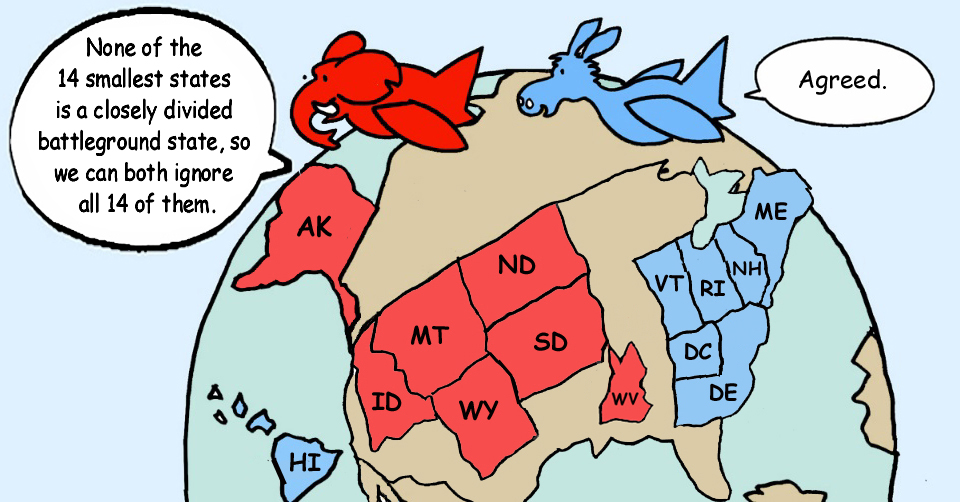
Contrary to what some may think, the current state-by-state winner-take-all method of awarding electoral votes decreases the political clout of small states in presidential elections.
Under the current system, political power comes from being a closely divided battleground state. It does not come from the two extra electoral votes that each state receives above the number warranted by population alone. Presidential candidates currently ignore the smallest states because they are almost entirely one-party states in presidential elections.
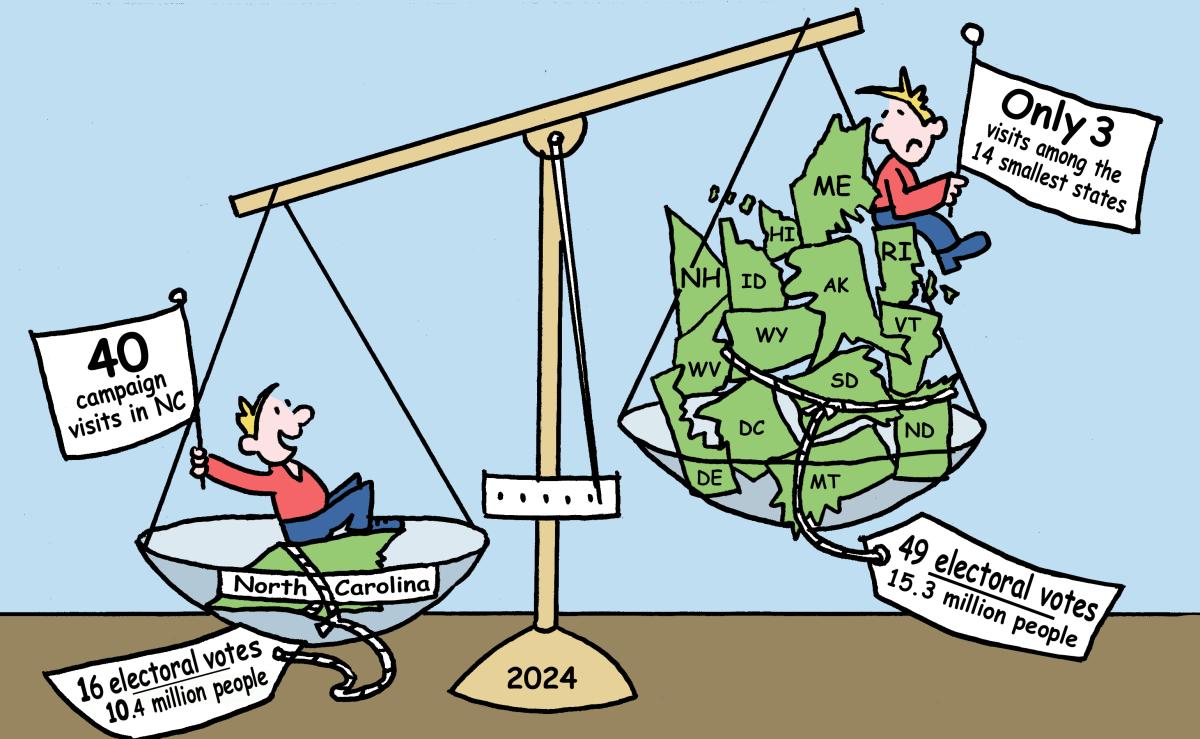
In 2024, the 14 smallest states (i.e., those with three or four electoral votes) together had over 15 million people—about 5% of the total U.S. population. Together they had 49 electoral votes—about 9% of the total. Despite this, they received only 3 of the nation’s 262 general-election campaign events—that is, only about 1% of the presidential campaign.
In contrast, the closely divided battleground state of North Carolina had considerably fewer people (only about 10 million) and considerably fewer electoral votes (only 15). However, North Carolina received 40 general-election events—15% of the nationwide total.
Similarly, each of the closely divided battleground states of Pennsylvania, Michigan, Wisconsin, Georgia, Arizona, and Nevada individually have considerably less population and considerably fewer electoral votes than the 14 smallest states together. However, these battleground states received 62, 45, 37, 27, 20, and 15 general-election campaign events, respectively.
General-election campaign events in 2024 in the 14 smallest states
|
R percent |
Visits |
State |
Trump |
Harris |
R-EV |
D-EV |
Population |
|
73% |
|
Wyoming |
192,633 |
69,527 |
3 |
|
576,851 |
|
71% |
|
West Virginia |
533,556 |
214,309 |
4 |
|
1,793,716 |
|
69% |
|
Idaho |
605,246 |
274,972 |
4 |
|
1,839,106 |
|
69% |
|
North Dakota |
246,505 |
112,327 |
3 |
|
779,094 |
|
65% |
|
South Dakota |
272,081 |
146,859 |
3 |
|
886,667 |
|
60% |
|
Montana |
352,079 |
231,906 |
4 |
|
1,084,225 |
|
57% |
|
Alaska |
184,458 |
140,026 |
3 |
|
733,391 |
|
49% |
2 |
New Hampshire |
395,523 |
418,488 |
|
4 |
1,377,529 |
|
46% |
|
Maine |
377,977 |
435,652 |
1 |
3 |
1,362,359 |
|
43% |
|
Rhode Island |
214,406 |
285,156 |
|
4 |
1,097,379 |
|
43% |
|
Delaware |
214,351 |
289,758 |
|
3 |
989,948 |
|
38% |
|
Hawaii |
193,661 |
313,044 |
|
4 |
1,455,271 |
|
34% |
|
Vermont |
119,395 |
235,791 |
|
3 |
643,077 |
|
7% |
1 |
D.C. |
21,076 |
294,185 |
|
3 |
689,545 |
|
53.1% |
3 |
TOTAL |
3,922,947 |
3,462,000 |
25 |
24 |
15,308,158 |
A national popular vote for President would make a voter in each of the 12 small non-battleground states as important as a voter in a battleground state.
Note that the table also shows that the small states are divided almost equally in terms of political party. In 2024, the popular vote in the 14 states was 53% Republican to 47% Democratic. The electoral vote was also divided almost equally—25 Republican and 24 Democratic.
As a thought experiment, suppose that the 14 smallest states were a single state (instead of 14 separate states), they would together have constituted a closely divided battleground state and would, therefore, have attracted an enormous amount of attention from presidential candidates. If the 14 smallest states were a single state, they would have received this greatly increased attention despite not having 26 of the 49 electoral votes that they currently possess (that is, they would no longer have the two “senatorial” electoral votes that each state receives above the number warranted by population alone).
Additional information can be found starting on page 717 (section 9.4) of our book Every Vote Equal: A State-Based Plan for Electing the President by National Popular Vote, which can be read or downloaded for free at www.Every-Vote-Equal.com.