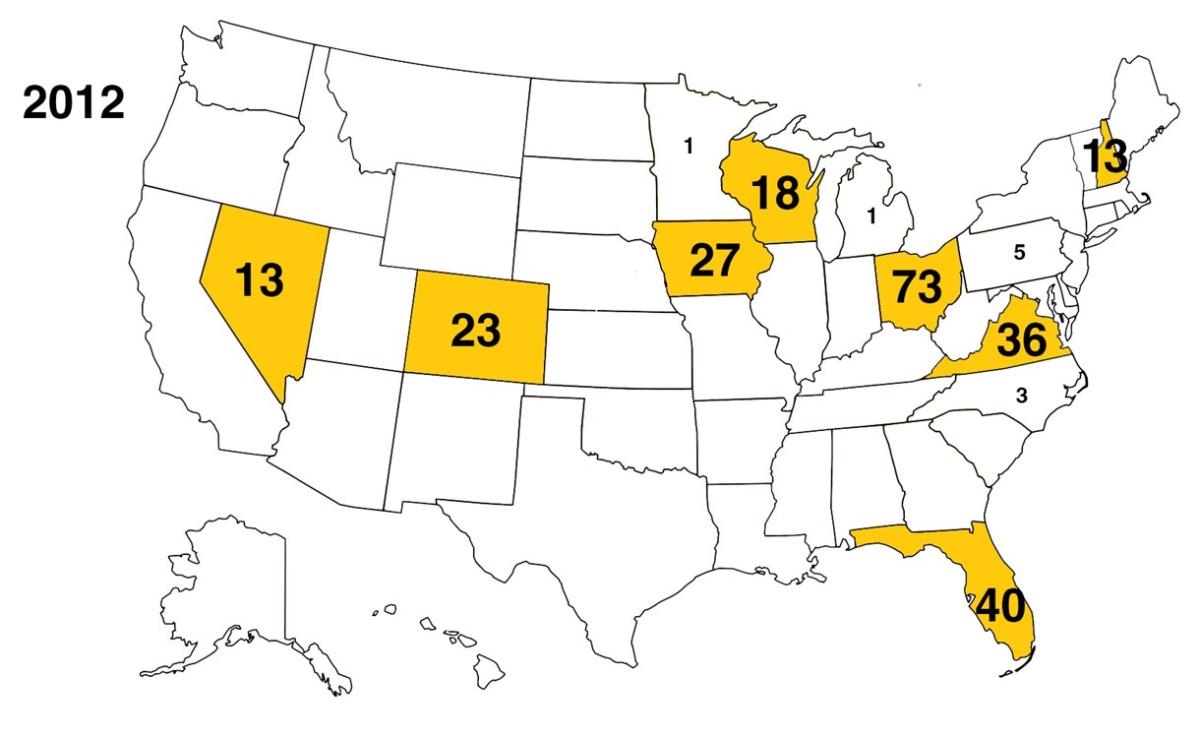
In 2012, 79% of the nation’s general-election campaign events (199 of 253) took place in five closely divided states—Ohio, Florida, Iowa, Virginia, and Colorado.
However, in 2024, these five states received less than 1% of the events (2 of 262).
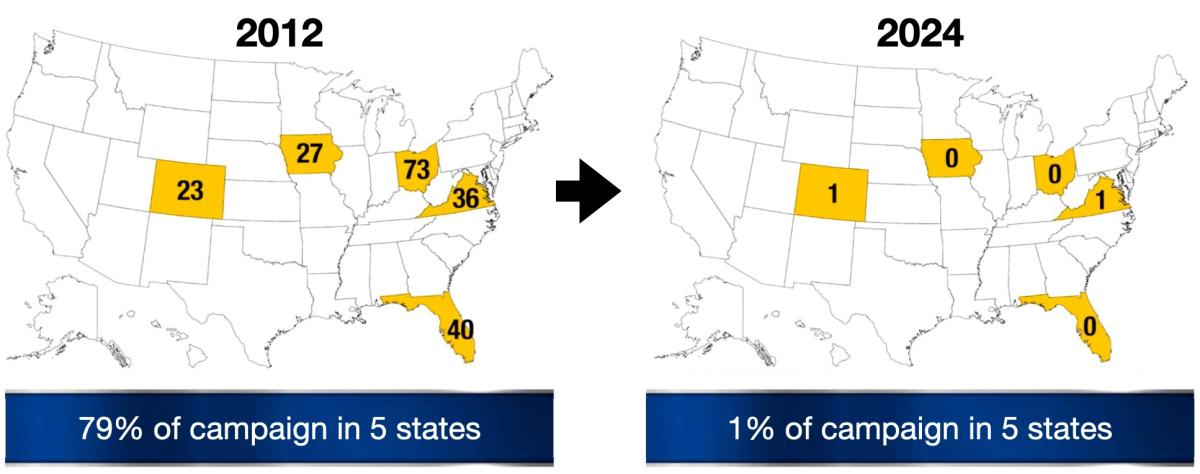
Meanwhile, states such as North Carolina, Georgia, and Arizona have become battleground states.
Pennsylvania and Michigan were almost entirely ignored in 2012
Although Pennsylvania and Michigan were battleground states in 2024, they were almost entirely ignored as recently as 2012, because they were not competitive in that particular year.
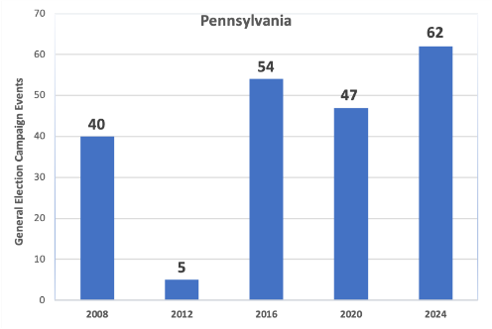
The Democratic ticket was comfortably ahead in Pennsylvania in 2012. In fact, the Obama-Biden ticket ended up winning Pennsylvania by 323,931 votes—a 54%–46% margin.
Under the current winner-take-all system, almost all general-election campaigning for President takes place in states where the major-party candidates are within less than eight percentage points of each other—that is, within a 54%–46% margin. Thus, in 2012, Pennsylvania was at the outer limit of states where presidential candidates bother to campaign.
Because polling showed that the Democratic ticket was comfortably ahead in Pennsylvania throughout 2012, there was virtually no general-election presidential campaign in the state. Pennsylvania received only five of the nation’s 253 general-election campaign events in 2012—compared to 54 events in 2016 (out of 399 nationally) and 45 events in 2020 (out of 212). That is, Pennsylvania received only about 1/10 of the attention in 2012 that it received in 2016 and 2020. The fact that Pennsylvania was “not on the map” in 2012 is further illustrated by the fact that neither President Obama nor Vice President Biden bothered to visit Pennsylvania.
As the campaign drew to a close, Governor Romney and Congressman Ryan made five visits to Pennsylvania—four at the very end of the campaign.
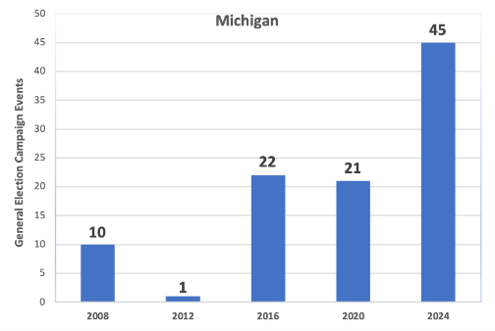
The fact that battleground status is fleeting and fickle is further illustrated by Michigan in 2012. Michigan received a large amount of attention in 2016 and 2020, but almost none in 2012. Michigan received 22 events in 2016 (out of 399 nationally) and 21 events in 2020 (out of 212). However, because polling showed that the Democratic ticket was comfortably ahead in Michigan throughout 2012, President Obama, Vice President Biden, and Republican presidential nominee Mitt Romney did not bother to visit Michigan at all. The state received only one visit in 2012—from Republican vice-presidential nominee Paul Ryan. Meanwhile, neighboring Ohio (which has about the same population as Michigan) was closely divided in 2012, and it received 73 of the nation’s 253 general-election campaign events.
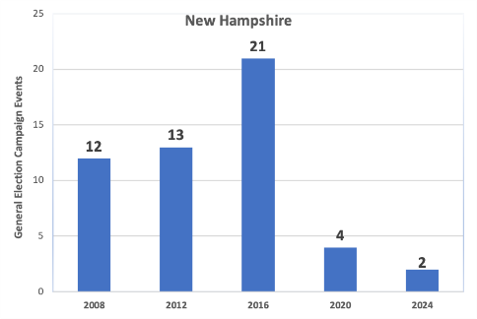
New Hampshire may well be ignored in 2028
New Hampshire was once a closely divided battleground state in presidential elections. However, the state has been increasingly Democratic in presidential elections in recent years. As a result, its battleground status was only borderline in 2020 and 2024.