In the last 7 presidential elections, the current state-by-state winner-take-all method of awarding electoral votes has resulted in 2 second-place Presidents and 3 near-misses in the Electoral College.
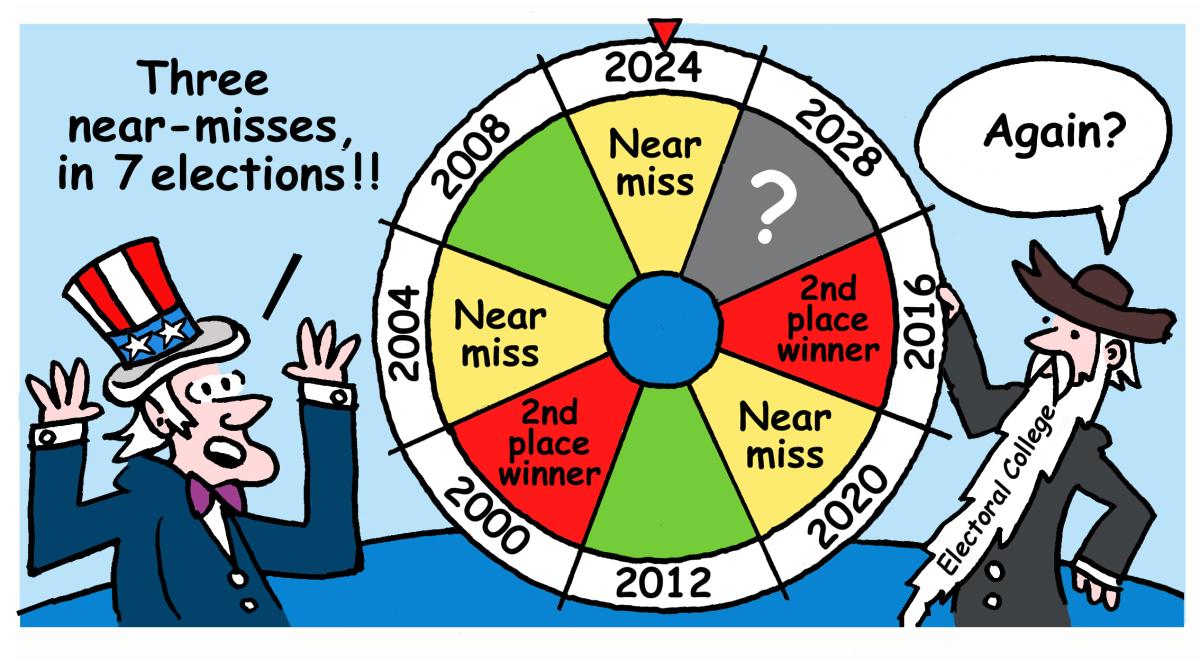
The 2 second-place presidents were
- 2000 election: In 2000, George W. Bush became President even though then-Vice President Al Gore won the national popular vote by 537,179 votes. Bush won the Presidency because he carried Florida by 537 votes. Each of these 537 votes for Bush in Florida was 1,000 times more important than the 537,179 votes cast for Gore in other states.
- 2016 election: In 2016, Donald Trump became President even though Hillary Clinton won the national popular vote by 2,868,518 votes. Clinton's margin was comparable to George W. Bush’s substantial margin of 3,012,171 in 2004. Trump won because he unexpectedly carried Michigan by 10,704 votes, Wisconsin by 22,748 votes, and Pennsylvania by 44,292 votes. Each of these 77,744 voters was 37 times more important than the 2,868,518 voters that voted for Clinton in other states.
The 3 near-misses were
- 2004 election: If 59,393 voters in Ohio in 2004 had changed their minds and not voted for incumbent President George W. Bush, John Kerry would have won Ohio's 20 electoral votes and won the Presidency in the Electoral College despite the fact that President Bush won the national popular vote.
- 2020 election: Biden won the national popular vote by 7,058,909 votes. However, if 21,461 voters had changed their minds and not voted for Biden (5,229 in Arizona, 5,890 in Georgia, and 10,342 in Wisconsin), Trump would have won the 37 electoral votes from these three states. There would then have been a 269-269 tie in the Electoral College. Trump would have been re-elected to the presidency, because the U.S. House of Representatives picks the President on a one-state-one-vote basis, and the Republicans controlled a majority of the House delegations at the beginning of the 2021 Congress. Each of these 21,461 voters for Biden was 329 times more important than the more than 7,058,909 people who voted for Biden across the country.
- 2024 election: If 114,884 voters had changed their minds and not voted for Trump (14,699 in Wisconsin, 40,042 in Michigan, and 60,133 in Pennsylvania), Harris would have won the 44 electoral votes from these three states and therefore had 270 electoral votes in the Electoral College (that is, enough to win the presidency) despite the fact that Trump won the national popular vote.