- 9.40.1 MYTH: There would have been no Emancipation Proclamation without the Electoral College.
- 9.40.2 MYTH: The Electoral College prevented a pro-slavery candidate from being elected in one case.
9.40.1 MYTH: There would have been no Emancipation Proclamation without the Electoral College.
QUICK ANSWER:
- Lincoln’s election in 1860 and 1864 did not depend on the state-by-state winner-take-all method of awarding electoral votes. He won both the Electoral College and the national popular vote in both elections.
Save Our States, the leading group that lobbies against the National Popular Vote Compact, is a project of the Oklahoma Council on Public Affairs (OCPA).
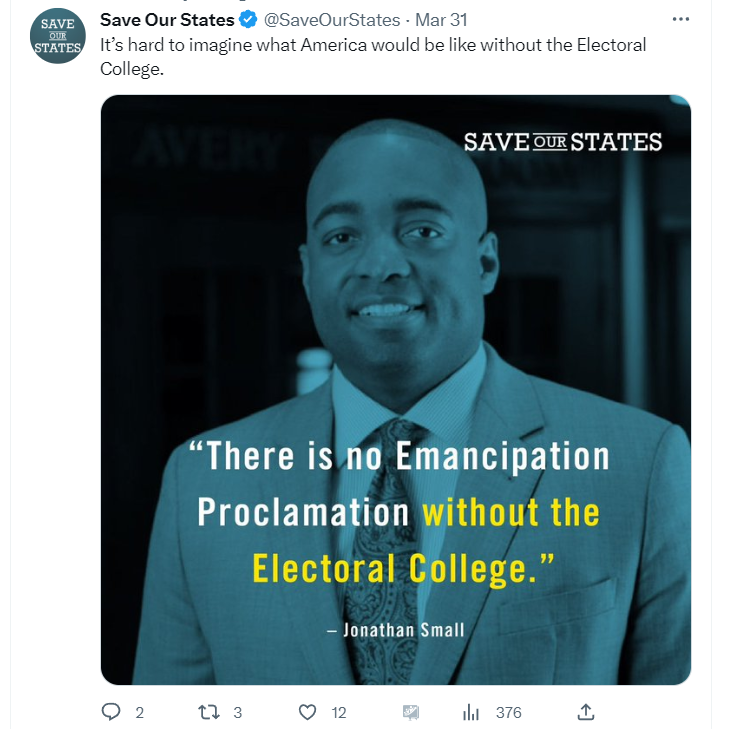
Jonathan Small, President of the Oklahoma Council on Public Affairs, tweeted in 2023:
“There is no Emancipation Proclamation without the Electoral College.”[1033]
Charlie Kirk, the founder and president of Turning Point USA, made a similar claim about the Electoral College:
“One of its minor accomplishments over a couple of centuries was that of making possible the election of Abraham Lincoln.”[1034]
President Lincoln issued the Emancipation Proclamation as an executive order on January 1, 1863.
In the four-way race of 1860, Lincoln won both the Electoral College and the national popular vote. Lincoln led his nearest competitor (Stephen A. Douglas) by a significant margin in the popular vote—more than 10% (485,706 out of 4,680,727), as shown in table 1.5.
Similarly, Lincoln won both the Electoral College and the national popular vote in 1864. Lincoln again led his nearest competitor (George B. McClellan) by a significant margin in the popular vote—more than 10% (411,401 out of 4,030,291), as shown in table 9.56.
Table 9.56 1864 election results
| Candidate | Party | Popular votes | Electoral votes |
| Abraham Lincoln | Republican | 2,220,846 | 212 |
| George B. McClellan | Democratic | 1,809,445 | 21 |
| Total | 4,030,291 | 233 |
Footnotes
[1033] Save Our States. March 31, 2023. Twitter. https://twitter.com/SaveOurStates/status/1641798951744438272?s=20
[1034] Kirk, Charlie. 2019. Beware Democrat Efforts to Abolish the Electoral College. January 14, 2019. https://www.breitbart.com/politics/2019/01/14/charlie-kirk-beware-democrat-efforts-to-abolish-the-electoral-college/
9.40.2 MYTH: The Electoral College prevented a pro-slavery candidate from being elected in one case.
QUICK ANSWER:
- If the Electoral College is to be credited in preventing Andrew Jackson from winning the presidency in 1824, it should also be criticized for electing him in 1828 and 1832. This myth is based on selective presentation of data.
Save Our States—the leading group opposed to the National Popular Vote Compact—credits the Electoral College with success for preventing the election of at least one pro-slavery candidate, namely Andrew Jackson in 1824.
In a memo entitled “The Three-Fifths Compromise and the Electoral College,” Save Our States wrote:
“In one clear case, the Electoral College prevented a pro-slavery candidate from winning.”
“In 1824 the Electoral College prevented the election of pro-slavery candidate Andrew Jackson.”[1035]
Save Our States selectively credits the Electoral College with success in preventing Jackson from winning the presidency in 1824 but fails to criticize it for electing this same slaveholder in 1828 and 1832.
In fact, Save Our States also turns a blind eye to the fact that eight of the first 12 Presidents owned slaves while in office, namely George Washington, Thomas Jefferson, James Madison, James Monroe, Andrew Jackson, John Tyler, James K. Polk, and Zachary Taylor.
Moreover, two additional Presidents from among the first 12 owned slaves at some point during their lives, namely Martin Van Buren and William Henry Harrison.
Two additional pre-Civil-War Presidents (Franklin Pierce and James Buchanan) were considered to be “dough-faced” on the issue of slavery in the sense that they were northerners with southern principles.
The historical reality is that the Three-Fifths Clause of the Constitution amplified the political power of southern slave states in both the U.S. House of Representatives and the Electoral College in the period before the Civil War.
Footnotes
[1035] Save Our States. 2021. The Three-Fifths Compromise and the Electoral College. https://saveourstates.com/uploads/The-Three-Fifths-Compromise-and-the-Electoral-College.pdf Accessed May 22, 2021.