- 9.34.1 MYTH: Recounts would be frequent under a national popular vote.
- 9.34.2 MYTH: The Compact should be opposed, because it might not be possible to conduct a recount in every state.
- 9.34.3 MYTH: Conducting a nationwide recount would be a logistical impossibility.
- 9.34.4 MYTH: The current system acts as a firewall that isolates recounts to particular states.
- 9.34.5 MYTH: Unfinished recounts could thwart the operation of the Compact.
- 9.34.6 MYTH: Resolution of a presidential election could be prolonged beyond inauguration day because of recounts under the Compact.
- 9.34.7 MYTH: There is no way to guarantee a recount in every state.
9.34.1 MYTH: Recounts would be frequent under a national popular vote.
QUICK ANSWER:
- Recounts in presidential elections would be far less likely to occur under a national popular vote system than under the current state-by-state winner-take-all method of awarding electoral votes.
- The number of votes that are likely to be changed by a nationwide recount can be estimated by standard statistical methods applied to historical data. The result of such analysis is that the probability is very high (99.74%) that a nationwide recount would change the initial winner’s lead by fewer than 24,294 votes in one direction or the other.
- To say it another way, the probability is very low (0.26% or approximately one chance in 369) that a nationwide recount would change the initial winner’s lead by more than 24,294 votes.
- Also, the probability is very high (99.74%) that only one nationwide presidential election in 324 would be close enough to be reversed by a recount. That is, one nationwide presidential election every 1,296 years would be close enough to be reversed by a recount.
- Recounts come to mind in connection with presidential elections only because a few thousand votes in a handful of closely divided states regularly decide the presidency under the current state-by-state winner-take-all system.
- Incorrect statements about recounts are often based on misinformation as to how rare recounts are in practice, how few votes are ever changed by recounts, and how few recounts ever change the outcome of an election.
- The myth that recounts would be frequent under a national popular vote is one of many examples in this book of a criticism of the National Popular Vote Compact where the Compact would be distinctly superior to the current state-by-state winner-take-all method of awarding electoral votes.
Tara Ross, a lobbyist against the National Popular Vote Compact who works closely with Save Our States, testified before the Alaska Senate:
“A direct election system … would result in … constant recounts.”[914] [Emphasis added]
As we will show in this section, recounts would be far less likely to occur under a national popular vote system than under the current state-by-state winner-take-all method of awarding electoral votes.
In fact, the probability is very high (99.74%) that only one nationwide presidential election in 324 would be close enough to be reversed by a recount. That is, one nationwide presidential election every 1,296 years would be close enough to be reversed by a recount.
Incorrect statements about recounts are often based on misinformation as to how rare recounts are in practice, how few votes are ever changed by recounts, and how few recounts ever change the outcome of an election.
Thus, we start the discussion of recounts with actual historical data about recounts. The “Facts about recounts” section below will show that recounts:
- are rare;
- change very few votes; and
- rarely reverse the original outcome.
We then apply standard statistical methods to show that the probability is very high (99.74%) that a nationwide recount would change the initial winner’s lead by fewer than 24,294 votes in one direction or the other.
Facts about recounts
FairVote has compiled historical data on elections[915] that shows that there have been 6,929 statewide general elections[916] in the 24-year period from 2000 to 2023.
Table 9.45 shows the number of statewide general elections by year.
Table 9.45 The number of statewide general elections 2000–2023
| Year | Number of elections |
| 2000 | 538 |
| 2001 | 52 |
| 2002 | 554 |
| 2003 | 79 |
| 2004 | 448 |
| 2005 | 59 |
| 2006 | 598 |
| 2007 | 70 |
| 2008 | 449 |
| 2009 | 40 |
| 2010 | 708 |
| 2011 | 60 |
| 2012 | 419 |
| 2013 | 46 |
| 2014 | 511 |
| 2015 | 56 |
| 2016 | 470 |
| 2017 | 36 |
| 2018 | 523 |
| 2019 | 62 |
| 2020 | 453 |
| 2021 | 67 |
| 2022 | 559 |
| 2023 | 72 |
| Total | 6,929 |
Table 9.46 shows the specific elective office or ballot proposition involved in the 6,929 statewide general elections between 2000 and 2023.
Table 9.46 The 6,929 statewide general elections 2000–2023 by type of election
| Office | Number of statewide general elections |
| President | 300 |
| U.S. Senator | 421 |
| U.S. Representative | 91 |
| Governor | 317 |
| Lieutenant Governor | 196 |
| Secretary of State | 220 |
| Attorney General | 262 |
| Treasurer | 214 |
| Auditor | 148 |
| Comptroller | 56 |
| Public Service Commissioner | 51 |
| Agriculture or Industries Commissioner | 71 |
| Labor Commissioner | 21 |
| Insurance Commissioner | 56 |
| Public Lands Commissioner | 29 |
| Tax Commissioner | 7 |
| Corporation Commissioner | 29 |
| Railroad Commissioner | 14 |
| Public Utilities Commissioner | 10 |
| Mine Commissioner | 6 |
| Superintendent of Public Instruction or Education | 77 |
| Board of Education or Governors | 33 |
| University Regent | 26 |
| Trustee | 10 |
| Judicial positions and retention | 1,762 |
| Ballot questions | 2,476 |
| Other | 26 |
| Total | 6,929 |
Table 9.47 shows the number of recounts by year.
Table 9.47 The number of statewide recounts by year
| Year | Number of statewide general elections | Number of recounts |
| 2000 | 538 | 5 |
| 2001 | 52 | |
| 2002 | 554 | |
| 2003 | 79 | |
| 2004 | 448 | 6 |
| 2005 | 59 | 1 |
| 2006 | 598 | 3 |
| 2007 | 70 | |
| 2008 | 449 | 2 |
| 2009 | 40 | 1 |
| 2010 | 708 | 3 |
| 2011 | 60 | 1 |
| 2012 | 419 | |
| 2013 | 46 | 1 |
| 2014 | 511 | 4 |
| 2015 | 56 | |
| 2016 | 470 | 1 |
| 2017 | 36 | |
| 2018 | 523 | 3 |
| 2019 | 62 | |
| 2020 | 453 | 2 |
| 2021 | 67 | 1 |
| 2022 | 559 | 2 |
| 2023 | 72 | |
| Total | 6,929 | 36 |
There were only 36 recounts among the 6,929 statewide general elections during the 24-year period from 2000 to 2023.[917]
That is, the probability of a recount in a statewide general election is 1-in-192, based on data from this period.
Table 9.48 shows the change in the initial winner’s votes in the 36 statewide recounts between 2000 and 2023. The recounts are listed in chronological order.
- Columns 1, 2, and 3 show the year, state, and race involved in the recount.[918]
- Column 4 shows whether the original result was upheld or reversed.
- Column 5 shows the total number of votes cast for the initial (pre-recount) winner and the initial loser.
- Column 6 shows the initial winner’s lead over the initial loser.
- Column 7 shows the final (post-recount) winner’s lead over the final loser.[919]
- Column 8 shows the change in the initial winner’s lead resulting from the recount. In the case of a recount that does not reverse the original outcome, a negative number in this column indicates that the initial winner’s lead was reduced by the recount, and a positive number indicates that the initial winner’s lead was increased by the recount. In the case of a recount that reversed the original outcome, the number in this column will always be negative.
Table 9.48 Change in the initial winner’s votes in all 36 recounts of statewide general elections 2000–2023
| Year | State | Race | Effect of the recount | Total votes | Initial winner’s lead | Final winner’s lead | Change in initial winner’s votes |
| 2000 | CO | Education Board | Upheld | 1,536,619 | 1,211 | 90 | -1,121 |
| 2000 | FL | President | Upheld | 5,816,486 | 1,784 | 537 | -1,247 |
| 2000 | MT | Public Instruction | Upheld | 63,080 | 64 | 61 | -3 |
| 2000 | WA | Secretary of State | Upheld | 2,137,677 | 10,489 | 10,222 | -267 |
| 2000 | WA | U.S. Senator | Upheld | 2,396,567 | 1,953 | 2,229 | 276 |
| 2004 | AK | U.S. Senator | Upheld | 289,324 | 9,568 | 9,349 | -219 |
| 2004 | AL | Amendment 2 | Upheld | 1,380,750 | 1,850 | 1,846 | -4 |
| 2004 | GA | Court of Appeals | Upheld | 414,484 | 348 | 363 | 15 |
| 2004 | WA | Governor | Reversed | 2,742,567 | 261 | 129 | -390 |
| 2004 | WY | Amendment A | Upheld | 218,433 | 858 | 803 | -55 |
| 2004 | WY | Amendment C | Upheld | 233,955 | 1,282 | 1,232 | -50 |
| 2005 | VA | Attorney General | Upheld | 1,941,449 | 323 | 360 | 37 |
| 2006 | AL | Amendment | Upheld | 816,102 | 2,642 | 3,150 | 508 |
| 2006 | NC | Court of Appeals | Upheld | 1,539,190 | 3,416 | 3,466 | 50 |
| 2006 | VT | Auditor | Reversed | 222,835 | 137 | 102 | -239 |
| 2008 | MN | U.S. Senator | Reversed | 2,422,965 | 215 | 225 | -440 |
| 2008 | OR | Measure 53 | Upheld | 978,634 | 550 | 681 | 131 |
| 2009 | PA | Superior Court | Upheld | 1,821,869 | 83,693 | 83,974 | 281 |
| 2010 | AZ | Proposition 112 | Upheld | 1,585,522 | 128 | 194 | 66 |
| 2010 | MN | Governor | Upheld | 1,829,620 | 8,856 | 8,770 | -86 |
| 2010 | NC | Court of Appeals | Upheld | 1,079,980 | 5,988 | 6,655 | 667 |
| 2011 | WI | Supreme Court | Upheld | 1,497,330 | 7,316 | 7,004 | -312 |
| 2013 | VA | Attorney General | Upheld | 2,207,389 | 165 | 907 | 742 |
| 2014 | MO | Amendment | Upheld | 996,249 | 2,067 | 2,375 | 308 |
| 2014 | NC | Supreme Court | Upheld | 2,474,117 | 5,427 | 5,410 | -17 |
| 2014 | NM | Public Lands Comm | Upheld | 499,330 | 656 | 704 | 48 |
| 2014 | OR | Initiative | Upheld | 1,506,176 | 802 | 837 | 35 |
| 2016 | WI | President | Upheld | 2,785,823 | 22,177 | 22,748 | 571 |
| 2018 | FL | Agriculture Comm | Upheld | 8,059,156 | 5,326 | 6,753 | 1,427 |
| 2018 | FL | Governor | Upheld | 8,119,910 | 33,600 | 32,463 | -1,137 |
| 2018 | FL | U.S. Senator | Upheld | 8,188,978 | 12,600 | 10,033 | -2,567 |
| 2020 | GA | President | Upheld | 4,935,716 | 12,780 | 12,284 | -496 |
| 2020 | NC | Supreme Court | Upheld | 5,391,556 | 416 | 401 | -15 |
| 2021 | PA | Commonwealth Court | Upheld | 2,561,068 | 16,804 | 22,354 | 5,550 |
| 2022 | AZ | Attorney General | Upheld | 2,508,715 | 511 | 280 | -231 |
| 2022 | AZ | Public Instruction | Upheld | 2,502,987 | 8,967 | 9,188 | 221 |
| Average | 2,380,628 | 7,368 | 57 |
Table 9.48 shows that recounts change very little:
- The outcome of the election was reversed in only three of the 36 recounts—that is, only one in 12 recounts reversed the outcome. In other words, the outcome of only one statewide general election in 2,309 was reversed by a recount.
- As one would expect, the initial winner gained votes in about half of the recounts (17 of the 36) and lost votes in the others (as shown in column 8).
- As one would expect, after adding up the gains and losses, the average change in the initial winner’s number of votes due to a recount is near-zero. Specifically, it is 57 votes—a mere 0.002% of the average number of votes cast in the recounted race (that is, 2,380,628, as shown in column 5). This 57-vote change is a mere 0.8% of the initial winner’s average lead (that is, 7,368, as shown in column 6).[920]
- As one would expect, the average magnitude (absolute value) of the change in the initial winner’s number of votes due to a recount is also near-zero. Specifically, it is 551 votes—a mere 0.02% of the average number of votes cast in the recounted race (that is, 2,380,628). This 551-vote change is also a small fraction of the initial winner’s average lead (that is, 7,368).
The only three recounts that overturned the original outcome during the 24-year period were of the:
- 2004 Governor’s race in Washington State, where the initial (pre-recount) winner’s 261-vote lead became a 129-vote loss;
- 2006 state Auditor’s race in Vermont, where the initial winner’s 137-vote lead became a 102-vote loss; and
- 2008 U.S. Senate election in Minnesota, where the initial winner’s 215-vote lead became a 225-vote loss.
Not surprisingly, the initial winners’ leads in the recounts that overturned the outcomes (261, 137, and 215, respectively) were all quite small in comparison to the average lead of all the initial winners in the table (that is, 7,368, as shown in column 6).
In summary, in the 6,929 statewide general elections in the 24-year period between 2000 and 2023:
- There were only 36 recounts. That is, the probability of a statewide general-election recount is 1-in-192.
- The average change in the initial winner’s vote count was 57 votes.
- Only 1-in-12 recounts reversed the original result.
Statistics of recounts
The distribution of the number of votes gained or lost by the initial winner as a result of a statewide recount (that is, column 8 of table 9.48) can be characterized by two numbers—the average (mean) and the standard deviation.
The standard deviation of a distribution (called “sigma” or “σ”) is a widely used statistical measure of the amount of variation in a set of data. It is described in any elementary textbook on statistics and in numerous tutorials.[921] The standard deviation, σ, of a set of data can be easily computed by spreadsheet software, such as Excel.
The standard deviation of the distribution of changes in the initial winner’s number of votes as a result of state-level recounts is 1,134 votes.
As previously mentioned, the average (mean) of the distribution of changes in the initial winner’s votes as a result of state-level recounts is 57 votes.
How many votes are likely to be changed by a nationwide recount?
Once we know the standard deviation and mean of distribution of changes produced by state-level recounts, we can estimate the likely number of votes that would be changed if 51 state-level recounts were conducted—that is, if a nationwide recount were conducted.
The number of votes that are likely to be changed by a nationwide recount can be estimated by standard statistical methods applied to data about actual recounts and the data about popular-vote margins in presidential elections.
The results of this analysis are:
- The probability is very high (99.74%) that a nationwide recount would change the initial winner’s lead by fewer than 24,294 votes in one direction or the other.
● To say it another way, the probability is very low (0.26% or approximately one chance in 369) that a nationwide recount would change the initial winner’s lead by more than 24,294 votes.
- The probability is very high (99.74%) that only one nationwide presidential election in 324 would be close enough to be reversed by a recount. That is, the outcome of only one nationwide presidential election in 1,296 years is likely to be changed by a recount.
Details of the statistical analysis
This section explains how the above conclusion was reached.
The fundamental theorem of statistics (also known as the “Central Limit Theorem”) provides a way of computing what is likely to happen when a statistical process (in this case, a state-level recount) is repeated numerous times.
The Central Limit Theorem tells us that the likely distribution of changes in the initial winner’s number of votes resulting from 51 state-level recounts (that is, a national recount) will be the familiar bell-shaped (Gaussian) curve.
In addition, the standard deviation of the distribution of the changes in votes resulting from 51 state-level recounts is 8,098 votes. This number is obtained by multiplying 1,134 (the standard deviation associated with one statewide recount) by the square root of 51 (the number of repetitions of the process).
Figure 9.23 shows a Gaussian distribution with a standard deviation of 8,098 votes.
To simplify the explanation of this figure, we temporarily assume that the average (mean) of the distribution is zero (when it is, in fact, 57 votes).
The numbers along the horizontal axis at the very bottom of this figure represent the number of votes that the initial (pre-recount) winner would lose or gain as a result of 51 state-level recounts.
The horizontal axis ranges from three times the standard deviation of 8,098 (that is, 24,294) below the mean to three standard deviations above the mean. That is, the figure focuses on a change of –24,294 votes (the initial winner losing that number of votes) to 24,294 votes (the initial winner gaining that number of votes).
The numbers above the number of votes on the horizontal axis correspond to the number of standard deviations. They range from three standard deviations below the mean (–3σ, that is –24,294 votes) to three standard deviations above the mean (3σ, that is 24,294).
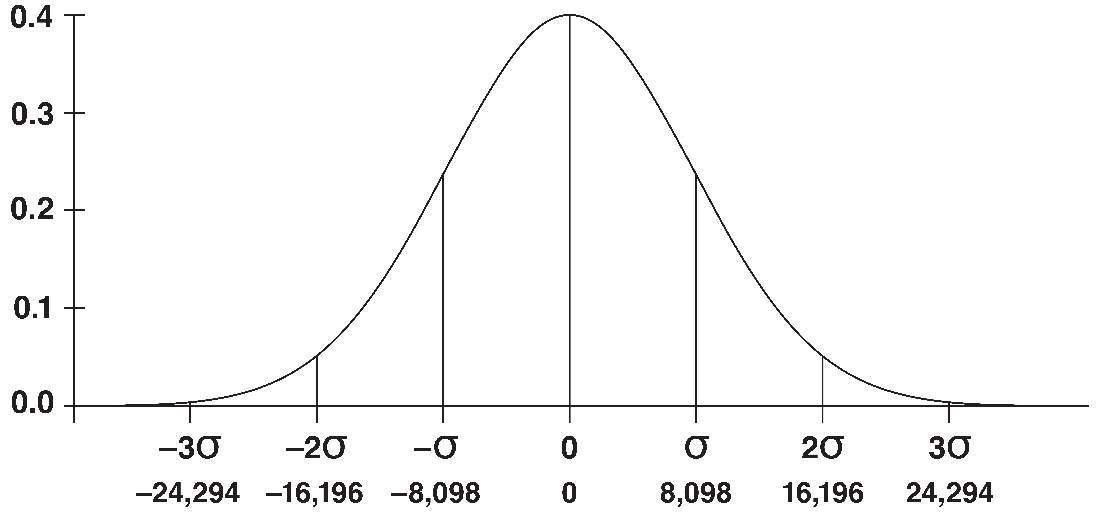
A key point about the Gaussian curve is that the area under the portion of the curve lying above two points on the horizontal axis equals the probability that a nationwide recount will change the number of votes between those two points on the horizontal axis.
For example, consider the portion of the Gaussian curve lying between –8,098 votes and 8,098 votes on the horizontal axis—that is, between one standard deviation below the mean (zero) and one standard deviation above the mean. This portion of the curve constitutes approximately two-thirds of the area under the Gaussian curve. This tells us that the probability is approximately two-thirds that the initial winner’s change in votes due to a nationwide recount will range between –8,098 and 8,098 votes (that is, within one standard deviation on either side of the mean).
Now consider the portion of the Gaussian curve lying between –24,294 votes and 24,294 votes (that is, three standard deviations on either side of the mean). This portion of the curve constitutes 99.74% of the area under the curve. This tells us that the probability is 99.74% that the initial winner’s change in votes due to a nationwide recount will range from –24,294 votes to 24,294 votes.
Note that there is only a tiny probability that a recount will change more than 24,294 votes in one direction or the other. Specifically:
- The portion of the Gaussian curve to the left of –3σ accounts for 0.13% of the area under the Gaussian curve. In other words, there is a probability of 0.13% that a recount will subtract more than 24,294 votes from the initial winner’s lead.
- The portion of the Gaussian curve to the right of +3σ accounts for the remaining 0.13% of the area under the curve. That is, there is a probability of 0.13% that a recount will add more than 24,294 votes to the initial winner’s lead.
Taken together, 0.26% of the area under this curve lies outside of the range between –3σ and 3σ.
A probability of 0.26% corresponds to a chance of 1-in-369.
To put it another way, it is very unlikely (a chance of only 1-in-369) that a nationwide recount will change the initial winner’s lead by more than 24,294 votes in one direction or the other.
The above discussion about the previous figure assumed, for simplicity, that the mean of the distribution was zero. That is, the previous figure did not reflect the impact of the near-zero change (57 votes) in the initial winner’s number of votes for each recount.
We now make the calculation more precise by considering the impact of the 57 votes.
The average (mean) change in votes resulting from conducting 51 state-level recounts is simply 51 times the average change (57 votes) resulting from one recount—namely 2,907 votes.
Figure 9.24 shows a Gaussian distribution with a standard deviation of 8,098 votes and a mean of 2,907 votes.
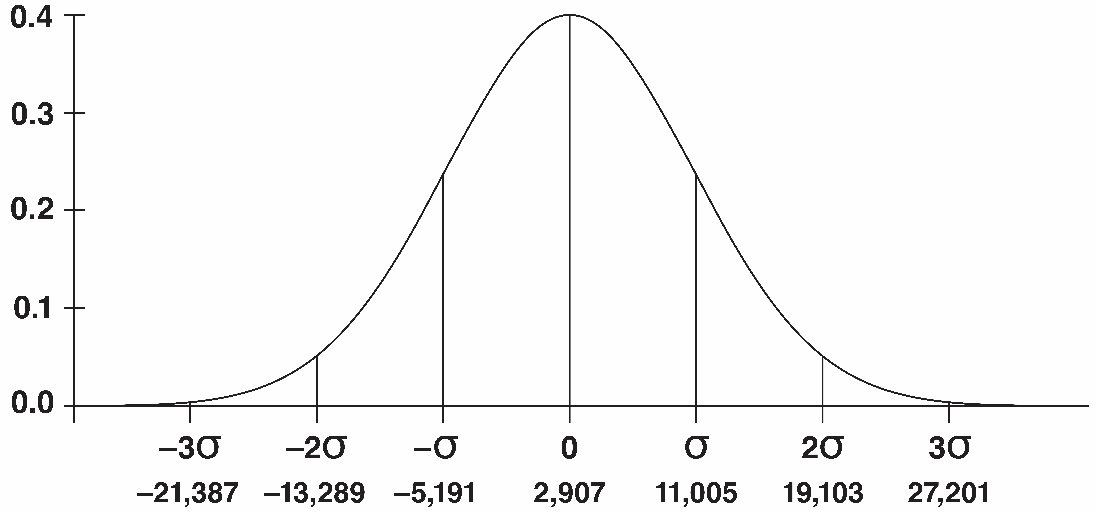
This figure shows that the probability is 99.74% that the change in the initial winner’s lead after a nationwide recount would be between:
- –21,387—that is, the mean (2,907) minus three standard deviations (8,098) and
- +27,201—that is, the mean (2,907) plus three standard deviations (8,098).
Statistics about the winning margins in presidential elections
Table 9.49 shows the national popular vote for the Republican and Democratic presidential nominees for the nine elections between 1988 and 2020.[922]
Column 4 shows the difference in the number of votes between the Republican nominee and Democratic nominee—the “R–D lead.”
Table 9.49 The national popular vote for President 1988–2020
| Election | Republican | Democrat | R–D lead in votes | R–D lead as a percentage |
| 1988 | 48,886,097 | 41,809,074 | 7,077,023 | 7.80% |
| 1992 | 39,103,882 | 44,909,326 | –5,805,444 | -6.91% |
| 1996 | 39,198,755 | 47,402,357 | –8,203,602 | -9.47% |
| 2000 | 50,460,110 | 51,003,926 | –543,816 | -0.54% |
| 2004 | 62,040,611 | 59,028,432 | 3,012,179 | 2.49% |
| 2008 | 59,934,814 | 69,456,898 | –9,522,084 | -7.36% |
| 2012 | 60,930,782 | 65,897,727 | –4,966,945 | -3.92% |
| 2016 | 62,985,134 | 65,853,652 | –2,868,518 | -2.23% |
| 2020 | 74,215,875 | 81,268,586 | –7,052,711 | -4.54% |
| Total | 497,756,060 | 526,629,978 | ||
| Average | -3,208,213 | -2.74% |
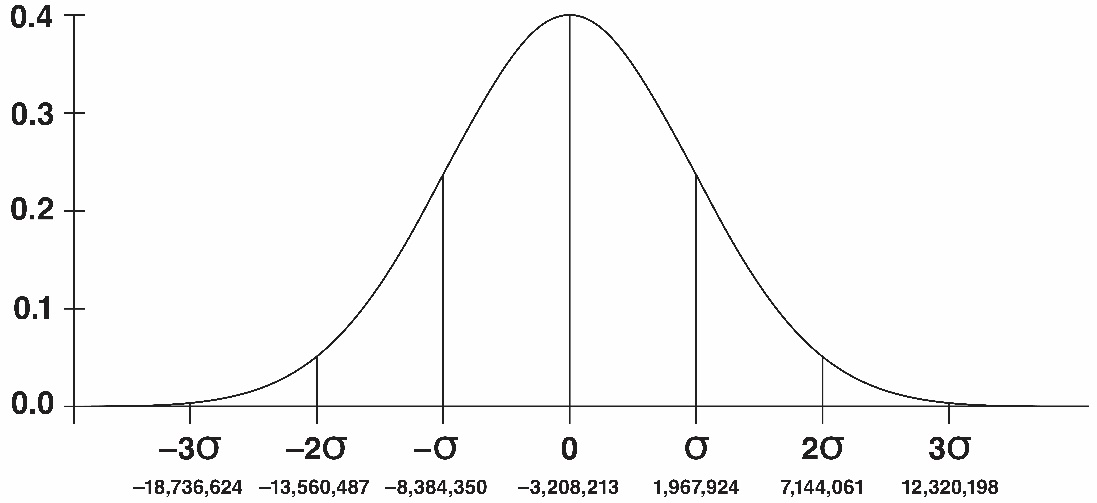
As can be seen from the table, the mean (average) of the R–D leads in the 1988–2020 period was –3,208,213votes.
The standard deviation of this distribution is 5,176,137 votes.
Figure 9.25 is a Gaussian distribution with a mean of –3,208,213 votesand a standard deviation of 5,176,137 votes.
Probability that a nationwide recount would change the outcome of a presidential election
We now have the two pieces of information necessary to calculate the probability that a nationwide recount would reverse the outcome of a presidential election:
- statistics about the changes in the initial winner’s lead due to a nationwide recount, and
- statistics about the popular-vote leads in recent presidential elections.
Specifically, we now know that a nationwide recount would likely only affect tens of thousands of votes, whereas the winner’s nationwide lead in a presidential election ordinarily ranges over many millions of votes.
Thus, if the initial winner’s lead is in the millions, it is very unlikely that a nationwide recount will reverse the result.
The laws of statistics give us a way to translate this intuition into a precise calculation of the probability that a nationwide recount will reverse the outcome.
Table 9.50 is based on the Gaussian distribution with a mean of –3,208,213and a standard deviation of 5,176,137 shown in the previous figure.
- Column 1 shows various R–D leads that might occur. For example, an R–D lead of –18,736,624 corresponds to a Democratic landslide (a negative three-sigma event). An R–D lead of +12,320,198 corresponds to a Republican landslide (a positive three-sigma event).
- Column 2 restates the number of votes shown in column 1 in terms of sigma (the standard deviation).
- Column 3 is the height of the Gaussian curve for a given R–D lead.
- Column 4 provides a way to calculate the area under a selected portion of the Gaussian curve. The number in this column is the cumulative probability (area under the curve). The difference between two entries in this column is the area under a particular portion of the Gaussian curve—that is, it is the probability that the R–D lead in a presidential election lies between two selected values.
Table 9.50 Probability that a nationwide presidential election produces various R–D leads in terms of number of votes
| R–D lead | Sigma | Height of Gaussian curve | Cumulative probability |
| -18,736,624 | -3.0 | 0.004 | 0.00135 |
| -13,560,487 | -2.0 | 0.054 | 0.02275 |
| -8,384,350 | -1.0 | 0.242 | 0.15866 |
| -3,208,213 | 0.0 | 0.399 | 0.50000 |
| -24,294 | 0.61511 | 0.330 | 0.73076 |
| 0 | 0.61981 | 0.329 | 0.73231 |
| 24,294 | 0.62450 | 0.328 | 0.73385 |
| 1,967,924 | 1.0 | 0.242 | 0.84134 |
| 7,144,061 | 2.0 | 0.054 | 0.97725 |
| 12,320,198 | 3.0 | 0.004 | 0.99865 |
For example, consider the first and fourth rows of column 4 of this table. These rows correspond to an R–D lead of between –18,736,624 votes (three standard deviations below the mean) and –3,208,213 votes (the mean). The difference between the cumulative probabilities in column 4 is the area under the portion of the curve for this range of votes. This difference is 0.49865. That tells us that there is a 49.865% probability that the R–D lead lies between –18,736,624 votes and –3,208,213 votes.
Now consider the red-colored row of table 9.50. An R–D lead of 0 corresponds to a tie in the national popular vote. A nationwide tie occurs at the 0.61981 point on the sigma scale.
Recall that the probability is very high (99.74%) that a nationwide recount would change the initial winner’s lead by fewer than 24,294 votes in one direction or the other.
In other words, if a nationwide recount is going to overturn the result of a nationwide election, the initial winner’s R–D lead must be, for all practical purposes, within 24,294 votes of a nationwide tie.
The green-colored row in the table represents an R–D lead of –24,294 votes and corresponds to a sigma of 0.61511.
The blue-colored row in the table represents an R–D lead of 24,294 votes and corresponds to a sigma of 0.62450.
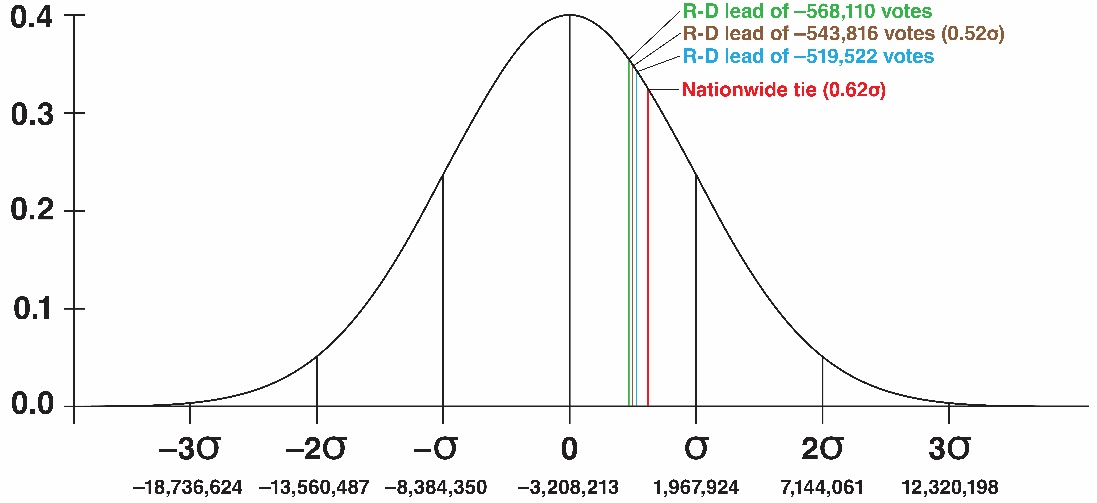
Figure 9.26 highlights the critical area between an R–D lead of –24,294 votes and 24,294 votes.
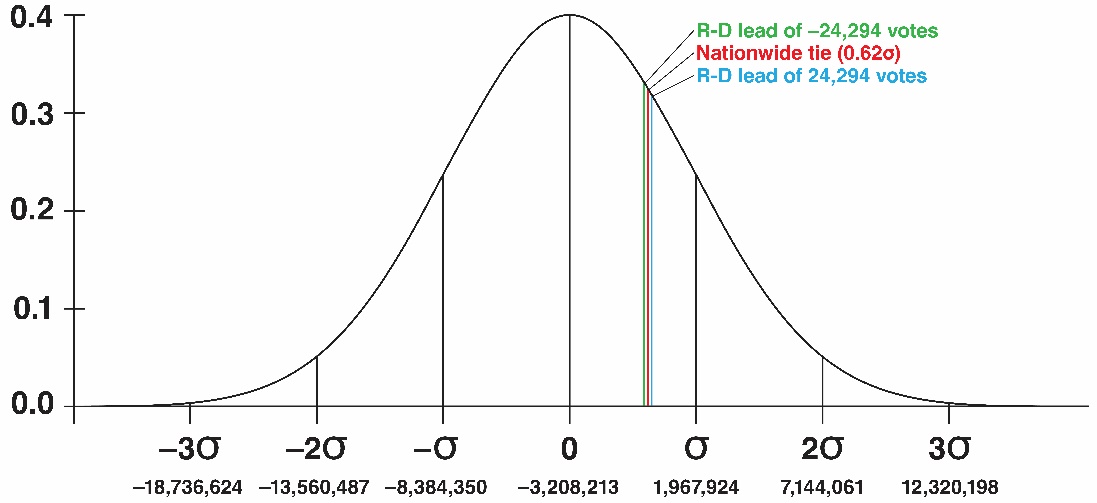
The area under the (very tiny) portion of the Gaussian curve between the green-colored vertical line and the blue-colored vertical line in the figure is the probability that the R–D lead in a presidential election is between –24,294 votes and 24,294 votes. This area under this portion of the curve is the difference in cumulative probabilities shown in column 4 of the green-colored row and the blue-colored row—that is, the difference between 0.73385 and 0.73076, namely 0.00309. That is, the probability that the R–D lead is between –24,294 votes and 24,294 votes is 0.309% or 1-in-324.
In other words, the probability is very high (99.74%) that a nationwide recount would reverse the outcome of one presidential election in 324.
In the context of presidential elections that occur every four years, a probability of 1-in-324 corresponds to one presidential election in 1,296 years.
To put it another way, the probability is very high (99.74%) that a nationwide recount would not change the outcome of 323 presidential elections out of 324.
Probability that a nationwide recount would have changed the national popular vote winner in 2000
The question arises as to whether a nationwide recount would have been likely to change the national popular vote winner in 2000.
The 2000 presidential election was the closest election in terms of the national popular vote between 1988 and 2020, as shown in table 9.49. The R–D lead in that election was –543,816 votes. That is, Al Gore led George W. Bush by 543,816 popular votes nationwide.
Recall that we determined above that the probability is very high (99.74%) that the initial winner’s lead would be changed by fewer than 24,294 votes in one direction or the other by a nationwide recount.
Therefore, the probability would be 99.74% that Gore’s lead would be changed by fewer than 24,294 votes in one direction or the other by a nationwide recount—that is, Gore’s lead would end up between 519,522 votes and 568,110 after a nationwide recount.
In short, it is very unlikely that a recount would change the outcome of an election when the initial (pre-recount) winner has a lead as large as 543,816 popular votes nationwide.
Figure 9.27 is a visualization of the conclusion that a nationwide recount of the 2000 election would not have come close to changing the outcome of the election. Even a loss of 24,294 votes would not have closed the gap.
- An R–D lead of 0 votes (that is, a nationwide tie) is represented by the red horizontal line located at a sigma of 0.61981.
- Gore starts with a pre-recount R–D lead of –543,816 votes—represented by a black horizontal line located at a sigma of 0.51475.
- The horizontal blue line at 0.51944σ represents an R–D lead of –519,522 votes—that is, Gore’s lead was reduced by 24,294 votes due to the recount.
- The horizontal green line at –0.51005σ represents an R–D lead of –568,110 votes—that is, Gore’s lead was increased by 24,294 votes due to the recount.
Probability that a nationwide recount would change the outcome of a presidential election expressed as percentages
The calculations above were based on the number of votes that are likely to be changed by a recount in a presidential election.
Table 9.51 shows the percentage change in the initial winner’s votes in all 36 recounts of statewide general elections between 2000 and 2023.
- Columns 1, 2, 3, and 4 are the same as in table 9.48.
- Column 5 shows the total number of votes for the initial (pre-recount) winner and the runner-up.
- Column 6 shows the change in the initial winner’s lead resulting from the recount. This is the same information that appears in column 7 of table 9.48.
- Column 7 shows the change in the initial winner’s lead resulting from the recount (column 6) as a percentage of the vote total (column 5).
Table 9.51 Percentage change in the initial winner’s votes in all 36recounts of statewide general elections 2000–2023
| Year | State | Race | Effect of the recount | Total votes | Change in initial winner’s lead | Percentage change in initial winner’s votes |
| 2000 | CO | Education Board | Upheld | 1,536,619 | -1,121 | -0.0730% |
| 2000 | FL | President | Upheld | 5,816,486 | -1,247 | -0.0214% |
| 2000 | MT | Public Instruction | Upheld | 63,080 | -3 | -0.0048% |
| 2000 | WA | Secretary of State | Upheld | 2,137,677 | -267 | -0.0125% |
| 2000 | WA | U.S. Senator | Upheld | 2,396,567 | 276 | 0.0115% |
| 2004 | AK | U.S. Senator | Upheld | 289,324 | -219 | -0.0757% |
| 2004 | AL | Amendment 2 | Upheld | 1,380,750 | -4 | -0.0003% |
| 2004 | GA | Court of Appeals | Upheld | 414,484 | 15 | 0.0036% |
| 2004 | WA | Governor | Reversed | 2,742,567 | -390 | -0.0142% |
| 2004 | WY | Amendment A | Upheld | 218,433 | -55 | -0.0252% |
| 2004 | WY | Amendment C | Upheld | 233,955 | -50 | -0.0214% |
| 2005 | VA | Attorney General | Upheld | 1,941,449 | 37 | 0.0019% |
| 2006 | AL | Amendment | Upheld | 816,102 | 508 | 0.0622% |
| 2006 | NC | Court of Appeals | Upheld | 1,539,190 | 50 | 0.0032% |
| 2006 | VT | Auditor | Reversed | 222,835 | -239 | -0.1073% |
| 2008 | MN | U.S. Senator | Reversed | 2,422,965 | -440 | -0.0182% |
| 2008 | OR | Measure 53 | Upheld | 978,634 | 131 | 0.0134% |
| 2009 | PA | Superior Court | Upheld | 1,821,869 | 281 | 0.0154% |
| 2010 | AZ | Proposition 112 | Upheld | 1,585,522 | 66 | 0.0042% |
| 2010 | MN | Governor | Upheld | 1,829,620 | -86 | -0.0047% |
| 2010 | NC | Court of Appeals | Upheld | 1,079,980 | 667 | 0.0618% |
| 2011 | WI | Supreme Court | Upheld | 1,497,330 | -312 | -0.0208% |
| 2013 | VA | Attorney General | Upheld | 2,207,389 | 742 | 0.0336% |
| 2014 | MO | Amendment | Upheld | 996,249 | 308 | 0.0309% |
| 2014 | NC | Supreme Court | Upheld | 2,474,117 | -17 | -0.0007% |
| 2014 | NM | Public Lands Comm | Upheld | 499,330 | 48 | 0.0096% |
| 2014 | OR | Initiative | Upheld | 1,506,176 | 35 | 0.0023% |
| 2016 | WI | President | Upheld | 2,785,823 | 571 | 0.0205% |
| 2018 | FL | Agriculture Comm | Upheld | 8,059,156 | 1,427 | 0.0177% |
| 2018 | FL | Governor | Upheld | 8,119,910 | -1,137 | -0.0140% |
| 2018 | FL | U.S. Senator | Upheld | 8,188,978 | -2,567 | -0.0313% |
| 2020 | GA | President | Upheld | 4,935,716 | -496 | -0.0100% |
| 2020 | NC | Supreme Court | Upheld | 5,391,556 | -15 | -0.0003% |
| 2021 | PA | Commonwealth Court | Upheld | 2,561,068 | 5,550 | 0.2167% |
| 2022 | AZ | Attorney General | Upheld | 2,508,715 | -231 | -0.0092% |
| 2022 | AZ | Public Instruction | Upheld | 2,502,987 | 221 | 0.0088% |
| Average | 2,380,628 | 57 | 0.00146% |
As can be seen from column 7 of the table, the average (mean) of the distribution of percentage changes in the initial winner’s vote is 0.00146% (that is, 0.0000146 of the total vote).
The standard deviation of the distribution of percentage changes in the initial winner’s vote is 0.0485% (that is, 0.000485).
The average (mean) deviation of the distribution of the percentage changes in votes resulting from 51 statewide recounts (that is, a nationwide recount) is 51 times 0.00146%—that is, 0.0745%.
The standard deviation of the distribution of the percentage changes in votes resulting from a nationwide recount would, according to the Central Limit Theorem, be 0.0485% times the square root of 51—that is, 0.346%.
The average percentage R–D lead for the nine presidential elections between 1988 and 2020 is –2.74%, as shown in table 9.49. The standard deviation of this distribution of percentages is 5.08%.
Footnotes
[914] Oral and written testimony presented by Tara Ross at the hearing of the Alaska Senate State Affairs Committee in February 2011.
[915] Otis, Deb. 2023. An Analysis of Statewide Elections Recounts 2000—2023. FairVote. https://fairvote.org/report/election-recounts-2023/. Additional information about each race, including the separate vote counts for each candidate and ballot proposition—before and after the recount—and other details are shown in FairVote’s recount spreadsheet at https://docs.google.com/spreadsheets/d/1ZSpGqPk7tElu__dRC3ulb3czFFJ72BCsybygpn1IorA/edit#gid=1833378664
[916] FairVote defines a “statewide general election” as a state-level election that provides the opportunity for all citizens—no matter where they live in the state—to vote for the same candidates or to vote on the same ballot question. A majority of such elections occur in November of even-numbered years. However, some elections occur in November of odd-numbered years, and some occur at other times (often the spring) of both even-numbered and odd-numbered years. In addition, statewide ballot propositions sometimes appear on primary election ballots, and there are occasional special statewide general elections (e.g., recalls). Note that a race for the U.S. House of Representatives is a “statewide general election” only if the state has just one seat in the House.
[917] Not all recounts are conducted because the apparent losing candidate believes that he or she has any realistic probability of reversing the outcome. Some states conduct automatic recounts that are triggered because the original difference between the top candidates is less than some specified percentage (often 0.1% but sometimes as large as 0.5%) or some specified number of votes. The government pays for automatic recounts. One reason that states conduct automatic recounts is to increase public confidence in elections. Another reason is that recounts provide state officials and the public with the periodic opportunity to audit the operation of the state’s election process.
[918] Note that the recount of the presidential vote in Florida in 2000 shown in the table was the automatic recount that was required by Florida law and that was held shortly after Election Day. This mechanical recount reduced Bush’s initial 1,784-vote lead by 1,247 to a 537-vote lead. This mechanical recount did not involve a hand inspection of each ballot. The Gore campaign subsequently requested a hand recount. This hand recount was halted by the U.S. Supreme Court, thus leaving Bush’s 537-vote statewide margin as the final result in Florida.
[919] The two entries for Wyoming in 2004 require explanation. In Wyoming, a constitutional amendment must be approved by a majority of the total number of votes cast on Election Day—rather than a majority of those voting on the amendment. In other words, failure to vote on a constitutional amendment is effectively a “no” vote. In November 2004, 245,789 votes were cast in Wyoming, so the required majority to pass an amendment was 122,896. Thus, the outcome was determined by the difference between the number of “yes” votes and 122,896 rather than the difference between the number of “yes” and “no” votes. Amendment A received 122,038 “yes” votes (and 96,792 “no” votes) in the initial count and was thus only 858 votes short of the 122,896 votes required for passage. This small shortfall (0.3491% of 245,789) triggered an automatic recount of Amendment A. The recount of Amendment A only changed 55 votes (0.0223% of 245,789). Thus, Amendment A was defeated—that is, the recount did not change the outcome. Amendment C received 124,178 “yes” votes (and 110,169 “no” votes) in the initial count and was thus only 1,282 over the 122,896 votes required for passage. This small overage (0.5216% of 245,789) triggered an automatic recount of Amendment C. The recount of Amendment C changed 50 votes (0.0203% of the 245,789). Thus, Amendment C was passed—that is, the recount did not change the outcome.
[920] The average of the absolute values in column 1 is 551.
[921] For example, see Wikipedia at https://en.wikipedia.org/wiki/Standard_deviation#Interpretation_and_application.
[922] Between 1988 and 2020, the United States has been in an era of close presidential elections, as discussed in section 1.1.2.
9.34.2 MYTH: The Compact should be opposed, because it might not be possible to conduct a recount in every state.
QUICK ANSWER:
- Under the current system for electing the President, a timely recount of presidential ballots is usually not obtainable during the brief 42-day period between Election Day and the Electoral College meeting in mid-December. There have been numerous examples, under the current system, where a recount was requested, but never conducted, in closely divided states that decided presidential elections. Most famously, supporters of George W. Bush were able to use the courts to thwart a hand recount of his slender 537-popular-vote lead in the decisive state of Florida in 2000. In 2004, attempts to obtain a recount in the decisive state of Ohio were unsuccessful. In 2016, requests to obtain recounts in two of that election’s three decisive states (Michigan and Pennsylvania) were successfully blocked in court by the candidate who was in the lead. In 2020, the results of six closely divided states were vigorously disputed, but a statewide recount was conducted in only one state—Georgia.
- The difficulty of obtaining a timely recount of a presidential election in the brief 42-day period between Election Day and the Electoral College meeting could theoretically be addressed by streamlining state recount laws in all 50 states and the District of Columbia. However, few legislatures have revised their recount laws in the two decades since the dispute over the never-held hand recount in Florida in 2000. A more practical approach would be for Congress to pass a federal law guaranteeing presidential candidates the right to a timely recount.
- There is unlikely to ever be a need to conduct a nationwide recount under the National Popular Vote Compact. The probability is very high (99.74%) that only one presidential election in 324 (that is, once in 1,296 years) would be close enough that a nationwide recount could overturn the result (as demonstrated in section 9.34.1). Indeed, there would be considerably less need for a recount in a nationwide election than under the current state-by-state winner-take-all method of awarding electoral votes.
- The fact that a recount might not be obtainable in every state is one of many examples in this book of a criticism aimed at the National Popular Vote Compact where the criticism also applies to the current system. In fact, given that a recount would almost never be needed under the Compact (section 9.34.1), the Compact is arguably superior to the current system in this respect.
Tara Ross, a lobbyist against the National Popular Vote Compact who works closely with Save Our States, has criticized the National Popular Vote Compact by saying:
“States have different criteria for what does (or does not) trigger recounts within their borders. … What if the national total is close—close enough to warrant a recount—but a recount can’t be conducted because the margins in individual states were not close?”[923] [Emphasis added]
Sean Parnell, the Senior Legislative Director of Save Our States, has written that in a nationwide election for President:
“Some states would conduct recounts, while others would not.”[924]
In fact, the ability to obtain a recount of a presidential vote “close enough to warrant a recount” is largely an illusion under the current system.
Indeed, there have been far more instances of a presidential-vote recount being requested than conducted.
In 2000, attempts to get a hand recount of George W. Bush’s slender 537-vote margin of victory in the decisive state of Florida were challenged by the Bush campaign and successfully blocked by the U.S. Supreme Court.[925] Given this tiny 537-vote lead, if there ever was an election that warranted a recount, it was the presidential race in Florida in 2000.
In 2004, attempts to obtain a recount of the presidential vote in the decisive state of Ohio were unsuccessful.[926]
In 2016, attempts to obtain recounts of the three decisive states were successfully blocked in court in two of these three states (that is, Michigan and Pennsylvania). Only Wisconsin conducted a recount.[927]
In 2020, 64 lawsuits were filed in six closely divided states (Arizona, Georgia, Michigan, Nevada, Pennsylvania, and Wisconsin) disputing the election.[928] However, there was a statewide recount for President in only one state—Georgia.[929]
Time is a major factor when it comes to recounting a presidential election.
It is not that a statewide recount takes much time (as discussed in detail in section 9.34.2). The problem is that legal maneuvering over whether to conduct a recount and other procedural issues consume some or all of the available time.
The U.S. Constitution requires that the Electoral College meet on the same day throughout the country—thus creating an immovable deadline for completing a recount. Article II, section 1, clause 4 states:
“The Congress may determine the Time of chusing the Electors, and the Day on which they shall give their Votes; which Day shall be the same throughout the United States.” [Emphasis added]
The date for the Electoral College meeting is specified in section 7 of the Electoral Count Reform Act of 2022 as the first Tuesday after the second Wednesday in December.[930]
In 1845, Congress established the Tuesday after the first Monday in November as the uniform nationwide day for appointing presidential electors—that is, Election Day. That date was retained in the Electoral Count Act of 1887 and the Electoral Count Reform Act of 2022 and is currently codified as section 1 of title 3 of the U.S. Code.
Thus, there are 42 days between Election Day and the date for the Electoral College meeting under current federal law. In 2024, Election Day is Tuesday, November 5, and the Electoral College meeting is Tuesday, December 17, 2024.
Because of this constitutional provision, all counting, pre-recount litigation, recounting, and post-recount litigation must be conducted so as to reach a final conclusion prior to the uniform nationwide date for the Electoral College meeting in mid-December.
These constitutional and statutory provisions, of course, apply equally to both the current state-by-state winner-take-all system of electing the President and the National Popular Vote Compact.
There are three practical reasons why the time available for conducting a recount of a presidential election is less than 42 days.
First, federal law diminishes the already-brief 42-day period by requiring each state to certify its popular-vote count within six days before the Electoral College meeting (the Safe Harbor Day). There are sound reasons for this six-day period. However, because of this six-day period, only 36 days are available between Election Day and the Safe Harbor Day.[931]
Second, more importantly, as the word “recount” implies, there cannot be a recount until there is a count.
Thus, an aggrieved presidential candidate cannot even begin the process of requesting a recount until after the official initial count is completed and certified.
It is true that unofficial vote counts are generally available from virtually every precinct in the country on Election Night or very shortly thereafter. However, various tasks must be performed before a state completes the official initial count.
The total number of days required to complete the official initial count varies by state, and depends on numerous factors determined by state law, including:
- whether pre-processing of mail-in ballots (i.e., verifying that the voter is registered and verifying the voter’s signature) may occur before Election Day, while the polls are open during Election Day, or only after Election Day;
- whether actual counting of mail-in ballots may occur before Election Day, while the polls are open during Election Day, or only after Election Day;
- whether mail-in ballots may be counted if they are received within a certain number of days after Election Day (provided, of course, that they are postmarked by Election Day);
- whether there is an extended deadline for receiving and counting military or overseas ballots;
- how much time is allowed by the state to validate, adjudicate, and cure provisional ballots; and
- how much time, if any, is allowed to cure correctable errors that are identified in provisional ballots.
After all ballots are counted at the local level, official documents certifying the local count must be delivered to the official or body designated by state law. Then, the designated official or body adds the local counts together and certifies the result as the initial statewide count.
A few states (New Hampshire, Oklahoma, South Dakota, and Vermont) routinely complete their official initial account very quickly—sometimes within a week after Election Day. However, most states take several weeks.
The amount of delay is illustrated by the 2012 election. In that year, the Electoral College meeting was on December 18, and the Safe Harbor Day was December 12.
- Nine of the 12 battleground states of 2012[932] completed their official initial presidential count on or after November 29—thus leaving less than two weeks before the Safe Harbor Day.
- Two of the 12 battleground states did not complete their official initial presidential count until December 10—thus leaving only two days.
- One of the 12 battleground states did not complete its official initial presidential count until December 12—thus leaving no time at all.
Third, once the official initial count is completed and certified, the aggrieved candidate’s request for a recount will almost inevitably be challenged by the candidate who is leading in the initial count. Such challenges often start at the administrative level but quickly find their way into either state or federal court—and sometimes both. And, of course, each administrative and judicial ruling may be appealed to various higher courts. A decision at the highest state court can often then be appealed to the federal courts. Lawyers for whichever candidate is leading initially are skilled at raising hair-splitting legal questions that generate delay and eventually run out the clock.
Fourth, even if the aggrieved candidate’s request for a recount is granted, it may be impossible to obtain a recount in a presidential election matter because of other hurdles and delays built into the existing state recount laws.
One of the reasons that a recount of a presidential election is unobtainable in practice is that state recount laws were written with state and local offices primarily in mind. For state and local offices, there is no time pressure analogous to the U.S. Constitution’s immovable requirement that the Electoral College meet on the same specified day in each state.
Indeed, recounts and associated legal challenges in races for offices other than President often meander on for months after Election Day. For example, the November 2008 Senate contest between Al Franken and Norm Coleman was not finally decided until June 20, 2009.[933]
The situation in Ohio in 2004 illustrates the legal difficulties for recounting or contesting a presidential election after the official initial count.
In Ohio in 2004, there were more than 150,000 provisional ballots. George W. Bush’s final margin in the state was 118,601.[934]
Senator John Kerry recognized that historically about two-thirds of provisional ballots are typically judged to be valid. That is, it was likely that about 100,000 of these provisional ballots would eventually be accepted. Kerry also knew, based on historical voting patterns in Ohio, that he was likely to win the eventually accepted provisional ballots by, at the most, a 57%–43% margin. That is, Kerry knew that he would be able, at best, to eke out only about a 14,000-vote margin over Bush from the provisional ballots.
Accordingly, based on Bush’s six-digit margin on Election Night and the known statistics concerning provisional ballots, Kerry conceded on the day after Election Day.
However, suppose Bush’s apparent Election Night margin had been in the neighborhood of 14,000.
At that point, the many practical problems in Ohio’s existing laws concerning recounts and contests would have come into play to frustrate the completion of a recount before the Electoral College meeting.
Professor Danial Tokaji of the Michael E. Moritz College of Law at Ohio State University identified some of the difficulties associated with trying to conduct a potential recount or contest for President in Ohio:
“There is no specific Ohio statute addressing a contest in a presidential election. Presumably, the generally applicable election contest procedure described above would apply. The Ohio statutory scheme, however, makes no reference to the federal statutes governing presidential election contests. This could prove problematic. Under the ‘safe harbor’ provision of 3 U.S.C. § 5, Ohio must reach a final determination of election controversies within 35 days of the presidential election. A quick review of Ohio’s election contest procedure illustrates the problem. A contestor must file the petition within 15 days of the election results being certified (assuming no automatic or requested recount). R.C. 3515.09. Presumably, a contest concerning presidential electors involves a “statewide office” requiring the petition to be filed with the Chief Justice. See R.C. 3515.08. The court must then set the hearing within the 15-to-30-day window of R.C. 3515.10. Even without considering the time delay from election day to certification of results, meeting the 35-day safe harbor provision is doubtful. Add to this mix the uncertainty of the 40-day deposition period of R.C. 3515.16 if the contest is “in the supreme court.” Further consider the effect of an appeal—if possible—and the 20-day appellate filing window. Following the Ohio statutory scheme makes compliance with 3 U.S.C. § 5 unlikely.”[935] [Emphasis added]
The bottom line is that the presidential candidate who is leading in the initial count will usually be able to use existing statutory provisions to “run out the clock” with dilatory tactics until the Safe Harbor Day.[936]
Existing recount laws in other states contain similar unworkable and illogical provisions that make it almost impossible to get a timely recount in a presidential race.
Moreover, in many states, a candidate only has the right to request a recount if the apparent winning candidate’s lead in the initial count is within a specified very small percentage. That is, recount laws in many states paradoxically offer the promise of correcting a small error in the initial count—but no way to correct a large error.
When a recount was requested in the closest of the three decisive states in the 2016 presidential election (Michigan), the initial winning candidate (Trump) pointed out that state law did not allow a recount in any precinct where there was a discrepancy between the number of votes cast and the number of people who signed the voting log. One would think that precincts with such a discrepancy would be precisely the ones that an aggrieved candidate might want to recount. Eight years after the 2016 election, a bill advanced in the Michigan legislature to correct this anomaly.[937]
In short, the possibility of conducting a timely recount of a presidential election is largely an illusion under existing state recount laws—regardless of whether the election is conducted under the current state-by-state winner-take-all method of awarding electoral votes or the National Popular Vote Compact.
As explained in section 9.34.1, there would be considerably less need for a recount under a national popular vote than under the current state-by-state winner-take-all method of awarding electoral votes. The probability is very high (99.74%) that only one presidential election in 324 (that is, once in 1,296 years) would be close enough that a nationwide recount could overturn the result.
Nonetheless, opponents of the National Popular Vote Compact argue that the Compact should be opposed because it might not be possible to recount every state, while simultaneously defending the current state-by-state system under which recounts are usually unobtainable in practice.
The fact that a recount might not be obtainable in every state is one of many examples in this book of a criticism aimed at the National Popular Vote Compact where the criticism also applies to the current system. In fact, given that a recount would almost never be needed under the Compact (section 9.34.1), the Compact is arguably superior to the current system in this respect.
In section 9.34.7, we present proposed federal legislation that would guarantee a timely recount to an aggrieved presidential candidate.
Footnotes
[923] Written testimony submitted by Tara Ross to the Delaware Senate in June 2010.
[924] Parnell, Sean. Opinion: Voting compact would serve Virginians badly. Virginia Daily Progress. August 9, 2020. https://dailyprogress.com/opinion/columnists/opinion-commentary-voting-compact-would-serve-virginians-badly/article_10a1c1bd-2ca3-5c97-b46d-a4b15289062d.html
[925] Reagan, Robert Timothy; Margaret S. Williams; Leary, Marie; Borden, Catherine R.; Snowden, Jessica L., Breen, Patricia D., and Jason A. Cantone. 2023. The 2000 Election of the President. Emergency Election Litigation in Federal Courts: From Bush v. Gore to COVID-19. Washington, DC: Federal Judicial Center. Pages 1266–1273. https://www.fjc.gov/sites/default/files/materials/55/Emergency-Election-Litigation-in-Federal-Courts.pdf
[926] Reagan, Robert Timothy; Margaret S. Williams; Leary, Marie; Borden, Catherine R.; Snowden, Jessica L., Breen, Patricia D., and Jason A. Cantone. 2023. Complete Ohio 2004 Presidential Recount. Emergency Election Litigation in Federal Courts: From Bush v. Gore to COVID-19. Washington, DC: Federal Judicial Center. Pages 1257–1260. https://www.fjc.gov/sites/default/files/materials/55/Emergency-Election-Litigation-in-Federal-Courts.pdf
[927] In the 2026 Wisconsin presidential recount, Trump increased his initial margin by 131 votes. Trump gained 844 votes (from 1,404,440 to 1,405,284), and Clinton gained 713 (from 1,381,823 to 1,382,536).
[928] A survey of the 64 lawsuits in the six states (Arizona, Georgia, Michigan, Nevada, Pennsylvania, and Wisconsin) may be found in Danforth, John; Ginsberg, Benjamin; Griffith, Thomas B.; Hoppe, David; Luttig, J. Michael; McConnell, Michael W.; Olson, Theodore B.; and Smith, Gordon H. 2022. Lost, Not Stolen: The Conservative Case that Trump Lost and Biden Won the 2020 Presidential Election. July 2022. https://lostnotstolen.org/
[929] A recount of two counties in Wisconsin was conducted in 2020.
[930] The Electoral Count Reform Act of 2022 (United States Code. Title 3. Section 7) is found in appendix B of this book.
[931] In 2024, Election Day is Tuesday, November 5. The Safe Harbor Day is Wednesday, December 11. The Electoral College meeting date is Tuesday, December 17.
[932] See section 1.2.3 for the list of the 12 battleground states of 2012.
[933] Wikipedia. 2008 United States Senate election in Minnesota/ Accessed July 13, 2024. https://en.wikipedia.org/wiki/2008_United_States_Senate_election_in_Minnesota#:~:text=After%20all%20the%20votes%20were,called%20the%20election%20for%20Coleman.
[934] Langley, Karen and McNulty, Timothy. Verifying provisional ballots may be key to election. Pittsburgh Post-Gazette. August 26, 2012.
[935] Tokaji, Daniel. 2012. Election Law@Moritz: Information and Insight on the Laws Governing Federal, State, and Local Elections. The quotation is from a continuously updated eBook on December 27, 2012. http://moritzlaw.osu.edu/electionlaw/ebook/part5/procedures_recount05.html#_edn9
[936] An additional factor would have prevented a recount in Ohio in 2004. The initial count was not certified until the Safe Harbor Day. Thus, a recount would have been impossible in the decisive state of the 2004 presidential election had it been warranted.
[937] See Michigan Senate Bill SB603 of 2024. https://www.legislature.mi.gov/Bills/Bill?ObjectName=2023-SB-0603&QueryID=159966389 and the Legislative Analysis of the Senate-passed bill by the House Fiscal Agency at https://www.legislature.mi.gov/documents/2023-2024/billanalysis/House/pdf/2023-HLA-0603-6C1B4E59.pdf
9.34.3 MYTH: Conducting a nationwide recount would be a logistical impossibility.
QUICK ANSWER:
- There is unlikely to ever be a need to conduct a nationwide recount under the National Popular Vote Compact. Indeed, there would be considerably less need for a recount under a national popular vote system than under the current state-by-state winner-take-all method of awarding electoral votes. The probability is very high (99.74%) that only one presidential election in 324 (that is, once in 1,296 years) would be close enough that a nationwide recount could reverse the initial result (as demonstrated in section 9.34.1).
- A recount can be conducted rapidly once an aggrieved presidential candidate surmounts the dilatory legal tactics that often block a recount. The history of presidential recounts in several states demonstrates that there is no logistical obstacle to conducting a recount in the 36-day period between Election Day and the Safe Harbor Day.
- For example, in 2020, Georgia conducted its initial count and two statewide recounts in the brief 36-day period between Election Day and the Safe Harbor Day. The initial statewide count was completed shortly after Election Day. In response to issues raised by Trump supporters, the Secretary of State initiated and completed a hand count of all of the state’s nearly five million ballots in six days. Then, at the request of the Trump campaign, the state conducted a third statewide count. Statewide recounts of presidential ballots have been completed in between three and 10 days in other states.
- The personnel and other resources necessary to conduct a recount are indigenous to each state. Thus, a state’s ability to conduct a recount inside its own borders is unrelated to whether another state is simultaneously conducting one.
Once an aggrieved presidential candidate surmounts the legal obstacles to obtaining a recount, there is plenty of evidence that a statewide recount of a presidential election can be conducted expeditiously.
The task of recounting the votes cast for President is not a logistical impossibility—as evidenced by the fact that the original counts for all offices and ballot questions are routinely completed and certified within a few days after Election Day.
As a matter of prudent planning, the election officials of every state stand ready with contingency plans to carry out their duty to conduct a recount in a timely manner if one is required.
Moreover, no state needs the assistance of any personnel or resources from any other state in order to conduct a statewide recount inside its own borders. The personnel and resources necessary to conduct a recount are entirely indigenous to each state. Votes are counted in parallel at the local level, and recounts are generally conducted at the same local level as the original count. Thus, a state’s ability to handle the logistics of a recount within its own borders is unrelated to whether recounts are being simultaneously conducted in other states.
Georgia 2020 statewide recounts
Georgia was a closely divided state in the 2020 presidential election.
The initial statewide count was completed shortly after Election Day.
Then, in response to issues raised by Trump supporters, Georgia Secretary of State Brad Raffensperger initiated a hand recount of 100% of the state’s nearly five million ballots in the presidential race (technically a “risk-limiting audit”).
This statewide hand count was executed during a period of six calendar days—specifically between Friday November 13 and Wednesday November 18.[938]
Like the original count on Election Night, the Secretary of State’s hand recount was conducted separately by each of Georgia’s 159 counties. That is, the work was conducted in parallel throughout the state.
Many of Georgia’s counties did not take the full six days to finish their work.
The state’s largest county (Fulton) finished its hand recount of 528,777 ballots in the first three days. [939], [940] Fulton County accomplished its work with 172 two-person counting teams aided by 15 additional people.[941] That is, the task was accomplished with a total 1,077 workdays of effort—that is, at a rate of about 490 ballots per workday.
Similarly, DeKalb County, a large suburban area east of Atlanta, finished recounting its 370,000 ballots for President in three days.
Cobb County, a large suburban area north of Atlanta, finished counting its 393,000 ballots by the end of the fifth day.
“Cobb County started the process Friday morning [November 13] with dozens of workers spread out at tables inside of an exhibit hall, sorting ballots into bins featuring the names of the presidential candidates. Approved poll watchers stood close by and looked over the shoulders of workers as they sorted ballots. A handful of members of the general public stood behind caution tape at the edge of the room.”[942]
Bryan County, one of Georgia’s smaller counties, finished its recount of 21,000 ballots by the afternoon of the first day.[943]
A total of 4.3 million of the state’s ballots—almost 90%—were recounted by the end of the fourth day.
In most counties, the recount resulted in no change in the vote count for President. In two counties, the hand count resulted in a modest change. In Fayette County, President Trump gained 449 votes over Vice President Biden as a result of the discovery of a memory card with 2,755 votes that had not been included in the original count.[944]
This hand recounting of all of Georgia’s ballots for President was finished throughout the state by Wednesday November 18—that is, within a total of six days.
The results were certified two days later.[945]
On November 22, the still-unsatisfied Trump campaign demanded yet another statewide count. This third count of Georgia’s ballot (officially designated as a “recount”) involved scanning the ballots by machine. CNN observed:
“Georgia already conducted an audit of the presidential ballots…. The audit was more rigorous than the recount will be, as the audit was a hand recount of every ballot, whereas the new recount will be done by a machine rescan.”[946] [Emphasis added]
Overall, Georgia conducted a total of three statewide counts between Election Day and the Safe Harbor Day:
- the original count starting on Election Night,
- the ballot-by-ballot hand count (audit) initiated by Secretary of State Raffensperger, and
- the machine recount demanded by the Trump campaign.
Wisconsin 2016 statewide recount
In 2016, Wisconsin conducted a full statewide recount in 10 days. As the Wisconsin Elections Commission announced on December 12, 2016:
“Wisconsin Elections Commission Chair Mark Thomsen today certified results of the presidential election following a 10-day recount process, confirming Republican Donald J. Trump the winner in Wisconsin.”
“Donald Trump received 1,405,284 votes in the recount compared to 1,404,440 in the original canvass. Hillary Clinton received 1,382,536 votes in the recount compared to 1,381,823 in the recount. The original margin between the top two candidates was 22,617 votes. After the recount, the margin is 22,748. After the recount, Trump’s margin over Clinton increased by just 131 votes.”[947] [Emphasis added]
Wisconsin 2020 recount of two large counties
In late November 2020, a recount was conducted in Wisconsin’s two biggest Democratic counties (Milwaukee and Dane counties) at the request of the Trump campaign.
The 2020 Wisconsin recount was conducted in seven days. It started on Friday November 20 and was completed (after a day off for Thanksgiving) on Friday November 27.[948]
These two counties accounted for about a quarter of the state’s total vote.
If a full statewide recount had been requested in Wisconsin in 2020, each of Wisconsin’s 72 counties would have separately and independently performed the work. That is, a statewide recount in Wisconsin could have been executed in essentially the same number of calendar days as was the geographically limited recount of Milwaukee and Dane counties. The personnel and other resources necessary to conduct a recount are indigenous to each county. Thus, a county’s ability to conduct a recount inside its own borders is unrelated to whether some other county is simultaneously conducting one.
Lycoming County Pennsylvania’s recount of 2020 ballots
A belated hand recount of all of Lycoming County Pennsylvania’s 2020 presidential ballots was conducted in three days. As reported by the New York Times in 2023:
“Under pressure from conspiracy theorists and election deniers, 28 employees of Lycoming County counted—by hand—nearly 60,000 ballots. It took three days and an estimated 560 work hours, as the vote-counters ticked through paper ballots at long rows of tables in the county elections department in Williamsport.”
“Mr. Trump ended up with seven fewer votes than were recorded on voting machines in 2020. Joseph R. Biden Jr. had 15 fewer votes. Overall, Mr. Trump gained eight votes against his rival. The former president, who easily carried deep-red Lycoming County in 2020, carried it once again with 69.98 percent of the vote—gaining one one-hundredth of a point in the recount.[949] [Emphasis added]
Lycoming County’s reported total of 560 hours (70 workdays) corresponds to a processing rate of 857 ballots per workday.
Rate of processing ballots in a recount
The average processing rate for Fulton County’s hand recount in 2020 and Lycoming County’s hand recount in 2023 was 674 ballots per workday.
Summary concerning logistics of a nationwide recount
The history of presidential recounts in several states demonstrates that there is no logistical obstacle to conducting a rapid recount in the brief 36-day period between Election Day and the Safe Harbor Day. A statewide recount can be conducted in about a week.
There is unlikely to ever be a need to conduct a nationwide recount under the National Popular Vote Compact. As demonstrated in section 9.34.1, the probability is very high (99.74%) that only one presidential election in 324 (that is, once in 1,296 years) would be close enough that a nationwide recount could reverse the original result. Indeed, there would be considerably less need for a recount under a national popular vote system than under the current state-by-state winner-take-all method of awarding electoral votes.
Nonetheless, if there ever were a reason to conduct a nationwide recount, the recount could and would be handled in the same way as they are currently handled—that is, under generally serviceable laws.
In any case, if the national popular vote were ever to be close enough to warrant a nationwide recount, it is virtually certain that the vote would simultaneously be close enough to warrant statewide recounts in several closely divided states.
Any extremely close election will almost certainly engender controversy, and the eventual loser will often go away unhappy.
The guiding principle in such circumstances should be that all votes should be counted fairly and expeditiously.
As U.S. Senator David Durenberger (R–Minnesota) said in the Senate in 1979:
“There is no reason to doubt the ability of the States and localities to manage a recount, and nothing to suggest that a candidate would frivolously incur the expense of requesting one. And even if this were not the case, the potential danger in selecting a President rejected by a majority of the voters far outweighs the potential inconvenience in administering a recount.”[950]
Footnotes
[938] Fausset, Richard and Batra, Jannat. 2020. Examine Ballot. Recite Name. Sort Into Bin. Repeat 5 Million Times. New York Times. November 13, 2020. https://www.nytimes.com/2020/11/13/us/georgia-recount-presidential-election.html
[939] Hallerman, Tamar and Kass, Arielle. 2020. Recount Day 3: DeKalb, Fulton finish counting; other counties closing in. Atlanta Journal. November 15, 2020. https://www.ajc.com/politics/live-updates-georgia-recount-enters-third-day/IZYV2YQGZVBGDKKR4LPT466BQ4/
[940] Fausset, Richard. 2020. As Tensions Among Republicans Mount, Georgia’s Recount Proceeds Smoothly. New York Times. November 17, 2020. https://www.nytimes.com/2020/11/16/us/politics/georgia-recount.html
[941] Murchison, Adrianne. 2020. Fulton finishes counting votes for presidential recount. Atlanta Journal. November 15, 2020. https://www.ajc.com/politics/live-updates-georgia-recount-enters-third-day/IZYV2YQGZVBGDKKR4LPT466BQ4/
[942] Moffatt, Emil. With Biden Ahead, Georgia Begins Hand Recount Of Nearly 5 Million Ballots. NPR. November 13, 2020. https://www.npr.org/2020/11/13/934592764/with-biden-ahead-georgia-begins-hand-recount-of-nearly-5-million-ballots
[943] Lee, Michelle and Thebault, Reis. 2020. In Georgia, a laborious, costly and historic hand recount of presidential ballots begins. Washington Post. November 14, 2020. https://www.washingtonpost.com/politics/georgia-election-recount/2020/11/14/7fc1c82e-25c9-11eb-952e-0c475972cfc0_story.html
[944] Brumback, Kate. 2020. Second Georgia county finds previously uncounted votes. Associated Press. November 17, 2020. https://apnews.com/article/election-2020-georgia-elections-voting-machines-voting-018eac6ac24733d63d356ee76f485530
[945] Niesse, Mark; Peebles, Jennifer; and Wickert, David. 2020. Georgia manual recount confirms Biden victory. Atlanta Constitution. November 18, 2020. https://www.ajc.com/politics/breaking-georgia-manual-recount-confirms-biden-victory/B7LNNHYZOVGKZBUVAT7NZT3VZE/
[946] Bohn, Kevin. 2020. Trump campaign requests Georgia recount that’s unlikely to change his loss in the state. CNN. November 22, 2020. https://www.cnn.com/2020/11/21/politics/georgia-presidential-election-recount/index.html
[947] Wisconsin Elections Commission. 2016. Wisconsin Recount Completed Ahead of Schedule with Relatively Small Changes to Final Totals. December 12, 2016. https://elections.wi.gov/news/wisconsin-recount-completed-ahead-schedule-relatively-small-changes-final-totals
[948] Martinez-Ortiz, Ana. 2020. Trump Sues Wisconsin After Election Recount. Milwaukee Courier. December 5, 2020. https://milwaukeecourieronline.com/index.php/2020/12/05/trump-sues-wisconsin-after-election-recount/
[949] Gabriel, Trip. 2023. Driven by Election Deniers, This County Recounted 2020 Votes Last Week. New York Times. January 15, 2023. https://www.nytimes.com/2023/01/15/us/politics/2020-recount-lycoming-county.html?searchResultPosition=1
[950] Congressional Record. July 10, 1979. Pages 17706–17707. https://www.congress.gov/bound-congressional-record/1979/07/10/senate-section
9.34.4 MYTH: The current system acts as a firewall that isolates recounts to particular states.
QUICK ANSWER:
- Far from acting as a firewall that helpfully isolates recounts to particular states, the current state-by-state winner-take-all method of awarding electoral votes repeatedly causes artificial crises and leads to unnecessary recounts.
- The current state-by-state winner-take-all method of awarding electoral votes regularly creates artificial crises, because a few thousand votes in one, two, or three states can decide the presidency. Because the current system divides the nation’s voters into 51 separate state-level pools of votes, razor-close elections in a few states are an inevitable and recurring feature of the current system. After the Balkanization of the nationwide vote into 51 separate state-level pools, a certain number of these state-level races for President will inevitably be close. Thus, almost inevitably, a few thousand votes in one, two, or three closely divided states decide the presidency. The nation’s 59 presidential elections between 1789 and 2020 have really been 2,339 separate state-level elections.
- There is unlikely to ever be a need to conduct a nationwide recount under the National Popular Vote Compact. The probability is very high (99.74%) that only one presidential election in 324 (that is, once in 1,296 years) would be close enough that a nationwide recount could overturn the result (section 9.34.1). Indeed, there would be considerably less need for a recount under a national popular vote system than under the current state-by-state winner-take-all method of awarding electoral votes.
- A single national pool of votes will drastically reduce the frequency of the artificial crises that are regularly produced by the current system.
- The question of recounts comes to mind in connection with presidential elections only because the current state-by-state system so frequently creates artificial crises and unnecessary disputes. If we were debating the question today of whether to elect Governors by a popular vote, the issue of recounts would never even come to mind, because recounts rarely occur in elections in which there is a single pool of votes and in which the winner is the candidate who receives the most popular votes. It is the winner-take-all rule—separately applied to 51 separate jurisdictions—that creates the frequent recounts of presidential ballots.
Trent England, Executive Director of Save Our States, has written:
“Containing elections within state lines also means containing election problems. The Electoral College turns the states into the equivalent of the watertight compartments on an ocean liner. Fraud or process failures can be isolated in the state where they occur and need not become national crises.”[951] [Emphasis added]
Tara Ross, a lobbyist against the National Popular Vote Compact who works closely with Save Our States, said in testimony to a Delaware Senate committee:
“The Electoral College typically produces quick and undisputed outcomes.”[952] [Emphasis added]
The web site of Save The Vote says that one of the advantages of the current system is:
“Stability and Certainty: The winner-takes-all approach in most states ensures a clear winner. It also prevents endless recounts and legal battles that could arise from a purely popular vote system.”[953] [Emphasis added]
Brendan Loomer Loy claims that the current state-by-state winner-take-all system acts as a helpful firewall that
“isolate[es] post-election disputes to individual close states.”[954]
Far from acting as a firewall that helpfully isolates recounts to particular states, the current state-by-state winner-take-all method of awarding electoral votes repeatedly creates unnecessary fires.
Our nation’s 59 presidential elections between 1789 and 2020 have really been 2,339 separate state-level elections.
The current system does not contain and isolate problems. Instead, it repeatedly creates artificial crises.
For example, the dispute over the 1876 presidential election was an artificial crisis created by the state-by-state winner-take-all method of awarding electoral votes.
In that election, Democrat Samuel J. Tilden received 4,288,191 votes—254,694 more than Republican Rutherford B. Hayes (4,033,497). Tilden’s nationwide percentage lead of 3.05% was not unsubstantial. It was, for example, greater than George W. Bush’s 2004 lead of 2.8%.
The 1876 election was contested because Hayes had extremely narrow popular-vote margins in three states:
- 889 votes in South Carolina,
- 922 votes in Florida, and
- 4,807 votes in Louisiana.
The closeness of the 1876 presidential election in the Electoral College was an artificial crisis created by the state-by-state winner-take-all method of awarding electoral votes.
The closest presidential election of the 20th century was the 1960 election in which John F. Kennedy led Richard M. Nixon by 118,574 popular votes (out of 68,838,219 votes cast nationwide).
The 1960 presidential election is remembered as being close because a shift of 4,430 voters in Illinois and 4,782 voters in South Carolina would have given Nixon a majority of the electoral votes. If Nixon had carried both Illinois and South Carolina, Kennedy still would have been ahead nationwide by almost 110,000 popular votes, but Nixon would have won the presidency.
The 1960 election in Hawaii was challenged. Nixon led in the initial count. However, Hawaii conducted a recount under judicial supervision, and John F. Kennedy ended up with a 115-vote lead.[955] There would have been no recount in Hawaii in 1960 if the election had been based on the national popular vote, because Kennedy’s six-digit nationwide margin was unlikely to be reversed by a recount (section 9.34.1).
The dispute over the 2000 presidential election was an artificial crisis created by the state-by-state winner-take-all method of awarding electoral votes. The dispute arose because George W. Bush’s total of 2,912,790 votes in Florida was a mere 537 more than the number of votes that Al Gore received in the state (2,912,353). Under the winner-take-all method of awarding electoral votes, Bush’s 537-popular-vote lead entitled him to all 25 of Florida’s electoral votes, which in turn gave Bush the presidency.
There was, however, nothing particularly close about the 2000 presidential election on a nationwide basis. Al Gore’s nationwide lead was 543,816 popular votes (1,013 times larger) than Bush’s 537-vote margin in Florida. Because a six-digit nationwide margin is unlikely to be reversed by a recount (section 9.34.1), no one would even have considered a recount in 2000 if the presidential election had been conducted on the basis of the national popular vote. Only almanac writers and trivia buffs would have cared whether Bush had, or had not, carried Florida by 537 popular votes.
Similarly, the disputes over the 2016 and 2020 presidential elections were created by the state-by-state winner-take-all method of awarding electoral votes—not because the national popular vote was close.
In particular, the 64 lawsuits filed in 2020 in six closely divided states (Arizona, Georgia, Michigan, Nevada, Pennsylvania, and Wisconsin) were about the relatively small margins in those particular states.[956] However, Biden’s margin of victory nationwide was 7,052,711 votes.
Tara Ross told a Nevada Senate committee:
“The Electoral College encourages stability and certainty in our political system. Events such as those that occurred in 2000 are rare.”[957] [Emphasis added]
The question of recounts comes to mind in connection with presidential elections only because the current state-by-state system so frequently creates artificial crises and unnecessary disputes. If we were debating the question today of whether to elect state Governors by a popular vote, the issue of recounts would never even come to mind, because recounts rarely occur in elections in which there is a single pool of votes and in which the winner is the candidate who receives the most popular votes.
Footnotes
[951] England, Trent. Op-Ed: Bypass the Electoral College? Christian Science Monitor. August 12, 2010.
[952] Written testimony submitted by Tara Ross to the Delaware Senate in June 2010.
[953] The Save The Vote web site (accessed July 13, 2024) is at https://www.savethevote2024.com/home
[954] Loy, Brendan Loomer, “Count Every Vote—All 538 of Them” Social Science Research Network. September 12, 2007. Available at http://ssrn.com/abstract=1014431
[955] As it happened, the judicial proceedings in Hawaii in 1960 were not completed until after the Electoral College had met. Hawaii’s three electoral votes did not affect the outcome of the presidential election. Congress met in joint session on January 6, 1961, to count the electoral votes. The losing presidential candidate, Vice President Richard M. Nixon, presided over the joint session. He graciously permitted Hawaii’s electoral votes to be counted in favor of John F. Kennedy (while ruling that this action would not constitute a precedent). A discussion of the similarities and differences between the Hawaii recount in the 1960 election and the “fake” elector slates in the 2020 election appears in Cheney, Kyle. 2022. See the 1960 Electoral College certificates that the false Trump electors say justify their gambit. Politico. February 7, 2022. https://www.politico.com/news/2022/02/07/1960-electoral-college-certificates-false-trump-electors-00006186
[956] A survey of the 64 lawsuits in the six states (Arizona, Georgia, Michigan, Nevada, Pennsylvania, and Wisconsin) may be found in Danforth, John; Ginsberg, Benjamin; Griffith, Thomas B.; Hoppe, David; Luttig, J. Michael; McConnell, Michael W.; Olson, Theodore B.; and Smith, Gordon H. 2022. Lost, Not Stolen: The Conservative Case that Trump Lost and Biden Won the 2020 Presidential Election. July 2022. https://lostnotstolen.org/
[957] Oral and written testimony presented by Tara Ross at the Nevada Senate Committee on Legislative Operations and Elections on May 7, 2009.
9.34.5 MYTH: Unfinished recounts could thwart the operation of the Compact.
QUICK ANSWER:
- An unfinished recount would be handled under the National Popular Vote Compact in the same way that it is handled under the current system.
- Presidential recounts are generally scheduled and conducted by administrators and courts so as to reach a final determination of the state’s vote count by the Safe Harbor Day (i.e., six days before the Electoral College meeting).
- In the unlikely event that a recount were to remain unfinished by the Safe Harbor Day, the state involved would nonetheless be obligated to comply with the requirements of the Electoral Count Reform Act of 2022 to issue a Certificate of Ascertainment by that day. Given that a recount can only occur after the completion of an initial certified count, and that the initial certified count is presumptively valid unless overturned, the initial certified count would appear in the state’s Certificate. The treatment would be identical under both the current system and the Compact.
- A special three-judge federal court established by the Electoral Count Reform Act of 2022 has the power to revise a state’s Certificate of Ascertainment. Thus, if an unfinished recount were to be completed in the six days between the Safe Harbor Day and the Electoral College meeting, the state’s count could be expeditiously updated by the three-judge court before the Electoral College meeting.
- If the recount were not completed before the Electoral College meeting, the clock would simply have run out. The U.S. Constitution specifically requires that all presidential electors cast their votes on the same day throughout the country. Thus, if the clock were to run out, the initial official certified vote count would stand—as it did in Florida in 2000.
- The myth about unfinished recounts is one of many examples in this book of a criticism aimed at the National Popular Vote Compact that applies equally to the current system.
In written testimony to the Michigan House Elections Committee on March 7, 2023, Sean Parnell, Senior Legislative Director of Save Our States, raised concerns about what would happen under the National Popular Vote Compact:
“If for some reason there is not an ‘official statement’ available to obtain vote totals by the time the compact needs them—for example, if there is a recount still underway or court challenges to results.”[958] [Emphasis added]
The answer to this hypothetical scenario applies equally to both the current system and the National Popular Vote Compact.
The U.S. Constitution explicitly requires that the Electoral College meet in each state on the same day throughout the country.
“The Congress may determine the Time of chusing the Electors, and the Day on which they shall give their Votes; which Day shall be the same throughout the United States.”[959] [Emphasis added] [Spelling as per original]
Congress has, by statute, determined that the Electoral College will meet on the first Tuesday after the second Wednesday in December.[960]
Historically, administrators and courts have scheduled and executed presidential recounts and litigation so as to reach a final determination of the state’s vote count inside the brief 36-dayperiod between Election Day and the Safe Harbor Day (i.e., six days before the Electoral College meeting). Such scheduling has been based on the presumption that each state wishes to enjoy the benefit of the safe harbor provisions of the Electoral Count Act of 1887.[961]
The Electoral Count Reform Act of 2022 increased the importance of the Safe Harbor Day by making it a firm deadline for a state to issue its Certificate of Ascertainment.
Section 5(a)(1) of the 2022 Act requires:
“Certification—Not later than the date that is 6 days before the time fixed for the meeting of the electors, the executive of each State shall issue a certificate of ascertainment…” [Emphasis added]
Thus, starting in 2024, we can expect administrators and courts to schedule and execute presidential recounts and litigation so as to reach a final determination of the state’s vote count inside the period between Election Day and the Safe Harbor Day.
Suppose that, for the sake of argument, a recount and the associated litigation is not finished prior to the federal statutory deadline.
As the name implies, a “recount” can only occur after the completion and certification of the state’s initial count. That is, a certified initial count necessarily already exists prior to the start of a recount.
In the unlikely event that a recount were to remain unfinished by the federal deadline, the state involved would nonetheless be obligated to comply with the deadline in the Electoral Count Reform Act of 2022.
Given that a recount can only occur after the completion of an initial certified count, and that an initial certified count is presumptively valid unless overturned, the state’s Certificate of Ascertainment would necessarily contain the already-completed and already-certified initial count.
The Electoral Count Reform Act of 2022 recognized the possibility that Certificates of Ascertainment might need revision during the six-day period between the Safe Harbor Day and the Electoral College meeting. Therefore, section 5(c)(1)(B) of the 2022 Act provides:
“Certificates issued pursuant to court orders—Any certificate of ascertainment of appointment of electors required to be issued or revised by any State or Federal judicial relief granted prior to the date of the meeting of electors shall replace and supersede any other certificates submitted pursuant to this section.”
If the unfinished recount is completed in the six days between the federal deadline and the Electoral College meeting, a special three-judge federal court established by the Electoral Count Reform Act of 2022 has the power to revise an already-issued Certificate of Ascertainment.
This new court—open only to aggrieved presidential candidates—has jurisdiction over the “issuance” of the Certificates of Ascertainment and its “transmission” to the National Archives.
This special court is required to operate on a highly expedited schedule, and there is an expedited appeal to the U.S. Supreme Court.
Given that the Constitution provides that the Electoral College meet on the same day in every state, all of the actions of both the three-judge court (and possible Supreme Court review) are to be scheduled:
“so that a final order … may occur on or before the day before the time fixed for the meeting of electors.”
Specifically, the Electoral Count Reform Act of 2022 Act provides:
“(1) In general—Any action brought by an aggrieved candidate for President or Vice President that arises under the Constitution or laws of the United States with respect to the issuance of the certification required under section (a)(1), or the transmission of such certification as required under subsection (b), shall be subject to the following rules:
“(A) Venue.—The venue for such action shall be the Federal district court of the Federal district in which the State capital is located.
“(B) 3-judge panel—Such action shall be heard by a district court of three judges, convened pursuant to section 2284 of title 28, United States Code, except that—
(i) the court shall be comprised of two judges of the Circuit court of appeals in which the district court lies and one judge of the district court in which the action is brought; and
(ii) section 2284(b)(2) of such title shall not apply.
“(C) Expedited procedure—It shall be the duty of the court to advance on the docket and to expedite to the greatest possible extent the disposition of the action, consistent with all other relevant deadlines established by this chapter and the laws of the United States.
“(D) Appeals—Notwithstanding section 1253 of title 28, United States Code, the final judgment of the panel convened under subparagraph (B) may be reviewed directly by the Supreme Court, by writ of certiorari granted upon petition of any party to the case, on an expedited basis, so that a final order of the court on remand of the Supreme Court may occur on or before the day before the time fixed for the meeting of electors.” [Emphasis added]
State law in at least one state (Michigan) empowers the state supreme court to order the issuance of a superseding Certificate of Ascertainment if a recount changes the previously certified results before the Electoral College meeting.[962]
As a practical matter, recounts are rare, and they change very few votes. An average of only 551 votes are changed in a statewide recount, according to data compiled by FairVote from all 36 recounts of statewide general elections in the 24-year period between 2000 and 2023 (section 9.34.1).
An unfinished state recount has the potential to slightly change the national popular vote total that each state belonging to the Compact reported on its Certificate of Ascertainment and issued by the Safe Harbor Day.
Given that 551 votes would be an infinitesimal fraction of the more than 158,000,000 votes cast nationally in a presidential election, it would be extremely unlikely that an unfinished state-level recount would change the winner of the national popular vote.
However, for the sake of argument, suppose that 551 votes were to change the winner of the national popular vote.
In that event, the special three-judge court created by the Electoral Count Reform Act of 2022 would provide the newly identified victor with a speedy mechanism for revising all the affected Certificates from the states belonging to the National Popular Vote Compact.
As previously mentioned, the U.S. Constitution specifically requires that all presidential electors cast their votes on the same day. Thus, if a recount were not completed before the Electoral College meeting, the clock would have run out—as it did in Florida in 2000. The originally certified vote count from the state would stand.
In any event, the hypothetical scenario involving unfinished recounting or unfinished litigation would be handled in an identical fashion under both the current system and the National Popular Vote Compact.
The myth about unfinished recounts is one of many examples in this book of a criticism aimed at the National Popular Vote Compact that applies equally to the current system and would be handled in the same way as the current system.
Footnotes
[958] Testimony of Sean Parnell, Senior Director, Save Our States Action, to the Committee on Elections, Michigan House of Representatives on HB4156 (The National Popular Vote Interstate Compact). March 7, 2023. Page 3. https://house.mi.gov/Document/?Path=2023_2024_session/committee/house/standing/elections/meetings/2023-03-07-1/documents/testimony/Sean%20Parnell.pdf
[959] U.S. Constitution. Article II, section 1, clause 4. https://constitution.congress.gov/browse/article-2/section-1/clause-4
[960] The Electoral Count Reform Act of 2022 changed the Electoral College meeting date by one day.
[961] See section 6.2.3 for a discussion of the “legislative wish.”
[962] See Michigan Public Act 269 of 2023 at https://www.legislature.mi.gov/documents/2023-2024/publicact/pdf/2023-PA-0269.pdf The legislative history of this act (Senate Bill 529 of 2023) is at https://www.legislature.mi.gov/(S(ppccw5zb44mss3s3023wkug4))/mileg.aspx?page=getObject&objectName=2023-SB-0529
9.34.6 MYTH: Resolution of a presidential election could be prolonged beyond inauguration day because of recounts under the Compact.
QUICK ANSWER:
- The U.S. Constitution and federal law establish a strict overall national schedule for finalizing the results of presidential elections. All counting, recounting, and administrative and judicial proceedings must be conducted so as to reach a final determination prior to the uniform nationwide date established for the Electoral College meeting in mid-December. This constitutional schedule would govern elections conducted under the National Popular Vote Compact in the same way that it controls the schedule of events under the current system.
- It may be argued that the schedule established by the U.S. Constitution and existing federal statutes could rush the count, prevent a recount of presidential ballots (as was the case in 2000, 2004, 2016, and 2020), and possibly even create injustice. However, there can be no denial that this schedule exists, and that it guarantees finality prior to the Electoral College meeting in mid-December.
Brendan Loomer Loy speculates that if we were to have a nationwide popular vote for President:
“Post-election uncertainty could stretch well into January, raising doubt about whether we would have a clear winner by inauguration day.”[963]
In fact, Loy’s scary scenario is precluded by the U.S. Constitution and existing federal law.
The U.S. Constitution establishes a strict overall national schedule for finalizing the results of a presidential election.
This constitutional schedule would apply to elections conducted under the National Popular Vote Compact in the same way that it applies to elections conducted today under the current system.
The U.S. Constitution provides:
“The Congress may determine the Time of chusing the Electors, and the Day on which they shall give their Votes; which Day shall be the same throughout the United States.”[964] [Emphasis added] [Spelling as per original]
Congress exercised its constitutional power to set the uniform nationwide date for the Electoral College meeting by enacting section 7 of the Electoral Count Reform Act of 2022:
“The electors of President and Vice President of each State shall meet and give their votes on the first Tuesday after the second Wednesday in December next following their appointment at such place in each State in accordance with the laws of the State enacted prior to election day.”[965] [Emphasis added]
Thus, all counting and recounting must be conducted so as to reach a final determination in the 42-day period between Election Day and the uniform nationwide date established for the Electoral College meeting in mid-December.
Note that the laws governing the final determination of the winner of a presidential election are entirely different from those governing, say, a disputed race for one of the 100 seats in the U.S. Senate or a disputed race for one of the 435 seats in the U.S. House.
For example, Al Franken, the winner of a recount of the 2008 U.S. Senate race in Minnesota, did not take office until July 7, 2009—more than six months after the beginning of a U.S. Senator’s term on January 3.
It may be argued that the schedule established by the U.S. Constitution and existing federal statutes could rush the count, prevent a recount (as was the case in 2000, 2004, 2016, and 2020), and possibly even create injustice. However, there can be no denial that this schedule exists, and that it guarantees finality prior to the Electoral College meeting in mid-December.
Footnotes
[963] Loy, Brendan Loomer. 2007. “Count Every Vote—All 538 of Them. Social Science Research Network. September 12, 2007. Available at http://ssrn.com/abstract=1014431.
[964] U.S. Constitution. Article II, section 1, clause 4.
[965] Under the Electoral Count Act of 1887, the Electoral College meeting was held one day earlier—that is, on the first Monday after the second Wednesday in December.
9.34.7 MYTH: There is no way to guarantee a recount in every state.
QUICK ANSWER:
- One way to solve the problem of guaranteeing a timely recount in a presidential election would be for every state to revise its existing recount laws so as to guarantee an aggrieved presidential candidate a recount as a matter of right. However, state legislatures have not addressed this issue despite the inability of presidential candidates to obtain recounts in 2000, 2004, 2016, and 2020.
- Enactment of the National Popular Vote Compact could create the impetus for the states or the federal government to update recount procedures.
- Alternatively, Congress could use its authority over the count in presidential elections to enact a federal recount law that would give presidential candidates a right to obtain a candidate-paid recount that must be completed prior to the federal Safe Harbor Day.
- A federal recount law would be especially beneficial to the operation of the current state-by-state winner-take-all method for awarding electoral votes. Such a law would also be potentially beneficial under the National Popular Vote Compact, even though there is unlikely to ever be a need to conduct a nationwide recount under the Compact. Under the Compact, the probability is very high (99.74%) that only one presidential election in 324 (that is, once in 1,296 years) would be close enough that a nationwide recount could overturn the result (section 9.34.1). Indeed, there would be considerably less need for a recount under a national popular vote system than under the current state-by-state winner-take-all method of awarding electoral votes.
One way to solve the problem of guaranteeing a timely recount in a presidential election would be for every state to revise its existing laws so as to guarantee an aggrieved presidential candidate the right to a timely recount.
Unfortunately, state legislatures have not focused on this issue despite the demonstrated inability of candidates to obtain recounts in 2000, 2004, 2016, and 2020.
Another approach would be for Congress to act.
Although Congress does not control the method of awarding a state’s electoral votes, it has constitutional authority over the counting of votes in presidential elections.
Since 1792, federal law has required each state to issue an appropriate certificate reporting its official results to the federal government.[966]
Both the Electoral Count Act of 1887 (which was in effect until 2022) and the Electoral Count Reform Act of 2022 illustrate the exercise of Congress’ authority over the count in presidential elections. Both laws require each state to issue a Certificate of Ascertainment containing the state’s final determination of the number of popular votes cast in the state for each presidential-vice-presidential slate (that is, the “canvass”).
Each state’s Certificate of Ascertainment provides supporting evidence for the state’s appointment of the presidential electors under the state’s chosen method of awarding electoral votes.
In the case of a state using the statewide winner-take-all method of awarding electoral votes, the Certificate contains the canvass of the statewide popular vote for President.[967] In the cases of states such as Maine and Nebraska that award some of their electoral votes by congressional district, the Certificate also contains the district-wide popular vote.[968]
A federal law would be especially beneficial to the operation of the current state-by-state winner-take-all method for awarding electoral votes, because it routinely creates close results in one, two, or three closely divided battleground states.
Each presidential election under the current system is really 51 separate state-level elections (as well as congressional-district-level elections in Maine and Nebraska). The nation’s 59 presidential elections between 1789 and 2020 have really been 2,339 separate state-level elections. Although the probability of a recount in any single statewide election is low (1-in-192 according to a study of the 6,929 statewide general elections in the 24-year period between 2000 and 2023 as discussed in section 9.34.1), the fact that each presidential election under the current state-by-state system is really 51 separate state-level elections means that there is a significant chance of future disputed presidential elections under the current system.
A federal law would also be potentially beneficial under the National Popular Vote Compact, even though the probability of recounts would be much lower with a single large national pool of votes. The probability is very high (99.74%) that only one presidential election in 324 (that is, once in 1,296 years) would be close enough that a nationwide recount could overturn the result (section 9.34.1).
Time is of the essence in conducting a recount in a presidential election. The U.S. Constitution and federal law establish a strict overall national schedule for finalizing the results of a presidential election.
In particular, the Constitution requires the Electoral College to meet on the same day throughout the United States. Current federal law requires states to issue their Certificate of Ascertainment six days before the Electoral College meeting (that is, 36 days after Election Day).
Thus, the initial count, pre-recount litigation, the recount, and post-recount litigation proceedings must be conducted so as to reach a final determination in a relatively brief period.
One key consideration in constructing a practical schedule for recounts in presidential elections is the fact that there cannot be a recount until there is a count. That is, the precondition for conducting a full ballot-by-ballot recount of a presidential election is rapid completion and certification of the initial count.
Taking all of the above considerations into account, we believe that it would be helpful if Congress were to enact a federal recount law for presidential elections with the following features.
First, a federal recount law should require that each state’s chief election official prepare and publish a recount plan 180 days before Election Day. The plan would include:
- a schedule for completing and certifying the initial count of the presidential vote and a schedule for conducting a recount (if requested by any presidential candidate on the ballot in states possessing a majority of the electoral votes) involving a one-by-one examination of every ballot (to the extent possible, given the state’s voting equipment and procedures) that is completed five days before the federal Safe Harbor Day;
- the cost of the recount—such cost to be paid for, in advance, by the requesting candidate;
- comprehensive standards for determining voter intent for all cases that may be reasonably anticipated given the state’s voting equipment and procedures.
Most problems associated with counting votes are well known to state election officials as a result of their years of experience in conducting elections and recounts using their own state’s voting equipment and procedures. However, in many states, the standards for resolving these problems are a mixture of various state statutes, case law, administrative procedures at the state and local level, and unwritten practices. Clear rules for determining voter intent in the form of administrative standards would increase the efficiency of the initial count and recount and effectively reduce the number of issues that could be successfully raised in post-recount litigation.
The requesting presidential candidate should be required to pay for the recount. As a practical matter, a presidential candidate who has a realistic chance of overturning an apparent loss of the White House would have no difficulty quickly raising the money to pay for the requested actions.
The right to a recount of a presidential vote count should be given to the presidential candidates themselves, because they are in the best position to make a realistic and pragmatic political judgment, based on available information, as to whether the election involved is close enough to warrant a recount. In practice, a candidate’s request would be made on the basis of a mixture of political intelligence concerning actual returns reported by election officials; exit polls; estimates of the number of uncounted mail-in ballots, uncounted provisional ballots, and uncounted military ballots; and historical information and current polling indicating the likely composition of mail-in, provisional, and military ballots.
Note that it is not desirable or possible to impose any preconditions concerning the closeness of the results on requests by the presidential candidates. The fact that the candidate would have to pay the costs of a requested acceleration of the initial count and the costs of a requested recount would act as a disincentive against unrealistic requests.
Second, a federal recount law should make it clear that it is an option in addition to any procedure available under state law, state administrative procedures, or state case law.
Third, the special three-judge federal court (open only to presidential candidates) created by the Electoral Count Reform Act of 2022 should be designated as the forum for any litigation under the federal recount law.
Fourth, there should be a federal deadline for a state to complete and certify its initial vote count for President. Such a deadline would prevent state officials from preventing a recount merely by slow-walking the initial count.
The Compact could provide the impetus for the states or the federal government to update recount laws.
The observation that existing state recount laws are not currently based on national popular vote totals is something of a straw man in that it suggests that existing state recount laws are permanent and unchangeable.
When the U.S. House of Representatives passed the proposed Celler-Bayh constitutional amendment in 1969 to establish a national popular vote for President, by a bipartisan 338–70 vote, there was no procedure for recounts in the amendment.
Similarly, when the U.S. Senate passed the proposed Lodge-Gossett constitutional amendment in 1950 to establish the fractional-proportional method for awarding electoral votes, by a bipartisan 64–27 vote, there was no procedure for recounts in the amendment.
The ratification of either constitutional amendment probably would have provided the impetus to update existing laws regarding timely recounts in presidential elections.
Similarly, the enactment of the National Popular Vote Compact would probably provide the impetus to update existing laws regarding timely recounts in presidential elections.
As Tara Ross, a lobbyist against the National Popular Vote Compact who works closely with Save Our States, said:
“To be fair, if NPV were implemented, then many state legislatures would probably work to make their recount statutes more lenient. Even if these states otherwise disagree with NPV, they would not want to be caught in a situation where they could not participate in a national recount. Moreover, as alluded to previously, many states already provide ‘optional recount’ statutes that allow recounts to be requested by candidates or voters even without a close margin.”[969] [Emphasis added]
Footnotes
[966] An Act relative to the Election of a President and Vice President of the United States, and declaring the Officer who shall act as President in case of Vacancies in the offices both of President and Vice President. 2nd Congress. 1 Stat. 239. March 1, 1792. Page 240. https://tile.loc.gov/storage-services/service/ll/llsl//llsl-c2/llsl-c2.pdf
[967] For example, see figure 3.3 showing Vermont’s 2008 Certificate of Ascertainment. The Certificates of Ascertainment for all 50 states and the District of Columbia for 2020 may be found at https://www.archives.gov/electoral-college/2020
[968] The Certificates of Ascertainment for all 50 states and the District of Columbia for 2020 may be found at https://www.archives.gov/electoral-college/2020
[969] Ross, Tara. 2012. Enlightened Democracy: The Case for the Electoral College. Los Angeles, CA: World Ahead Publishing Company. Second edition. Page 159.