- 9.31.1 MYTH: Governors have the “prerogative” to thwart the Compact by simply ignoring it.
- 9.31.2 MYTH: A rogue Governor could thwart the Compact by simply refusing to issue the state’s Certificate of Ascertainment.
- 9.31.3 MYTH: A Secretary of State could change a state’s method of awarding electoral votes after the people vote in November, but before the Electoral College meets in December.
- 9.31.4 MYTH: A state could greatly inflate the vote count by reporting the cumulative number of votes cast for all of its presidential electors.
- 9.31.5 MYTH: Keeping election returns secret could thwart the Compact.
- 9.31.6 MYTH: Abolition of popular voting for President or abolition of the short presidential ballot are “Achilles’ heels” that would thwart the Compact.
9.31.1 MYTH: Governors have the “prerogative” to thwart the Compact by simply ignoring it.
QUICK ANSWER:
- Under the U.S. Constitution, the method of awarding a state’s electoral votes is specified by state law.
- All state officials are legally bound to comply with their own state’s laws for appointing presidential electors. No Governor has the personal “prerogative” to ignore the National Popular Vote Compact if it has been enacted as the state’s law for awarding electoral votes.
- This myth about Governors is one of many examples in this book of a criticism aimed at the Compact that—even if valid—would be equally possible under the current system. That is, this criticism provides no reason to favor the current system over the Compact.
- This hypothetical scenario is founded on the undemocratic notion that voters do not have a right to have their votes for President counted and that a single high-handed state official can ignore the law.
Jason Willick, an opinion columnist, wrote in 2023 that a constitutional crisis could arise under the National Popular Vote Compact if Governors were to use what he called their “prerogative” to thwart the operation of the Compact by simply ignoring it.
In an opinion column entitled “This Blue-State Election Compact Could Create a Constitutional Crisis,” Willick wrote:
“Would swing-state Democratic governors certify a Republican presidential candidate as the winner of their state’s electoral votes if most voters in their states voted for the Democratic candidate? The governors could claim a prerogative to ignore the compact.”[799] [Emphasis added]
Under the U.S. Constitution (Article II, section 1), the choice of method of awarding the state’s electoral votes is specified by state law.
“Each State shall appoint, in such Manner as the Legislature thereof may direct, a Number of Electors….”[800] [Emphasis added]
An interstate compact is both a state law and a legally binding contractual agreement with other states.
The fact that an interstate compact is, first of all, a state law is made clear by the wording typically used by states when adopting compacts—that is, that the compact:
“Is hereby enacted into law and entered into.” [Emphasis added]
All state officials, including Governors, are legally bound to comply with their own state’s laws for appointing presidential electors—whether the law is a winner-take-all law that awards all of the state’s electoral votes based on a statewide plurality, a law awarding electoral votes based on the congressional-district popular vote, or a law awarding electoral votes based on the nationwide popular vote.
In particular, state officials are obligated to comply with the method of awarding electoral votes specified by their state’s law—regardless of whether they personally prefer a different method or think it is a poor policy choice.
Moreover, when a state appoints presidential electors, it is performing a function delegated to it by the U.S. Constitution (Article II, section 1).
Federal law requires that:
- A state’s appointment of its presidential electors must be in accordance with state law.
- The state law must have been enacted prior to Election Day.
Specifically, section 5(a)(1) of the Electoral Count Reform Act of 2022 requires:
“The executive of each State shall issue a certificate of ascertainment of appointment of electors, under and in pursuance of the laws of such State providing for such appointment and ascertainment enacted prior to election day.” [Emphasis added]
In short, Willick’s scenario would violate both state and federal law.
The Governor’s “prerogative”—even if it existed—provides no reason to favor the current system over the Compact.
In his opinion column entitled “This Blue-State Election Compact Could Create a Constitutional Crisis,” Willick presented his hypothetical scenario involving a Governor’s “prerogative” as a reason not to adopt the National Popular Vote Compact.
If it were true that state Governors have the personal prerogative to ignore the state’s law for awarding electoral votes, then they would also have that prerogative today—under the current system.
Does Willick seriously believe that Maine’s Democratic Governor in 2020 (Janet Mills) had the “prerogative” to refuse to certify the Republican presidential elector chosen by the voters of the state’s 2nd congressional district in accordance with her state’s existing law—merely by pointing to the fact that the “most voters in [her] state voted for the Democratic candidate”?
Does Willick believe that Nebraska’s Republican Governor in 2020 (Jim Pillen) had the “prerogative” to refuse to certify the Republican Democratic presidential elector chosen by the voters of Nebraska’s 2nd congressional district in accordance with that state’s existing law? After all, the “most voters in [his] state voted for the Republican candidate.”
Recall that Donald Trump won the most popular votes in Pennsylvania in 2016 while not winning the most popular votes nationwide. Does Willick believe that Pennsylvania’s Democratic Governor in 2016 (Tom Wolf) had the personal prerogative to ignore Pennsylvania’s existing winner-take-all law and award all of the state’s electoral votes to the national-popular-vote winner?
If Willick actually believes that Governors have the “prerogative” to ignore state laws specifying the method of awarding electoral votes, he could have written the paragraph below rather than the paragraph quoted at the beginning of this section:
“Would swing-state Democratic governors certify a Republican presidential candidate as the winner of their state’s electoral votes if most voters in their states nationally voted for the Democratic candidate? The governors could claim a prerogative to ignore the compact state’s existing winner-take-all law.” [Emphasis added]
If Willick believes that Governors have this personal prerogative, why did he not acknowledge that the very same “constitutional crisis” lurks in the current system?
Willick’s hypothetical scenario about Governor’s possessing a personal “prerogative” to ignore the National Popular Vote Compact is one of many examples in this book of a criticism aimed at the Compact that—even if legally well-founded—would be equally possible under the current system.
Thought experiment about what would happen if a rogue Governor were to claim the prerogative to ignore the state’s law for awarding electoral votes
For the sake of argument, let’s consider what would happen if a Governor were to attempt to exercise the “prerogative to ignore the compact” that Willick claims to exist.
Suppose that a Governor were to issue a Certificate of Ascertainment awarding the state’s electoral votes to a candidate different from the one specified by the state’s existing law.[801]
The presidential candidate disfavored by the Governor could obtain relief in either federal or state court.
In summarizing the “mechanisms in place to compel states to produce valid certificates” under the Electoral Count Reform Act of 2022, Kate Hamilton writes:
“The ECRA creates a procedure by which federal courts can hear federal claims brought by presidential candidates ‘with respect to a state executive’s duty to issue and transmit to Congress the certification of appointed electors. In other words, if a presidential candidate brings a claim under federal law—which could be statutory or constitutional—and successfully argues that they are entitled to a state’s electoral votes, then the ECRA-created three-judge panel could order a state executive to issue a certificate of ascertainment. That court-ordered slate of electors would then become the state’s single slate of electors to be counted by Congress, even if not initially certified before the federal deadline.”[802] [Emphasis added]
The Electoral Count Reform Act of 2022 created (in section 5) a special three-judge federal court for the specific purpose of deciding:
“Any action brought by an aggrieved candidate for President or Vice President that arises under the Constitution or laws of the United States with respect to the issuance of the certification required under section (a)(1), or the transmission of such certification as required under subsection (b).” [Emphasis added]
This court is open only to aggrieved presidential candidates.
It has the power to revise a state’s Certificate of Ascertainment. The 2022 Act also specifies that the court-ordered revised Certificate supersedes the original one.
This new court operates on a highly expedited schedule. Time-consuming delays (such as the five-day notice required by 28 U.S.C. 2284b2) do not apply.[803]
There is expedited appeal to the U.S. Supreme Court.
Given that the Constitution requires that the Electoral College meet on the same day in every state, the 2022 Act also requires that all of the actions of both the three-judge court and the Supreme Court be scheduled so that a final conclusion will be reached prior to the Electoral College meeting.
In her discussion of “mechanisms in place to compel states to produce valid certificates,” Kate Hamilton also points out that, in many (but not all) states, the disfavored presidential candidate could obtain a writ of mandamus compelling the Governor to carry out the ministerial duty of issuing the Certificate of Ascertainment in accordance with state law.[804]
“Aggrieved candidates could turn to state courts to force any recalcitrant state officials to perform their legal duties under state law. As Derek T. Muller has written, the writ of mandamus—a remedy issued to public officials requiring them to perform the ‘clear legal duty’ with which they are tasked by state law—is a potentially useful tool for combatting election subversion caused by state officials refusing to perform their nondiscretionary duties.[805] Mandamus has a clear use as a remedy in the event that a public official—for example, an administrator or member of a board of elections—refuses to perform the ministerial duty required of them by state law, such as canvassing or certifying election results.”[806]
Footnotes
[799] Willick, Jason. 2023. This blue-state election compact could create a constitutional crisis. Washington Post. June 11, 2023. https://www.washingtonpost.com/opinions/2023/06/11/democratic-electoral-alliance-potential-constitutional-crisis/
[800] U.S. Constitution. Article II, section 1, clause 2.
[801] The unlikely possibility of a Governor refusing to issue any Certificate is discussed separately in section 9.31.2.
[802] Hamilton, Kate. 2023. State Implementation of the Electoral Count Reform Act and the Mitigation of Election-Subversion Risk in 2024 and Beyond. The Yale Law Journal Forum. November 22, 2023. Pages 271–272. https://www.yalelawjournal.org/forum/state-implementation-of-the-electoral-count-reform-act-and-the-mitigation-of-election-subversion-risk-in-2024-and-beyond#_ftnref11
[803] 28 U.S. Code section 2284(b)(2) provides: “If the action is against a State, or officer or agency thereof, at least five days notice of hearing of the action shall be given by registered or certified mail to the Governor and attorney general of the State.”
[804] A writ of mandamus can generally be issued by a state court against lower-level state officials (such as a Secretary of State) or boards (such as a canvassing board) in all states. However, in some states, state courts cannot issue a writ of mandamus against the Governor. See Myer, Edward J. 1905. Mandamus against a Governor. Michigan Law Review. June 1905. Volume 3. Number 8. Pages 631–645. https://www.jstor.org/stable/1273996. In those states, the remedy would lie with the federal judiciary under the Electoral Count Reform Act of 2022.
[805] Muller, Derek T. 2023. Election Subversion and the Writ of Mandamus. William and Mary Law Review. https://papers.ssrn.com/sol3/papers.cfm?abstract_id=4380829
[806] Hamilton, Kate. 2023. State Implementation of the Electoral Count Reform Act and the Mitigation of Election-Subversion Risk in 2024 and Beyond. The Yale Law Journal Forum. November 22, 2023. Pages 271–272. https://www.yalelawjournal.org/forum/state-implementation-of-the-electoral-count-reform-act-and-the-mitigation-of-election-subversion-risk-in-2024-and-beyond#_ftnref11
9.31.2 MYTH: A rogue Governor could thwart the Compact by simply refusing to issue the state’s Certificate of Ascertainment.
QUICK ANSWER:
- Long-standing federal law requires that each state Governor issue an officially certified count of the popular votes cast in the state for each presidential-vice-presidential slate. Specifically, the Electoral Count Reform Act of 2022 requires that each state Governor issue a Certificate of Ascertainment containing the number of popular votes received by each candidate no later than six days before the Electoral College meeting.
- The National Popular Vote Compact does not rely on the personal preference or gracious cooperation of state Governors, but, instead, on their complying with federal law.
- The myth about rogue Governors “throwing the system into chaos” by refusing to issue the state’s Certificate of Ascertainment is one of many examples in this book of a criticism aimed at the National Popular Vote Compact that—if legally possible—would be equally possible under the current system. In fact, the current system would be more vulnerable to this scary scenario than the Compact would be. A presidential candidate’s entire electoral-vote lead came from a single state in 17 elections, but a candidate’s entire national-popular-vote lead came from a single state in only six elections.
- This hypothetical scenario is founded on the undemocratic notion that voters do not have a right to have their votes for President counted and that a single high-handed state official can ignore the law.
Sean Parnell, Senior Legislative Director of Save Our States, has advanced the theory that a rogue state Governor can thwart the National Popular Vote Compact by simply refusing to issue the state’s Certificate of Ascertainment required by federal law.
In his testimony to the Connecticut Government Administration and Elections Committee in 2014, Parnell said:
“A very simple way for any non-member state to thwart the Compact, either intentionally or unintentionally, would simply be to not submit their Certificate or release it to the public until after the electoral college has met. This simple act would leave states that are members of the compact without vote totals from every state, throwing the system into chaos.”[807] [Emphasis added]
Parnell wrote the following in 2021 in a memo on the Save Our States Blog:
“There are many ways non-member states could accidentally or intentionally interfere with NPV.”
“NPV relies on the full cooperation and uniform vote reporting of every state—including states that refuse to join the compact. This would lead to an electoral crisis if any state is unable or unwilling to report vote totals cast, counted, and certified in the manner assumed by NPV.”[808] [Emphasis added]
In written testimony to the Michigan House Elections Committee on March 7, 2023,[809] and similar testimony in Nevada on May 2, 2023[810] and Alaska on April 25, 2023,[811] Sean Parnell again asserted that the Compact could be thwarted:
“If a state is simply refusing to cooperate with the compact.”[812]
Under the 12th Amendment, the threshold required to win the presidency in the Electoral College is not an absolute majority of the number of electoral votes (as is often stated in informal discussions), but instead a “majority of the whole number of Electors appointed.”
Thus, the failure of a state to appoint presidential electors would lower the number of electoral votes required to win the presidency in the Electoral College.
If it were true that a Governor had the unilateral power to prevent the appointment of his state’s presidential electors, then any Governor whose personal preference differed from that of a plurality of that state’s voters could unilaterally lower the number of electoral votes needed by his favored candidate.
A rogue Governor refusing to issue the state’s Certificate of Ascertainment would not succeed in thwarting the Compact.
Contrary to the impression created by Save Our States, the process of certifying popular-vote counts does not rely on the personal preference or gracious cooperation of state Governors, but instead on their complying with existing federal law—as required by the Supremacy Clause of the U.S. Constitution.[813]
The Electoral Count Reform Act of 2022 requires:
“§5(a)(1) Certification—Not later than the date that is 6 days before the time fixed for the meeting of the electors, the executive of each State shall issue a certificate of ascertainment of appointment of electors, under and in pursuance of the laws of such State providing for such appointment and ascertainment enacted prior to election day.
“(2) Form of certificate—Each certificate of ascertainment of appointment of electors shall (A) set forth the names of the electors appointed and the canvass or other determination under the laws of such State of the number of votes given or cast for each person for whose appointment any and all votes have been given or cast….”[814] [Emphasis added]
The 2022 Act also requires:
“§5(b)(1) Transmission—It shall be the duty of the executive of each State—(1) to transmit to the Archivist of the United States, immediately after the issuance of a certificate of ascertainment of appointment of electors and by the most expeditious method available, such certificate of ascertainment of appointment of electors.”[815], [816][Emphasis added]
The National Archives is, in turn, required to make the Certificates “public” and “open to public inspection.”[817]
As described in more detail in section 9.30.1, the Electoral Count Reform Act of 2022 created a special three-judge federal court whose sole function is to enforce the federal requirement for the timely “issuance” and prompt “transmission” of each state’s Certificate of Ascertainment.
The rogue Governor scenario—even if legally possible—provides no reason to favor the current system over the Compact.
The myth about rogue Governors “throwing the system into chaos” by refusing to issue the state’s Certificate of Ascertainment is one of many examples in this book of a criticism aimed at the National Popular Vote Compact that—even if legally possible—would be equally applicable to the current system.
If state Governors could refuse to issue their state’s Certificate of Ascertainment under the National Popular Vote Compact, then they would necessarily possess this power today under the current system.
Almost every election provides numerous examples of states whose Governors belong to the political party opposite to the party that won their state in the presidential election.
In 2020, for example, Joe Biden won the Electoral College with 36 more electoral votes than the 270 required. Nonetheless, Biden’s ascension to the presidency depended on certifications by Republican Governors. Republican Governors certified 42 of Biden’s electoral votes in 2020, namely:
- Arizona—11 electoral votes—Governor Doug Ducey (R)
- Georgia—16 electoral votes—Governor Brian Kemp (R)
- Massachusetts—11 electoral votes—Governor Charlie Brown (R)
- Vermont—3 electoral votes—Governor Phil Scott (R)
- Nebraska—1 electoral vote from the 2nd congressional district—Governor Pete Ricketts (R)
Alternatively, for the sake of argument, suppose that Donald Trump in 2020 had won the three states that gave him his Electoral College majority in 2016, namely Michigan, Pennsylvania, and Wisconsin. If Trump had retained these three states in 2020, their 46 electoral votes would have given him eight votes more than the 270 required for election. Nonetheless, Trump’s re-election to the presidency in 2020 would have depended on certifications of 68 electoral votes by eight Democratic Governors, namely:
- Kansas—6 electoral votes—Governor Laura Kelly (D)
- Kentucky—8 electoral votes—Governor Andy Beshear (D)
- Louisiana—8 electoral votes—Governor John Bel Edwards (D)
- North Carolina—15 electoral votes—Governor Roy Cooper (D)
- Michigan—16 electoral votes—Governor Gretchen Whitmer (D)
- Pennsylvania—20 electoral votes—Governor Tom Wolf (D)
- Wisconsin—10 electoral votes—Governor Tony Evers (D)
- Maine—1 electoral vote from the 2nd congressional district—Governor Janet Mills (D)
Moreover, if state Governors could refuse to issue their state’s Certificate of Ascertainment, the current system would be more vulnerable to this scary scenario than the National Popular Vote Compact.
Indeed, a presidential candidate’s entire electoral-vote lead came from a single state in 17 presidential elections, but a candidate’s entire national-popular-vote lead came from a single state in only six elections (as shown in table 9.16 and table 9.17 in section 9.4.3).
Footnotes
[807] Parnell, Sean. 2014. Testimony before Connecticut Government Administration and Elections Committee. February 24, 2014.
[808] Save Our States. 2021. Can non-member states thwart the NPV compact? Accessed May 22, 2021. https://saveourstates.com/uploads/Non-member-states.pdf
[809] Testimony of Sean Parnell, Senior Director, Save Our States Action, to the Committee on Elections, Michigan House of Representatives on HB4156 (The National Popular Vote Interstate Compact). March 7, 2023. Page 3. https://house.mi.gov/Document/?Path=2023_2024_session/committee/house/standing/elections/meetings/2023-03-07-1/documents/testimony/Sean%20Parnell.pdf
[810] Parnell, Sean. 2023. Testimony of Sean Parnell Senior Director, Save Our States Action to the Legislative Operations and Elections Committee, Nevada Senate, Re: AJR6 (The National Popular Vote interstate compact), May 2, 2023. Page 2. https://www.leg.state.nv.us/App/NELIS/REL/82nd2023/ExhibitDocument/OpenExhibitDocument?exhibitId=68316&fileDownloadName=SenLOE_AJR6Testimony_SeanParnell_SeniorDirector_SaveOurStatesAction.pdf
[811] Testimony of Sean Parnell, Senior Director, Save Our States Action, to the State Affairs Committee of the Alaska Senate Re: SB 61 (The National Popular Vote interstate compact), April 25, 2023. Page 3. https://www.akleg.gov/basis/get_documents.asp?session=33&docid=26238. Parnell made a similar statement before the Michigan House Elections Committee on March 7, 2023. See Page 2 of https://house.mi.gov/Document/?Path=2023_2024_session/committee/house/standing/elections/meetings/2023-03-07-1/documents/testimony/Sean%20Parnell.pdf
[812] Testimony of Sean Parnell, Senior Director, Save Our States Action, to the Committee on Elections, Michigan House of Representatives on HB4156 (The National Popular Vote Interstate Compact). March 7, 2023. Page 3. https://house.mi.gov/Document/?Path=2023_2024_session/committee/house/standing/elections/meetings/2023-03-07-1/documents/testimony/Sean%20Parnell.pdf
[813] The Supremacy Clause of the U.S. Constitution (Article VI, clause 2) provides: “This Constitution, and the Laws of the United States which shall be made in Pursuance thereof; and all Treaties made, or which shall be made, under the Authority of the United States, shall be the supreme Law of the Land; and the Judges in every State shall be bound thereby, any Thing in the Constitution or Laws of any State to the Contrary notwithstanding.”
[814] The Electoral Count Reform Act of 2022 may be found in appendix B of this book.
[815] The Electoral Count Reform Act of 2022 may be found in appendix B of this book.
[816] Section 5(b)(1) of the 2022 Act further requires the executive of each state “to transmit to the electors of such State, on or before the day on which the electors are required to meet under section 7, six duplicate-originals of the same certificate.”
[817] This section is similar to the wording of the earlier Electoral Count Act of 1887 (which was in effect between 1887 and 2022).
9.31.3 MYTH: A Secretary of State could change a state’s method of awarding electoral votes after the people vote in November, but before the Electoral College meets in December.
QUICK ANSWER:
- The U.S. Constitution gives state legislatures the power to choose their state’s method of awarding its electoral votes. No state legislature has delegated this power to its Secretary of State.
- The role of the Secretary of State in certifying the winning slate of presidential electors is ministerial. It does not matter whether the Secretary of State personally thinks that electoral votes should be allocated by congressional district, proportionally, by the winner-take-all rule, or by a national popular vote.
- This hypothetical scenario is founded on the undemocratic notion that voters do not have a right to have their votes for President counted and that a single high-handed state official can ignore the law.
The following concern about the National Popular Vote Compact has been raised by a participant of the Election Law Blog:
“In 2004 George Bush won a majority of the votes nationwide, but John Kerry came within something like 60,000 votes in Ohio of winning the Electoral College while losing the popular vote. Say Kerry won those 60,000 votes in Ohio, and the NPV program was in place with California a signer. In that entirely plausible scenario, does anyone think California’s (Democratic) Secretary of State, representing a state that Kerry won by a 10% margin (54%–44%), would actually certify George Bush’s slate of electors and personally put George Bush over the top for reelection, as the NPV agreement would have required?”[818]
Article II, section 1 of the U.S. Constitution provides:
“Each State shall appoint, in such Manner as the Legislature thereof may direct, a Number of Electors….”[819] [Emphasis added]
The method of awarding electoral votes in each state is controlled by the state’s election law—not the personal political preferences of the Secretary of State. No state election law gives the Secretary of State the power to select the manner of appointing the state’s presidential electors.
No Secretary of State has the power to ignore or override the National Popular Vote Compact if it is the law in the state, any more than he or she could ignore or override the statewide winner-take-all method of awarding electoral votes.
The role of the Secretary of State in certifying the winning slate of presidential electors is ministerial. That is, the role of the Secretary of State is to execute the state’s existing law. It does not matter whether the Secretary of State personally thinks that electoral votes should be allocated by the winner-take-all rule, by congressional district, in a proportional manner, or by a national popular vote.
In the unlikely and unprecedented event that a Secretary of State were to attempt to certify an election using a method of awarding electoral votes different from the one specified by existing state law, a state court would immediately prevent the Secretary of State from violating the law’s provisions (by injunction) and compel the Secretary of State to execute the provisions of the law (by mandamus).[820]
Note that if this hypothetical scenario were legally permissible or politically plausible, it would have occurred previously under the current system.
In 2000, George W. Bush received 271 electoral votes (including Florida’s 25 electoral votes)—just one more than the magic number of 270.
In 2000, there were 10 states[821] that George W. Bush carried that had a Democratic Secretary of State (or chief election official).[822]
The electoral votes of any one of these 10 states would have been sufficient to give Al Gore enough electoral votes to become President.
Of course, none of these 10 Democratic Secretaries of State attempted to override their state’s existing winner-take-all law by certifying the election of presidential electors who supported the presidential candidate who received the most popular votes nationwide.
Such a post-election change in the rules of the game would not have been supported by the public (even though the public intensely dislikes the winner-take-all system), would have been nullified by a state court, and almost certainly would have led to the subsequent impeachment of the Secretary of State attempting such a maneuver.
Moreover, awarding electoral votes proportionally in any of nine states with a Democratic Secretary of State at the time would have been sufficient to give Gore enough electoral votes to become President (even after Bush received all 25 of Florida’s electoral votes).[823] A proportional allocation of electoral votes would have, indisputably, represented the will of the people of each of these nine states more accurately than the state-level winner-take-all rule. This is, of course, a policy argument in favor of proportional allocation of electoral votes—not a legal argument.
In addition, awarding electoral votes by congressional districts in any of three states with a Democratic Secretary of State at the time[824] would have been sufficient to give Al Gore enough electoral votes to become President (even after Bush received all 25 of Florida’s electoral votes). A district allocation of electoral votes arguably would have represented the will of the people of each of these three states more closely than the winner-take-all rule. Again, this is a policy argument in favor of a system that a state might adopt, but the states involved had not enacted.
If a state legislature enacts the National Popular Vote Compact, and if the presidential campaign is then conducted with voters and candidates knowing that the Compact will govern the awarding of electoral votes in that state, then the Secretary of State will faithfully execute the state’s law.
In short, the hypothesized scenario has no basis in law or political reality.
Footnotes
[818] The rules of the Election Law Blog do not permit attribution.
[819] U.S. Constitution. Article II, section 1, clause 2.
[820] Muller, Derek T. 2023. Election Subversion and the Writ of Mandamus. March 5, 2023. https://papers.ssrn.com/sol3/papers.cfm?abstract_id=4380829https://papers.ssrn.com/sol3/papers.cfm?abstract_id=4380829
[821] Al Gore’s home state of Tennessee, Alaska, Arkansas, Georgia, Kentucky, Mississippi, Missouri, New Hampshire, North Carolina, and West Virginia.
[822] In Alaska, there is no Secretary of State, and the Lieutenant Governor is the state’s chief election official.
[823] All of those previously mentioned except Alaska.
[824] Georgia, Missouri, and North Carolina.
9.31.4 MYTH: A state could greatly inflate the vote count by reporting the cumulative number of votes cast for all of its presidential electors.
QUICK ANSWER:
- The vote tabulation specified by National Popular Vote Compact is based on the number of popular votes received by each “presidential slate”—not the cumulative number of votes received by all of the separate candidates for presidential elector.
- The (much larger) cumulative number of votes cast for all of a state’s numerous presidential electors is not relevant to the calculation specified by the Compact.
- This hypothetical scenario is founded on the undemocratic notion that voters do not have a right to have their votes for President counted in accordance with the law.
Trent England, Executive Director of Save Our States and a Vice President of the Oklahoma Council on Public Affairs,[825] proposed the following in a memo entitled “Can Non-Member States Thwart the NPV Compact?” on May 22, 2021:
“There are many ways non-member states could accidentally or intentionally interfere with NPV.”
“A non-member state could … multiply each individual vote by the number of electors, dramatically inflating the reported vote count. If Oklahoma had done this in 2016, Donald Trump would have received more popular votes nationally than Hillary Clinton.”[826] [Emphasis added]
Sean Parnell, Senior Legislative Director of Save Our States, provided written testimony to the Maine Veterans and Legal Affairs Committee on January 8, 2024, saying:
“The Compact can be easily gamed or manipulated. … The chief election official of a state [could] report on its ‘official statement’ each voter as having cast as many votes as the state has presidential electors. Based on the 2020 results, if Wyoming’s Secretary of State … were to do so, it would add nearly a quarter net million votes to the Republican national vote totals.”[827] [Emphasis added]
Let’s examine England’s and Parnell’s claim in relation to Oklahoma—the state where the Oklahoma Council on Public Affairs is located.[828]
Oklahoma has seven electoral votes.
In 2016, 949,136 Oklahoma voters voted for the Trump-Pence presidential slate.[829]
The cumulative number of votes for all seven Republican presidential electors in Oklahoma in 2016 was 6,643,952—that is, seven times the number of people (949,136) who voted for the Trump-Pence slate.
The authors of this book concede that England’s and Parnell’s “one-person-seven-votes” plan would indeed be “dramatically inflating.”
England continued his advocacy of the “one-person-seven-vote” plan in a 2023 memo referring to the 2020 election (in which the Trump-Pence presidential slate received 1,020,280 votes[830] in Oklahoma):
“According to the compact, NPV states ‘shall treat as conclusive an official statement’ of election returns from other states. So no discretion, right? … NPV states must accept whatever a non-compact state reports as its results then? No matter what? The problem here is obvious.
“The simplest recourse for anti-NPV states would be to report votes for a presidential slate as a vote for each presidential elector on that slate. In Oklahoma, that would mean that each voter is casting seven votes. Instead of Donald Trump receiving 1,020,280 votes in Oklahoma in 2020, the state could have reported the total as 7,141,960.”[831] [Emphasis added]
The “one-person-seven-votes” scheme would not disrupt the operation of the National Popular Vote Compact.
There is no ambiguity about the fact that the vote tabulation specified by the National Popular Vote Compact is the number of popular votes received by each “presidential slate”—not the cumulative number of votes received by all of the separate candidates for presidential elector in a state.
The (much larger) cumulative number of votes cast for all of a state’s presidential electors is no more relevant to the calculation specified by the Compact than the temperature on the steps of the Oklahoma State Capitol on Election Day.
Article III, clause 1 of the Compact states:
“[T]he chief election official of each member state shall determine the number of votes for each presidential slate in each State of the United States and in the District of Columbia in which votes have been cast in a statewide popular election and shall add such votes together to produce a ‘national popular vote total’ for each presidential slate.” [Emphasis added]
Article V of the Compact defines the term “presidential slate” as follows:
“‘presidential slate’ shall mean a slate of two persons, the first of whom has been nominated as a candidate for President of the United States and the second of whom has been nominated as a candidate for Vice President of the United States….” [Emphasis added]
Article III, clause 5 of the Compact says:
“The chief election official of each member state shall treat as conclusive an official statement containing the number of popular votes in a state for each presidential slate.” [Emphasis added]
Recall that when Trent England described his plan for “dramatically inflating” Oklahoma’s vote, he started by quoting seven words directly from the National Popular Vote Compact. The seven accurately quoted words are shown in green below. However, England then stopped quoting from the Compact and switched to vague words of his own invention (shown in red below). The relevant sentence in England’s explanation is shown below:
“According to the compact, NPV states ‘shall treat as conclusive an official statement’ of election returns from other states.”[832]
The National Popular Vote Compact does not use the vague words “election returns.”
It uses the words “number of popular votes in a state for each presidential slate.”
The “one-person-seven-votes” plan would not succeed in thwarting the National Popular Vote Compact.
Now, for the sake of argument, let’s consider what would have happened if the National Popular Vote Compact had been in effect in 2020 and a hypothetical Oklahoma Governor had tried to implement England’s and Parnell’s “one-person-seven-votes” plan for “dramatically inflating” Oklahoma’s vote.
That is, what would have happened if a Governor had issued a Certificate of Ascertainment containing the number 7,141,960 (the cumulative number of votes received by the seven Republican presidential electors) rather than 1,020,280 (the actual number of people who voted for the Trump-Pence slate in 2020)?
As a point of reference, let’s start by looking at what Oklahoma’s Governor actually did in 2020.
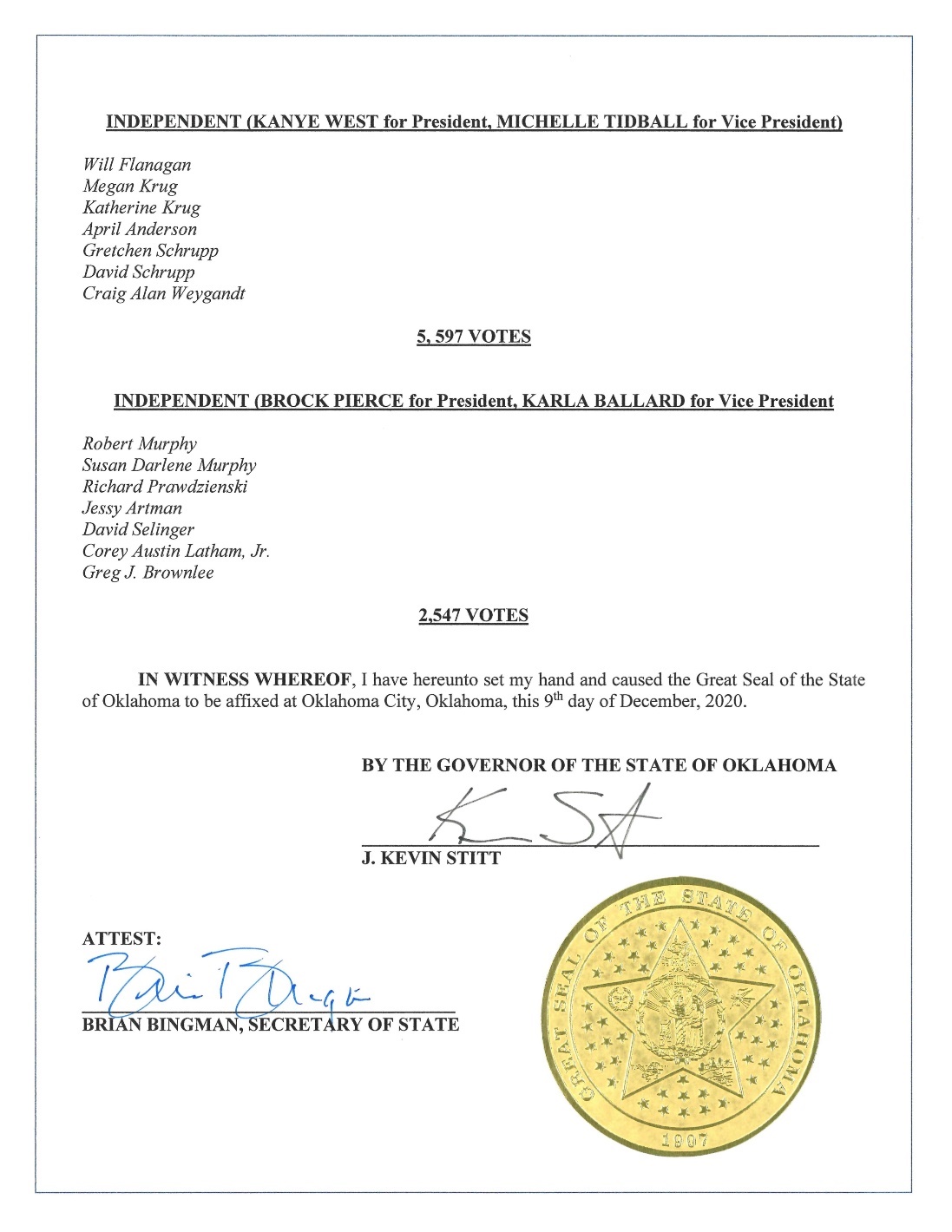
Governor J. Kevin Stitt issued an accurate Certificate in 2020 stating that the Trump-Pence presidential slate received 1,020,280 votes, as shown in figure 9.19, figure 9.20, and figure 9.21.[833]
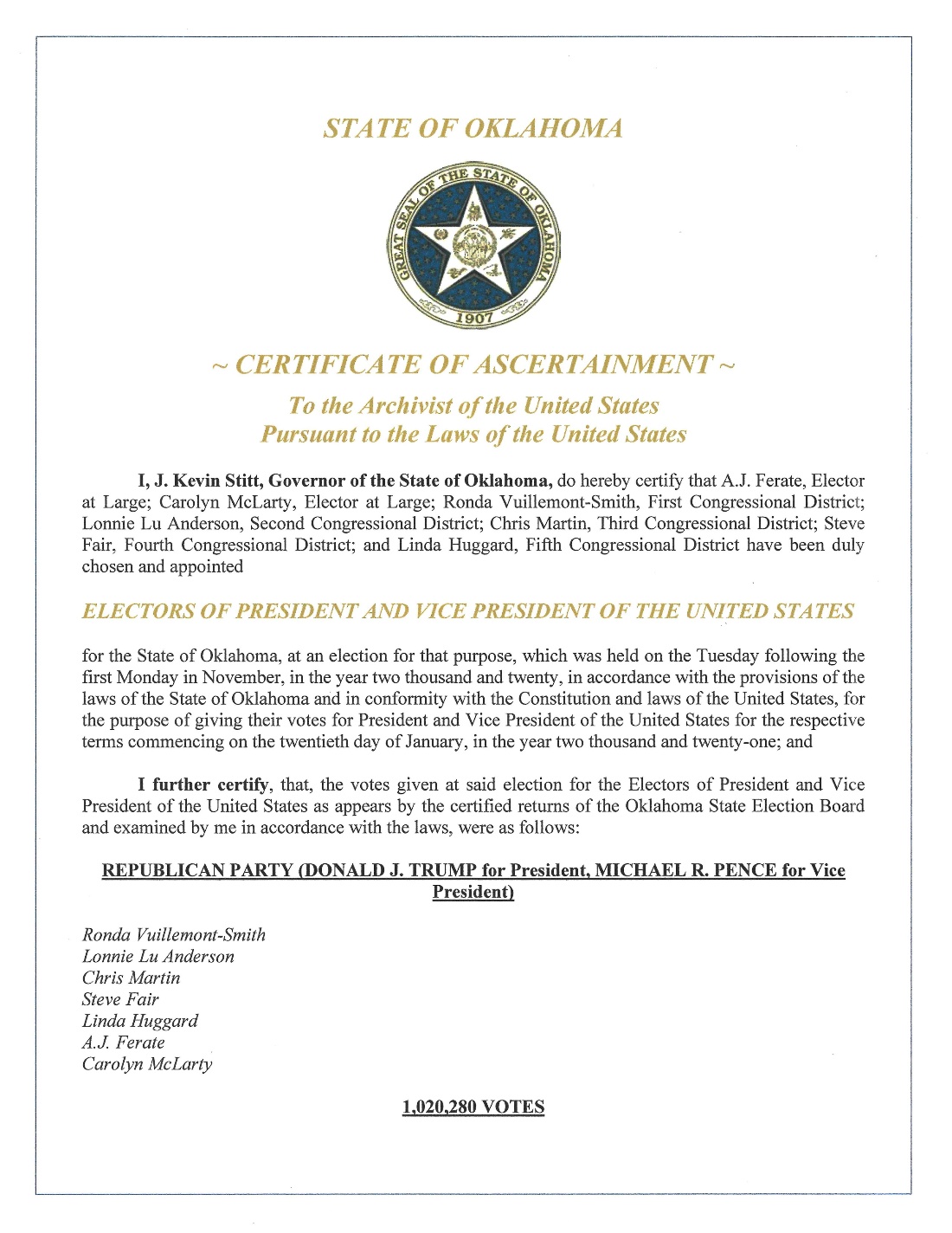
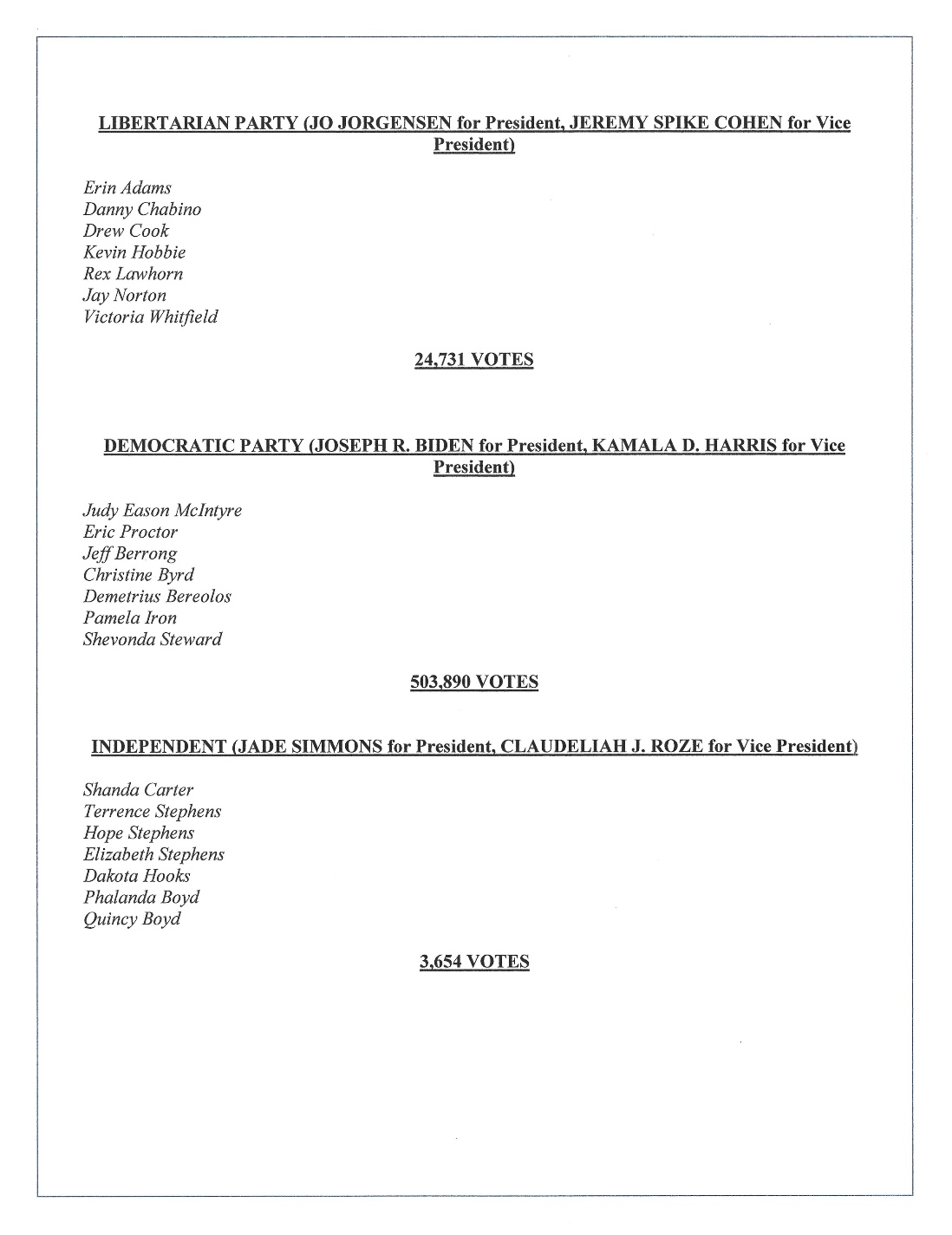
Figure 9.20 Oklahoma’s actual 2020 Certificate of Ascertainment—Page 2¤
There are two ways that a hypothetical Governor could have tried to implement England’s “one-person-seven-votes” plan.
Case 1—The Governor is forthright and honest.
In Oklahoma (and every other state), the presidential vote count is compiled by some designated body (e.g., the state canvassing board) or official (e.g., the Secretary of State) and their employees.
In Oklahoma, the certified vote count is produced by the State Elections Board.
The Board’s role as the source of the state’s popular-vote count is explicitly acknowledged on page 1 of Governor Stitt’s 2020 Certificate of Ascertainment (figure 9.19), which referred to “the certified returns of the Oklahoma State Election Board.”
The minutes of the Board (figure 6.1) show that the Board met a week after Election Day in 2020 and certified 1,020,280 votes for the Trump-Pence slate.[834]
If the hypothetical Governor were forthright, the state’s Certificate of Ascertainment would make clear that the Trump-Pence slate had received 1,020,280 votes—just as Governor Stitt’s actual 2020 Certificate did.
A Governor conceivably might gratuitously include the much larger number (7,141,960) in his Certificate. When properly labeled, the cumulative number of votes cast for the seven Republican candidates for presidential elector would simply be unneeded and irrelevant, but harmless, additional information.
Upon examining Oklahoma’s Certificate, the officials of states belonging to the National Popular Vote Compact would, of course, follow their own state’s law (that is, the Compact) and use the number specified by the Compact in their calculation of the national popular vote. That is, the officials of states belonging to the Compact would ignore the irrelevant inflated number (7,141,960) and uneventfully record 1,020,280 votes for the Trump-Pence slate. They would use:
“the number of popular votes in a state for each presidential slate.”[835]
In short, Trent England’s “one-person-seven-votes” plan for “dramatically inflating” Oklahoma’s vote in order to “interfere with NPV” would fizzle if the Governor were forthright and honest.
Case 2—The Governor is not forthright.
In fact, outright deception is the only way to try to execute England’s and Parnell’s plan for “dramatically inflating” Oklahoma’s vote.
The obvious way to try to execute the deception would be for the hypothetical Governor to issue a Certificate containing Oklahoma’s historically used wording (such as used in 2016[836] and 2020 and earlier years) and then insert the inflated cumulative number (7,141,960) in lieu of the actual number of people who voted for the Republican presidential slate (1,020,280).
England and Parnell apparently think that inserting a fraudulent number (considerably larger than the state’s population) would go unnoticed and unchallenged.
At least two groups would be keenly interested in the fraudulent number.
Lawyers and political operatives working with each presidential campaign routinely scrutinize the actions of canvassing boards, canvassing officials, and Governors throughout every step of the vote-counting and vote-certification process.[837] These scrutineers would have been aware that the Oklahoma State Election Board certified the fact that the Trump-Pence slate received 1,020,280 votes on November 10, 2020 (a week after Election Day).
More importantly, if the National Popular Vote Compact were in effect, the chief election officials of states belonging to it would also be aware that the Oklahoma Board had certified 1,020,280 votes for the Trump-Pence slate.[838] The officials of the states belonging to the Compact would have the minutes of the Oklahoma State Election Board in their possession.
Because the inflated number (7,141,960) in the fraudulent Certificate eventually issued by the hypothetical Governor is manifestly not the number that the Compact requires to be used to compute the national popular vote total, the chief election officials of the states belonging to the Compact would simply use the correct number already in their possession from the state’s canvassing board.
The result would be that England’s and Parnell’s “one-person-seven-votes” plan for “dramatically inflating” Oklahoma’s vote in order to “interfere with NPV” would have no effect on the operation of the Compact.
Although England’s and Parnell’s plan would have fizzled in terms of interfering with the operation of the Compact, the presidential candidate who won the national popular vote would almost certainly want to see an official correction made in the fraudulent Certificate issued by the hypothetical Governor.
To do this, the disfavored candidate could use state courts. However, a disfavored candidate today would more likely use the special three-judge federal court created by the Electoral Count Reform Act of 2022. This court is open only to presidential candidates and was specifically created to consider cases concerning the “issuance” of a state’s Certificate of Ascertainment and its timely “transmission” to the National Archives. The 2022 Act gives this court the power to revise a Governor’s fraudulent Certificate.
This new court is to operate on a highly expedited schedule. Time-consuming delays (such as the five-day notice of 28 U.S.C. 2284b2)[839] do not apply. There is expedited appeal to the U.S. Supreme Court. Given that the Constitution requires that the Electoral College meet on the same day in every state, all of the actions of both the three-judge court and the Supreme Court are to be scheduled so that a final conclusion will be reached prior to the Electoral College meeting.
Footnotes
[825] See web site of the Oklahoma Council on Public Affairs at https://ocpathink.org/about
[826] England, Trent. 2021. Can non-member states thwart the NPV compact? Save Our States Blog. Accessed May 22, 2021. https://saveourstates.com/uploads/Non-member-states.pdf
[827] Testimony of Sean Parnell to the Veterans and Legal Affairs Committee of the Maine Legislature Re: LD 1578 (The National Popular Vote interstate compact). January 8, 2024. Page 6. https://legislature.maine.gov/testimony/resources/VLA20240108Parnell133489622801109869.pdf
[828] Oklahoma ballots (like those of 46 other states) do not show the names of each party’s seven candidates for the position of presidential elector. In 2020, only three states (Arizona, Idaho, and South Dakota) listed the names of the elector candidates on their ballots. Figure 3.3 shows Idaho’s 2020 presidential ballot.
[829] Oklahoma’s 2016 Certificate of Ascertainment may be viewed at https://www.archives.gov/files/electoral-college/2016/ascertainment-oklahoma.pdf
[830] Oklahoma’s 2020 Certificate of Ascertainment may be viewed at https://www.archives.gov/files/electoral-college/2020/ascertainment-oklahoma.pdf
[831] Save Our States. 2023. NPV Compact Quirks: Ignoring Non-Compact States. August 25, 2023. Accessed July 13, 2024. https://saveourstates.com/blog/npv-compact-quirks-ignoring-non-compact-states
[832] Save Our States. 2023. NPV Compact Quirks: Ignoring Non-Compact States. August 25, 2023. Accessed July 13, 2024. https://saveourstates.com/blog/npv-compact-quirks-ignoring-non-compact-states
[833] Oklahoma’s 2020 Certificate of Ascertainment may be also be viewed at the National Archives web site at https://www.archives.gov/files/electoral-college/2020/ascertainment-oklahoma.pdf
[834] The Oklahoma State Board of Elections met on November 10, 2020. The agenda of the meeting https://oklahoma.gov/content/dam/ok/en/elections/agendas/agendas-2020/agenda-11102020.pdf The “meeting packet” containing the statewide vote counts is at https://oklahoma.gov/content/dam/ok/en/elections/election-results/2020-election-results/2020-general-election-results/meeting-packet-11102020.pdf The minutes of the meeting showing the Board’s certification of the vote counts are at https://oklahoma.gov/content/dam/ok/en/elections/minutes/2020-minutes/minutes-11102020.pdf
[835] National Popular Vote Compact. Article III, clause 5.
[836] Oklahoma’s 2016 Certificate of Ascertainment may be viewed at https://www.archives.gov/files/electoral-college/2016/ascertainment-oklahoma.pdf
[837] 7,141,960 is almost twice Oklahoma’s population of 3,959,353 (2020 census).
[838] While the chief election official of each member state might choose to individually monitor the vote-counting and vote-certification process in every other state, it is far more likely—as a matter of practicality and efficiency—that these officials would have pre-designated (by executive agreement) one or two of their members (perhaps on a rotating basis, from year to year) to act as a clearinghouse to collect and distribute certified copies of the officially certified vote count produced by each state’s canvassing board or official.
[839] 28 U.S. Code section 2284(b)(2) provides: “If the action is against a State, or officer or agency thereof, at least five days notice of hearing of the action shall be given by registered or certified mail to the Governor and attorney general of the State.”
9.31.5 MYTH: Keeping election returns secret could thwart the Compact.
QUICK ANSWER:
- Lobbyists opposing the National Popular Vote Compact have promoted legislation in four states aimed at thwarting the Compact by keeping the popular-vote count secret during the 42 days between Election Day and the Electoral College meeting.
- Federal law guarantees that each state’s popular-vote counts would be made public before the Electoral College meets.
- The secret-elections bill promoted by opponents of the Compact would have violated the 1887 federal law that applied at the time it was first proposed. The Electoral Count Reform Act of 2022 provides additional protections against secret elections.
- The secret-elections bill had numerous practical flaws that would have prevented it from ever becoming operational.
- The proposal for conducting secret elections is an antidemocratic parlor game untethered to the real world of law, politics, or public opinion.
Sean Parnell, Senior Legislative Director of Save Our States, testified before a Connecticut state legislative committee on February 24, 2014, saying:
“A very simple way for any non-member state to thwart the Compact, either intentionally or unintentionally, would simply be to not submit their Certificate or release it to the public until after the electoral college has met. This simple act would leave states that are members of the compact without vote totals from every state, throwing the system into chaos.”[840] [Emphasis added]
The first state legislative bill to implement Parnell’s plan for secret elections was introduced in New Hampshire on January 8, 2020.[841]
Tara Ross, a lobbyist against the National Popular Vote Compact who works closely with Save Our States, wrote in the Daily Signal on January 14, 2020:
“New Hampshire legislators have introduced an election bill that would be completely unacceptable under normal circumstances. But these are not normal times.
“Constitutional institutions, especially the Electoral College, are under attack.
“Extraordinary action may be needed. Thus, some New Hampshire legislators have proposed to withhold popular vote totals at the conclusion of a presidential election. The numbers would eventually be released, but not until after the meetings of the Electoral College.
“The idea sounds crazy and anti-democratic. In reality, however, such proposals could save our republic: They will complicate efforts to implement the National Popular Vote legislation that has been working its way through state legislatures.”[842] [Emphasis added]
We agree with Ross that the idea of secret elections is “crazy,” “anti-democratic,” and “completely unacceptable.” We disagree with her call to action to save the Republic.
An article in the conservative publication Townhall on January 18, 2020, entitled “National Popular Vote Opponents Are Afraid of the Constitution” took exception to the New Hampshire secret-elections bill:
“The tinfoil hat wearers, the faction that includes moon-landing deniers and the kind of crackpots William F. Buckley Jr. and Russell Kirk expelled from mainstream conservatism, has set its sights on derailing the National Popular Vote Interstate Compact. … One pundit is actually suggesting that the Granite State defy federal law, specifically section 3, title 3 of the U.S. code—a provision in effect since 1887—to throw a monkey wrench into the final nationwide tally for president. This particularly nutty idea would involve New Hampshire refusing to submit the state’s official vote count until after electors meet.”[843] [Emphasis added]
Shortly thereafter, the New Hampshire House committee unanimously rejected the bill.[844]
Meanwhile, in South Dakota on February 10, 2020, South Dakota Senator Jim Stalzer urged a Senate committee to pass a similar bill:
“This is a small way we can slow down, delay or even prevent the National Popular Vote from undoing what the founders so carefully put together.”[845]
The executive director of the South Dakota Newspaper Association, Dave Bordewyk, testified in opposition to the secret-elections bill, saying:
“Our concern with this bill is the withholding of the actual votes from the public after an election.”
“[Withholding vote totals would raise] suspicions in the minds of those who participated in the election.”[846], [847]
On February 12, 2020, the South Dakota Senate killed the bill by a 31–1 vote.[848]
In 2021, a similar secret-elections bill was introduced in Mississippi, but it died in committee.[849]
However, a similar bill gained some traction in North Dakota in 2021.[850]
In written testimony to the North Dakota Senate Government and Veterans Affairs Committee on February 11, 2021, Tara Ross said:
“The Electoral College is under attack, and this legislative body can do something about it. Adoption of SB 2271 would be an important first step in protecting America’s unique presidential election system from the latest anti-Electoral College movement.”
“The goal of withholding vote totals is to confuse NPV’s efforts to tabulate a national popular vote, without which the compact fails.”[851] [Emphasis added]
Former North Dakota State Senator Curtis Olafson provided written testimony saying:
“Senate Bill 2271 is intended to thwart the NPVIC should it ever reach 270 Electoral College votes.”[852]
On February 10, 2021 (one day before a North Dakota Senate committee hearing), Sean Parnell summarized the Save Our States effort to pass secret election legislation:
“What if a state was deliberately trying to thwart the compact? Could they deny NPV compact states access to the vote totals they needed to operate? Last year legislation was introduced in New Hampshire, HB 1531, that would prevent the release of vote totals prior to the meeting of the Electoral College. Two more states, Mississippi and North Dakota, have similar bills this year (HB 1176 and SB 2271, respectively).
“This legislation is specifically aimed at thwarting NPV.”[853] [Emphasis added]
The only written testimony submitted to the North Dakota Senate committee hearing on February 11 on the secret-elections bill was the supportive testimony from Tara Ross and former State Senator Olafson. The committee approved the bill, and five days later, the North Dakota Senate passed it by a 43–3 vote.
The Senate-passed bill required that the popular-vote count be kept secret until after the Electoral College meeting (which is currently 42 days after Election Day). It read:
“Unless a recount has been requested under chapter 16.1-16 or a contest is initiated under this chapter, a public officer, employee, or contractor of this state or of a political subdivision of this state may not release to the public the number of votes cast in the general election for the office of thepresident of the United States until after the times set by law for the meetings and votes of the presidential electors in all states. After the votes for presidential electors are canvassed, the secretary of state may release the percentage of statewide votes cast for each set of presidential electors to the nearest hundredth of a percentage point, a list of presidential candidates in order of increasing or decreasing percentage of the vote received by presidential electors selected by the candidates, and the presidential candidate whose electors received the highest percentage of votes.”
“This Act becomes effective upon certification by the secretary of state to the legislative council of the adoption and enactment of substantially the same form of the national popular vote interstate compact has been adopted and enacted by a number of states cumulatively possessing a majority of the electoral college votes.”[854] [Emphasis added]
The North Dakota House then held a hearing at which both supporters and opponents of the bill testified.
The web site of the group opposing the secret-elections bill (“No Secret Elections”) said:
“SB2271 is a bill moving through the North Dakota Legislature that would make presidential election vote totals secret until about seven weeks after Election Day, when the Electoral College meets.
“Proponents of the bill think it could stop implementation of the National Popular Vote Interstate Compact, which is progressing towards enactment, by preventing the ascertainment of the national vote for president. They are wrong.
“Whatever one thinks about the National Popular Vote Interstate Compact, the “secret elections” bill, SB2271, is a downright scary idea: It threatens the foundations of North Dakota elections, and it could rob North Dakota voters of their voice in presidential elections.
“Bills almost identical to SB2271 were defeated in the South Dakota Senate by a 32–1 vote in 2020, rejected unanimously by a New Hampshire House committee in 2020, and died in committees in the Mississippi House and Senate already in 2021. North Dakota would be wise also to reject the bizarre idea of keeping election results secret.”[855]
Various editorials, op-eds, public comments, and news articles covered the debate.[856], [857], [858], [859]
After the public hearing, the House deleted everything in the Senate bill and replaced it with a bill urging Congress to oppose the National Popular Vote Compact. The House’s substitute bill stated:
“The sixty-seventh legislative assembly urges Congress not to consent to the interstate compact and to oppose any efforts to seek a national popular election of a president other than through an amendment to the Constitution.”[860]
A House–Senate conference committee then met to reconcile the differences between the two bills.
The conference committee adopted the House-passed bill expressing the legislature’s opposition to the National Popular Vote Compact and added the following provision calling for a study:
“During the 2021-22 interim, the legislative management shall consider studying how to defeat the effort of the national popular vote interstate compact to ensure the electoral college process is preserved as prescribed in the United States Constitution. The study also must include examination of how states report presidential election results and whether states report the results using vote percentages or vote totals.”[861] [Emphasis added]
The conference committee’s bill then passed the Senate by a 39–8 vote, and the House by an 80–12 vote, and the Governor signed it.
After the legislature adjourned, “the legislative management” quietly decided not to bother with the study.
The first way that the secret-elections bill violates federal law is that the law requires the state’s Certificate of Ascertainment to contain the actual number of popular votes—not percentages.
The law that eventually passed in North Dakota in 2021 asked the legislative leadership to consider conducting an interim study as to:
“whether states report the results using vote percentages or vote totals.”
An elaborate study is not necessary to answer the question of whether a state may report the results of its presidential election using percentages rather than the actual number of votes.
Both the Electoral Count Act of 1887 and the Electoral Count Reform Act of 2022 are identical in that they require each state to report the number of votes cast—not percentages.
Both the 1887 law and the 2022 law are identical in that they require:
“The canvass or other determination under the laws of such State of the number of votes given or cast for each person for whose appointment any and all votes have been given or cast.”[862] [Emphasis added]
North Dakota’s 2020 Certificate of Ascertainment (figure 9.22) is an example of a certificate that complies with federal law in that it shows the number of popular votes that each candidate received.
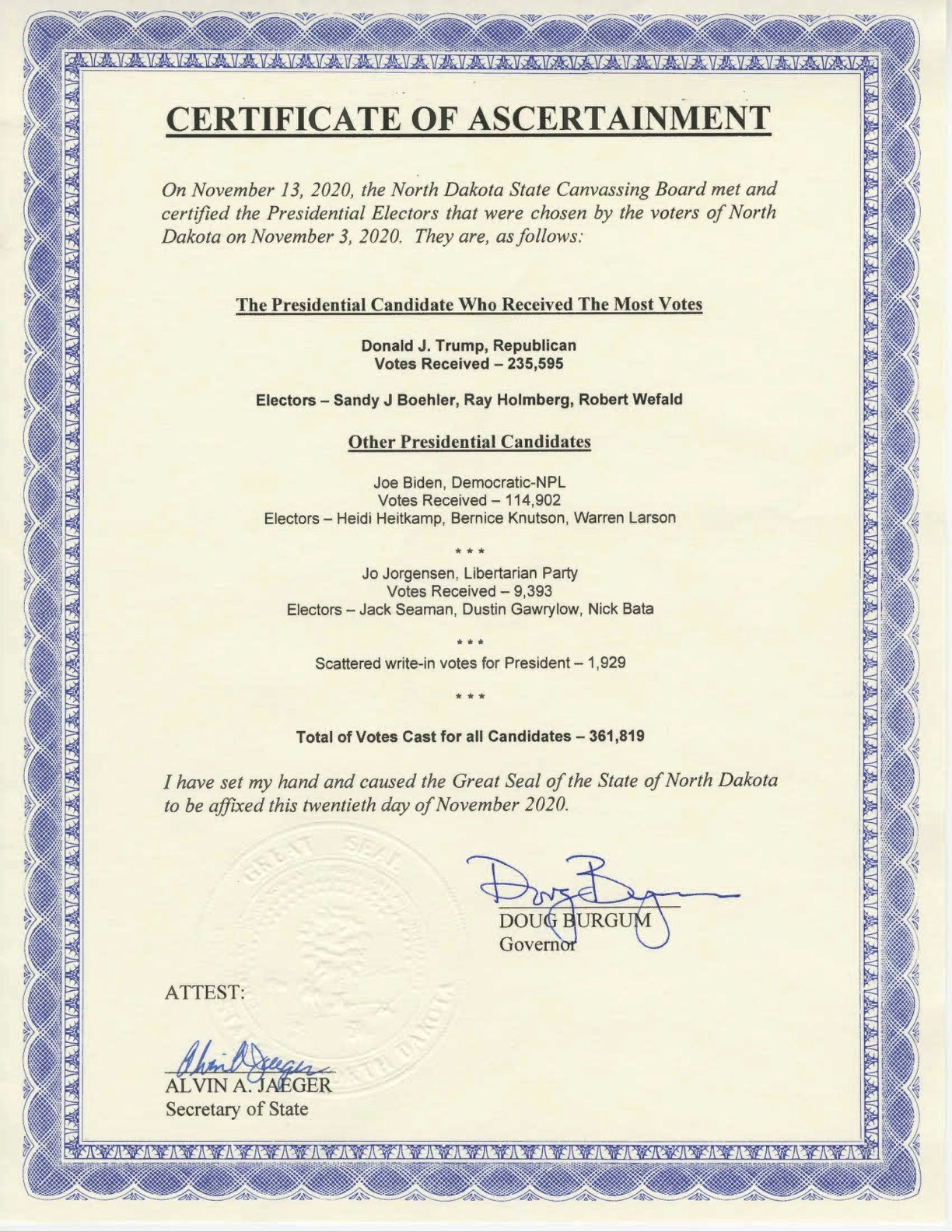
As can be seen from North Dakota’s 2020 Certificate, the state Board of Canvassers met on November 13 (shortly after Election Day) and certified the number of popular votes won by each presidential slate. A week later (November 20), the Governor and Secretary of State signed the state’s Certificate of Ascertainment.
As in most states, North Dakota’s Certificate was issued well before the so-called Safe Harbor Day of December 8, 2020, and well before the Electoral College meeting date of December 14, 2020.
The second way that the secret-elections bill violates federal law is that the law requires the state’s Certificate of Ascertainment to be issued no later than six days before the Electoral College meets.
No state may play “hide the ball” with its popular-vote counts.
The Electoral Count Reform Act of 2022 requires:
“§5(a)(1) Certification—Not later than the date that is 6 days before the time fixed for the meeting of the electors, the executive of each State shall issue a certificate of ascertainment of appointment of electors, under and in pursuance of the laws of such State providing for such appointment and ascertainment enacted prior to election day.
“(2) Form of certificate—Each certificate of ascertainment of appointment of electors shall (A) set forth the names of the electors appointed and the canvass or other determination under the laws of such State of the number of votes given or cast for each person for whose appointment any and all votes have been given or cast….” [Emphasis added]
The third way that the secret-elections bill violates federal law is that the law prevents the state’s Certificate of Ascertainment from being kept secret until after the Electoral College meeting.
As previously mentioned, the North Dakota Governor and Secretary of State signed the Certificate on November 20, 2020—weeks before the Safe Harbor Day of December 8, 2020, and the Electoral College meeting date of December 14, 2020.
However, even if the Governor and Secretary of State had kept the signed Certificate secret until the Safe Harbor Day (or even if they had delayed issuing the Certificate until that day), they would have been unable to continue to keep North Dakota’s vote counts secret.
Federal law requires that the Certificate be “immediately” transmitted to the National Archives in Washington using “the most expeditious method available.” A courier from any state capital would take, at most, overnight.
The Electoral Count Reform Act of 2022 requires:
“§5(b)(1) Transmission—It shall be the duty of the executive of each State—(1) to transmit to the Archivist of the United States, immediately after the issuance of a certificate of ascertainment of appointment of electors and by the most expeditious method available, such certificate of ascertainment of appointment of electors.”[863] [Emphasis added]
Certificates received by the National Archives must be open to public inspection according to section 6 of the 2022 Act.
The requirement for immediate transmission of the Certificate was adopted as a committee amendment during the Senate Administration Committee’s consideration of the Electoral Count Reform Act of 2022 in order to prevent secret elections.
As a result of this amendment, a Governor cannot, for example, delay the start of the Certificate’s journey to Washington until after the Electoral College meets (and then belatedly send it by “the most expeditious method available”).
Thus, if the Governor complies with federal law, the Certificate will arrive at the National Archives in Washington no later than the morning of the fourth day before the Electoral College meeting.
A secret-elections bill would not succeed in keeping a state’s vote count secret, because presidential candidates have direct access to a new three-judge federal court whose sole role is to enforce the timely issuance and immediate transmission of Certificates of Ascertainment.
The Electoral Count Reform Act of 2022 created a special three-judge federal court that is open only to presidential candidates.
The new court’s sole functions are to guarantee rapid enforcement of the requirement for:
- timely “issuance” and
- prompt “transmission” of each state’s Certificate of Ascertainment to federal officials.
These are precisely the issues that would be presented by an attempt to keep presidential vote counts secret.
This court is to operate on a highly expedited schedule. Time-consuming delays (such as the five-day notice of 28 U.S.C. 2284b2)[864] do not apply. There is expedited appeal to the U.S. Supreme Court.
Given that the Constitution provides that the Electoral College meet on the same day in every state, all of the actions of both the three-judge court and the Supreme Court are to be scheduled so that a final conclusion will be reached prior to the Electoral College meeting.
Secret election laws would deny voters the right to have their vote count.
All 50 states and the District of Columbia currently allow their voters to cast a vote for President. However, each state legislature has the power (under Article II, section 1 of the U.S. Constitution) to choose the method for selecting the state’s presidential electors.
Thus, the legislature could authorize itself—instead of the people—to select the state’s presidential electors. Indeed, state legislative appointment of presidential electors was the method used by several states in the early years of the Republic.
However, once a state legislature allows its voters to choose the state’s presidential electors, each voter acquires the fundamental right to have his or her vote counted.
The U.S. Supreme Court has noted:
“[I]t is ‘as equally unquestionable that the right to have one’s vote counted is as open to protection … as the right to put a ballot in a box.’” Reynolds v. Sims, 377 U.S. 533, 554–55 (1964) (quoting United States v. Mosley, 238 U.S. 383, 386 (1915)).” [Emphasis added]
In the Voting Rights Act, Congress codified the definition of the right to vote to:
“include all action necessary to make a vote effective in any primary, special, or general election, including, but not limited to … having such ballot counted properly and included in the appropriate totals of votes cast.”[865] [Emphasis added]
Secret elections would deprive the state’s voters of the full value of their votes.
The secret-elections bill would never become operational, because its secrecy provision is automatically suspended if any candidate initiates a recount or a contest.
The defects of the original Senate version of North Dakota’s secret-elections bill go far beyond noncompliance with federal law.
The author of the North Dakota bill (and the similar bills introduced in New Hampshire, South Dakota, and Mississippi) recognized the inherent conflict between secrecy and the ability to recount or contest an election.
Thus, the North Dakota bill provided that its secrecy requirement would be automatically suspended if a recount (an administrative proceeding) were to be requested or a contest (a judicial proceeding) were to be initiated.
That is, a single presidential candidate could unilaterally disable operation of the North Dakota secret-elections bill merely by requesting a recount or initiating a contest—regardless of the request’s merits or its ultimate disposition. Specifically, the bill provided:
“Unless a recount has been requested under chapter 16.1-16 or a contest is initiated under this chapter, a public officer, employee, or contractor of this state or of a political subdivision of this state may not release to the public the number of votes cast in the general election for the office of the president of the United States until after the times set by law for the meetings and votes of the presidential electors in all states.” [Emphasis added]
Of course, the Republican presidential nominee would be especially anxious to see North Dakota’s popular votes included in the national popular vote total.
Although the current state-by-state winner-take-all method of awarding electoral votes makes North Dakota politically irrelevant in present-day presidential campaigns, the state’s overwhelming Republican margin would be very important in a national popular vote for President.
The state of North Dakota gave the 2020 Republican nominee (Trump) a lead of 120,693 votes over the 2020 Democratic nominee (Biden). This margin of 120,693 was considerably greater than Biden’s combined margin (42,918) in the three closest states that Biden carried (Georgia, Arizona, and Wisconsin), as shown in table 9.42. These three states together provided Biden with his entire margin of victory in the Electoral College.[866]
Table 9.42 Biden’s lead in the three closest states he carried in 2020
| State | Trump | Biden | Democratic lead | Electoral votes |
| Georgia | 2,461,854 | 2,473,633 | 11,779 | 16 |
| Arizona | 1,661,686 | 1,672,143 | 10,457 | 11 |
| Wisconsin | 1,610,184 | 1,630,866 | 20,682 | 10 |
| Total | 42,918 | 37 |
In fact, North Dakota’s 120,693-vote Republican margin was almost equal to Biden’s combined margin in the four closest states that he carried, as shown in table 9.43.
Table 9.43 Biden’s lead in the four closest states he carried in 2020
| State | Trump | Biden | Republican lead | Electoral votes |
| Georgia | 2,461,854 | 2,473,633 | 11,779 | 16 |
| Arizona | 1,661,686 | 1,672,143 | 10,457 | 11 |
| Wisconsin | 1,610,184 | 1,630,866 | 20,682 | 10 |
| Pennsylvania | 3,377,674 | 3,458,229 | 80,555 | 20 |
| Total | 123,473 | 57 |
The secret-elections bills contain no plan for running a system of voting and counting that is half-public and half-secret.
Members of Congress, state legislators, numerous other officials, and ballot propositions are on the ballot at the same time as the President.
North Dakota election law specifically requires that each step of the election process for non-presidential offices and ballot propositions be public.
Watchdog groups, candidates, political parties, the media, and ordinary citizens expect to have timely access to the vote counts for non-presidential offices and ballot propositions.
However, the secret-elections bills in New Hampshire, South Dakota, Mississippi, and North Dakota contained no plan for simultaneously conducting and counting secret and non-secret elections.
At the minimum, voting for President would almost certainly have to be conducted using ballots that are separate from those used for the non-secret voting being conducted at the same time and place.
There would be the cost of printing separate ballots for President. The ballots for President would then have to be counted separately from the ballots for other offices—thereby adding to the time required to process the ballots after the polls close.
If electronic voting devices were used (either for everyone or perhaps disabled voters), voting for President would have to be conducted using separate devices. Thus, there would be a cost associated with having a second set of devices.
In short, the secret-elections bills fail to specify how to operate a system of voting and counting that is half-public and half-secret—probably because there is no workable (much less any economic or efficient) way to do that.
The secret-elections bills contain no penalty for the crime of revealing vote counts.
Secrecy can only be maintained if there is some consequence for violating that requirement.
Thus, every “public officer, employee, or contractor of this state or of a political subdivision of this state” involved in conducting a secret presidential election would have to be subject to some fine, jail time, or other penalty for violating the law. However, the secret-elections bills in New Hampshire, South Dakota, Mississippi, and North Dakota contain no penalties.
The secret-elections bills are flawed, because they fail to muzzle the presidential candidates.
Existing North Dakota law provides for both recounting votes[867] and contesting elections in court.[868]
North Dakota law concerning recounts specifically permits the presence of a candidate “personally, or by a representative.”
However, the secret-elections bill in North Dakota (and the similar bills in New Hampshire, South Dakota, and Mississippi) did not require secrecy by the candidate or the candidate’s representative in either recounts or contests.
Instead, the secrecy requirement would have applied only to a limited group of people, namely:
“a public officer, employee, or contractor of this state or of a political subdivision of this state.”
There is no politically plausible way by which a state could succeed in muzzling a presidential candidate in the midst of a recount or a legal challenge to an election.
Secret court proceedings would necessarily be required for a secret-elections bill to work.
Professor Norman Williams of Willamette College in Oregon recognized that a secret-elections bill could not possibly succeed in achieving its goal without also requiring secret court proceedings. Williams pointed out the necessity of:
“releasing the vote totals only to the candidateson the condition that the totals are kept confidential until after the Electoral College meets. Such selective release wouldallow the losing candidate to pursue a judicial election contest, which itself could be kept closed to the public to ensure the vote total’s confidentiality, but it would frustrate the NPVC [National Popular Vote Compact] by keeping other states from knowing the official vote tally.”[869] [Emphasis added]
The secret-elections bills in New Hampshire, South Dakota, Mississippi, and North Dakota did not contain provisions to make court proceedings secret or to require non-disclosure agreements—a tacit acknowledgment that this kind of legislation has no possibility of ever actually going into effect.
Inadvertent errors or fraud could remain undiscovered until after the state’s electoral votes were cast in the Electoral College.
Secret vote counts conflict with the principle of having “many eyes” monitor elections.
Today, inadvertent errors (and even fraud) can be uncovered by watchdog groups, candidates, political parties, the media, and ordinary citizens who diligently compare the officially reported vote with what was observed on Election Day at local voting places.
Under all of the proposed secret-elections bills, the counting authority at the state level (e.g., the Board of Canvassers, Secretary of State) would receive the secret counts from local voting places, add them up in secret, and keep both the local and statewide counts secret until after the Electoral College meets.
If vote counts were successfully kept secret at local voting places, the bill would make it impossible for such independent monitoring to occur.
Because the required secrecy would not end until after the Electoral College meeting, inadvertent errors would remain undiscovered.
Supporters of secret elections assume that the public has such a strong attachment to the current winner-take-all rule that they would be willing to abandon the long-standing tradition of having elections closely monitored by the media, civic groups, and challengers and observers representing the parties, candidates, and ballot propositions that happen to be on the ballot at the same time as the presidential election.
Secret vote counts would conflict with provisions of some state constitutions.
In some states, secret vote counts would conflict with the state constitution.
The first secret-elections bill was introduced in New Hampshire.
The New Hampshire Constitution (Article 8) provides:
“The public’s right of access to governmental proceedings and records shall not be unreasonably restricted.”
The North Dakota secret-elections bill would not have succeeded in concealing the state’s popular-vote count.
Even if the original North Dakota secret-elections bill (and virtually identical bills in New Hampshire, South Dakota, and Mississippi) complied with federal law, and even if there were a solution to the practical and legal problems of implementing secret elections, the proposed legislation would not have succeeded in achieving its goal of concealing the state’s popular-vote count.
The reason is that none of these bills required enough secrecy.
The polling books at each local voting location show the total number of voters who voted. This number is closely monitored by candidates, political parties, watchdog groups, the media, and the supporters and opponents of the various statewide ballot measures.
The total number of voters who voted is particularly important, because it provides an absolute cap on the largest number of votes that can possibly be legitimately cast for each race on the ballot. This number is an inherent part of the process of monitoring the security and integrity of elections. It is available at each local voting location.
More importantly, this number is publicly reported on a statewide basis on the web sites of the North Dakota Secretary of State and the federal Election Assistance Commission.[870], [871]
The officially reported statewide total of the number of people who voted in North Dakota in the November 2020 election was 364,499.
Simple arithmetic applied to the official statewide percentages that would have been publicly released under the terms of the secret-elections bill would immediately reveal the lowest and highest possible number of votes that each presidential candidate possibly could have received.
If the North Dakota secret-elections bill had been in effect in 2020, 36 votes would have been the difference between the highest and lowest number of popular votes that a presidential candidate could have received.
Nationally, there were 158,224,999 votes cast for President in 2020.
In table 9.44:
- Column 2 shows the number of popular votes received in North Dakota in 2020 by each presidential candidate. These numbers are colored red to indicate that they would have been kept secret under the terms of the North Dakota secret-elections bill. For example, Donald Trump received 235,595 votes. The total number of votes cast for President was 361,819.[872]
- Column 3 shows the percentage of the popular votes received by each candidate to the nearest hundredth of a percent. For example, Trump received 65.11% of the vote. This percentage would have been publicly disclosed under the specific terms of the secret-elections bill. This column and subsequent columns in this table are colored green to indicate that this information would not have been secret under the terms of the secret-elections bill.
- Column 4 shows the smallest percentage of votes that each candidate could have received, namely 0.005% less than the percentage in column 3. For example, this percentage for Trump is 65.105%.
- Column 5 shows the largest percentage of votes that candidate could have received, namely 0.005% greater than the percentage in column 3. For example, this percentage for Trump is 65.115%.
- Column 6 shows the smallest number of votes that a candidate could possibly have received in North Dakota, given the percentage shown in column 4 and the known official number of voters who voted as reported by the Secretary of State (364,499). For Trump, this number was 237,308 votes.
- Column 7 shows the highest number of votes that a candidate could possibly have received in North Dakota, given the percentage shown in column 4 and the known official number of voters who voted. For Trump, this number was 237,343 votes.
- Column 8 shows the difference between the lowest possible number of votes from column 6 and the highest possible number of votes from column 7.
Table 9.44 Analysis of North Dakota secret-elections bill
| Candidate | Votes | Percent of the candidate’s vote rounded off to nearest hundredth | Smallest percent of votes candidate could have received | Largest percent of votes candidate could have received | Smallest number of votes candidate could have received | Largest number of votes candidate could have received | Diff | |
| Status | Secret | Public | Public | Public | Public | Public | Public | |
| Trump | 235,595 | 65.11% | 65.105% | 65.115% | 237,308 | 237,343 | 35 | |
| Biden | 114,902 | 31.76% | 31.755% | 31.765% | 115,747 | 115,783 | 36 | |
| Others | 11,322 | 3.13% | 3,125% | 3.135% | 11,391 | 11,427 | 36 | |
| Total | 361,819 | 100.00% | ||||||
Thus, if the North Dakota secret-elections bill had been in operation for the 2020 presidential election, the publicly available official information from the state of North Dakota would have established that:
- Trump received somewhere between 237,308 and 237,343 votes—a difference of 35
- Biden received somewhere between 115,747 and 115,783 votes—a difference of 36
- Other candidates together received somewhere between 11,391 and 11,427 votes—a difference of 36.
The popular-vote count from the other 49 states and the District of Columbia in 2020 (shown in table 4.16) was:
- Trump—73,980,280
- Biden—81,153,684
- Others—2,729,216.
When we add in the largest and smallest possible numbers of popular votes for each candidate based on the publicly available official information from North Dakota, the nationwide totals will contain 35 or 36 votes of uncertainty:
- Trump—between 74,217,588 and 74,217,623—a difference of 35
- Biden—between 81,269,431 and 82,269,467—a difference of 36
- Others—between 2,740,607 and 2,740,643—a difference of 36
Thus, the lowest possible nationwide total for Biden would have been 81,269,431, and the highest possible nationwide total for Trump would have been 74,217,623—that is, a nationwide lead for Biden of 7,051,808.
Thus, an accurate designation of the national popular vote winner could be confidently made based on the publicly available official information from North Dakota.
Accordingly, if the National Popular Vote Compact had been in effect in 2020, Biden would have been designated as the “national popular vote winner,” and all of the electoral votes of all the states belonging to the Compact would have been awarded to him.
Theoretically, the resulting appointment of presidential electors could be contested; however, the precondition to litigation is the existence of an aggrieved party.
There could only be an aggrieved presidential candidate in the extraordinarily unlikely situation in which the 36 votes were critical to deciding the “national popular vote winner” out of 158,224,999 votes cast nationally.
If the 36 votes (out of 158,224,999 votes cast nationally) could not possibly affect the correctness of the designation of the national popular vote winner, there would be no aggrieved candidate. At most, this would be a case of “no harm, no foul.”
Of course, if 36 votes were to matter at the national level, the three-judge federal court (described previously) would use its power to obtain access to North Dakota’s actual vote counts and then, if appropriate, use its power to revise the Certificates of Ascertainment submitted by the states belonging to the Compact to reflect the correct national popular vote winner.
Footnotes
[840] Parnell, Sean. 2014. Testimony before Connecticut Government Administration and Elections Committee. February 24, 2014.
[841] New Hampshire House Bill 1531 of 2020 entitled “Relative to the release of voting information in a presidential election.” https://www.gencourt.state.nh.us/bill_status/legacy/bs2016/
[842] Ross, Tara. 2020. New Hampshire Is Fighting Back to Defend the Electoral College. Daily Signal. January 14, 2020. https://www.dailysignal.com/2020/01/14/new-hampshire-is-fighting-back-to-defend-the-electoral-college/
[843] Herzog, Ashley. 2020. National Popular Vote Opponents Are Afraid of the Constitution. Townhall. January 18, 2020. https://townhall.com/columnists/ashleyherzog/2020/01/18/national-popular-vote-opponents-are-afraid-of-the-constitution-n2559694
[844] On January 28, 2020, former Michigan Republican Chair Saul Anuzis testified on behalf of the National Popular Vote organization against the bill. See Testimony Against the Secret Presidential Elections Bill (HB1531) by Saul Anuzis at the New Hampshire House Committee on Election Law https://www.nationalpopularvote.com/sites/default/files/testimony-nh-bill-hb1531-secret_elections-2020-1-28.pdf
[845] Hess, Dana. 2020. GOP bill keeps presidential election vote totals a secret in state. Rapid City Journal. February 10, 2020. https://rapidcityjournal.com/news/local/gop-bill-keeps-presidential-election-vote-totals-a-secret-in/article_d557b7d1-19b8-5f57-ae23-e4867bdd7c97.html
[846] Ibid.
[847] Heidelberger, Cory Allen. 2020. SB 103: Stalzer Sabotaging National Popular Vote by Keeping South Dakota Vote Count Secret? Dakota Free Press. February 10, 2020. https://dakotafreepress.com/2020/02/10/sb-103-stalzer-sabotaging-national-popular-vote-by-keeping-south-dakota-vote-count-secret/
[848] South Dakota SB103 of 2020. Limit the disclosure of presidential election results and to provide for a suspension of such disclosure. http://sdlegislature.gov/Legislative_Session/Bills/Bill.aspx?Bill=103&Session=2020
[849] Mississippi SB2549 of 2021. Election results; prohibit the release of the number of votes cast for the Office of President of the United States. http://billstatus.ls.state.ms.us/2021/pdf/history/SB/SB2549.xml
[850] North Dakota SB2271 of 2021. An Act relating to withholding vote totals for presidential elections. https://ndlegis.gov/assembly/67-2021/regular/bill-overview/bo2271.html?bill_year=2021&bill_number=2271
[851] Ross, Tara, 2021. Written testimony on SB 2271 to the North Dakota Senate Government and Veterans Affairs Committee. February 11, 2021. https://ndlegis.gov/assembly/67-2021/testimony/SGVA-2271-20210211-6352-F-ROSS_TARA.pdf
[852] Olafson, Curtis. 2021. Written testimony on SB 2271 to the North Dakota Senate Government and Veterans Affairs Committee. February 11, 2021. https://ndlegis.gov/assembly/67-2021/testimony/SGVA-2271-20210211-6349-F-OLAFSON_CURTIS.pdf
[853] Parnell, Sean. 2021. States consider preemptive measures against National Popular Vote. Save Our States Blog. February 10, 2021. Accessed July 13, 2024. https://saveourstates.com/blog/states-consider-preemptive-measures-against-national-popular-vote
[854] Engrossed Senate bill SB2271. https://ndlegis.gov/assembly/67-2021/regular/documents/21-0828-02000.pdf
[855] See https://www.nosecretelections.com/
[856] Tribune editorial: Keeping vote count secret a bad solution. Bismark Tribune. March 10, 2021. https://bismarcktribune.com/opinion/editorial/tribune-editorial-keeping-vote-count-secret-a-bad-solution/article_b085761c-21c5-545f-abcd-cc6f9af7d638.html
[857] Hennen, Scott. 2021. Bizarre election bill, SB2271, must be defeated. Minot Daily News. February 20, 2021. https://www.minotdailynews.com/opinion/community-columnists/2021/02/bizarre-election-bill-sb2271-must-be-defeated/
[858] Port, Bob. 2021. Plain Talk: North Dakota Senate has passed a bill hiding presidential vote counts. Inforum. February 24, 2021. https://www.inforum.com/opinion/plain-talk-north-dakota-senate-has-passed-a-bill-hiding-presidential-vote-counts
[859] Gerszewski, Matt. 2021. Letter to editor. Inforum. March 3, 2021. https://www.inforum.com/opinion/letter-death-to-north-dakotas-secret-election-act
[860] Engrossed Senate bill SB2271 with House amendments. https://ndlegis.gov/assembly/67-2021/regular/documents/21-0828-03000.pdf
[861] Engrossed Senate bill SB2271 with conference committee amendments. https://ndlegis.gov/assembly/67-2021/regular/documents/21-0828-04000.pdf
[862] The Electoral Count Reform Act of 2022 is found in appendix B of this book. The earlier Electoral Count Act of 1887 is found in appendix B of the 4th edition of this book at https://www.every-vote-equal.com/4th-edition
[863] Section 5(b)(1) of the 2022 Act further requires the executive of each state “to transmit to the electors of such State, on or before the day on which the electors are required to meet under section 7, six duplicate-originals of the same certificate.”
[864] 28 U.S. Code section 2284(b)(2) provides: “If the action is against a State, or officer or agency thereof, at least five days notice of hearing of the action shall be given by registered or certified mail to the Governor and attorney general of the State.”
[865] 52 U.S.Code section 10310(c)(1).
[866] Georgia, Arizona, and Wisconsin together possessed 37 electoral votes. Without those three states, Biden’s 306–232 victory in the Electoral College would have become a 269–269 tie in the Electoral College. In the event of a tie in the Electoral College, the presidential election would have been thrown into the U.S. House of Representatives (with each state having one vote). In the House, the Republican Party had the 26 votes required to elect a President on January 6, 2021.
[867] North Dakota Century Code section 16.1-16-01. https://law.justia.com/codes/north-dakota/2015/title-16.1/chapter-16.1-16/
[868] North Dakota Century Code section 16.1-16-02. https://law.justia.com/codes/north-dakota/2015/title-16.1/chapter-16.1-16/
[869] Williams, Norman R. 2011. Reforming the Electoral College: Federalism, majoritarianism, and the perils of subconstitutional change. 100 Georgetown Law Journal 173. November 2011. Page 213.
[870] North Dakota Secretary of State. Official 2020 General Elections Results—November 3, 2020. Accessed July 13, 2024. https://www.sos.nd.gov/elections/election-results
[871] U.S. Election Assistance Commission. 2021. The Election Administration and Voting Survey: 2020 Comprehensive Report. Page 28. https://www.eac.gov/sites/default/files/document_library/files/2020_EAVS_Report_Final_508c.pdf. Also see https://www.eac.gov/research-and-data/datasets-codebooks-and-surveys
[872] Note that the total number of votes cast for President was 361,819, and that this number is about 99% of those who voted.
9.31.6 MYTH: Abolition of popular voting for President or abolition of the short presidential ballot are “Achilles’ heels” that would thwart the Compact.
QUICK ANSWER:
- The National Popular Vote Compact was specifically drafted to prevent a single non-member state from affecting its operation by abolishing popular voting for President or by abolishing the short presidential ballot.
All 50 states and the District of Columbia currently permit the people to vote for President.
Professor Norman Williams of Willamette University has suggested that a single state could obstruct the operation of the National Popular Vote Compact by abolishing popular voting for President.
“The most dramatic way in which a non-signatory state could obstruct the determination of which candidate was the most popular across the nation is for the state to eliminate its statewide popular elections for President and have its legislature (or somebody other than the state’s voters) appoint its Presidential electors.”[873] [Emphasis added]
We agree that Williams’ proposal is “dramatic.”
Dicta in the U.S. Supreme Court decision in McPherson v. Blacker indicate that abandonment of popular voting for presidential electors would be constitutional.[874] It is a historical fact that, in the nation’s first presidential election in 1789, presidential electors were chosen by the state legislature in three states (Connecticut, Georgia, and South Carolina).
An equally dramatic proposal has been advanced by Alexander S. Belenky, who has suggested that a single state could obstruct the operation of the National Popular Vote Compact by abolishing the short presidential ballot.
All 50 states and the District of Columbia currently use the so-called “short presidential ballot”—that is, they permit their voters to vote for President with a convenient single vote (section 2.14).
For example, the use of the short presidential ballot in California permits a voter to cast a convenient single vote for the Trump-Vance slate and to have that single vote be deemed to be a vote for each of the 54 Republican candidates for presidential elector. The short presidential ballot eliminates the burden of casting separate votes for 54 candidates for presidential elector. If the short presidential ballot were not used, a certain number of voters would inevitably get tired or confused while voting separately for 54 candidates. Some voters might vote for candidate(s) for presidential elector from different parties. Other voters might vote for just one elector—an error that was quite common before the short presidential ballot came into universal use.
In any case, the 54 winning elector candidates would inevitably receive slightly different numbers of votes. Consequently, there would be no single number of popular votes attributable to a given presidential-vice-presidential slate in California.
Professor Belenky claimed in an op-ed:
“Opposing states can turn the plenary right of every state to choose a manner of appointing its electors … into the NPV’s Achilles’ heel.
“By allowing voters to favor individual electors of their choice from any slate of state electors…, the legislature of each opposing state can make it impossible to tally votes cast there as part of the national popular vote for president.”[875] [Emphasis added]
Belenky’s proposed ballot would be, of course, constitutional. Indeed, for most of American presidential history, voters cast votes for individual presidential-elector candidates rather than for presidential candidates. The short presidential ballot did not come into widespread use until the middle of the 20th century.[876]
The presidential ballot in Alabama in 1960 (figure 3.10a and figure 3.10b in section 3.13) shows how a ballot would look under Belenky’s proposal. Note that the names of the actual candidates (e.g., John F. Kennedy and Richard Nixon) did not appear on the ballot. Voters were expected to cast 11 separate votes for presidential electors.
Ballots requiring that the voter cast a separate vote for each presidential elector were abolished for the obvious reason that they were inconvenient, confusing, and error prone.
However, neither Williams’ nor Belenky’s proposal represents an “Achilles’ heel” that would permit a single state to paralyze the operation of the National Popular Vote Compact.
In fact, the National Popular Vote Compact was specifically constructed to prevent a single state from thwarting its operation along the lines of Williams’ and Belenky’s proposals.
Article II of the National Popular Vote Compact creates a legally binding obligation to conduct a popular election for President and Vice President in each member state.
“Each member state shall conduct a statewide popular election for President and Vice President of the United States.” [Emphasis added]
The term “statewide popular election” is specifically defined in Article V of the Compact as:
“a general election at which votes are cast for presidential slates by individual voters and counted on a statewide basis.” [Emphasis added]
The term “presidential slate” is defined in Article V of the Compact as follows:
“‘Presidential slate’ shall mean a slate of two persons, the first of whom has been nominated as a candidate for President of the United States and the second of whom has been nominated as a candidate for Vice President of the United States, or any legal successors to such persons, regardless of whether both names appear on the ballot presented to the voter in a particular state.”
That is, the National Popular Vote Compact commits each member state to continue to allow its people to vote for President (something not required by the U.S. Constitution) and also to vote for “presidential slates” rather than individual candidates for presidential elector (something else obviously not required by the Constitution).
These two requirements guarantee that each member state will generate a single number representing the popular vote for each presidential-vice-presidential slate as part of a “statewide popular election.”
Of course, non-member states are not bound by the National Popular Vote Compact. Although all 50 states and the District of Columbia currently (and wisely) permit their voters to vote for President and (wisely) give their voters the convenience of using the short presidential ballot, a non-member state is not constitutionally obligated to continue these policies.
Thus, a non-member state may effectively opt out of participation in the national popular vote either by repealing its current law establishing the short presidential ballot or by repealing its current law permitting its own voters to vote for President.[877]
The National Popular Vote Compact addresses both of these unlikely possibilities by specifying that the popular votes that are to be included in the “national popular vote total” are those that are:
“cast for each presidential slate in each State of the United States and in the District of Columbia in which votes have been cast in a statewide popular election.” [Emphasis added]
If a state continues to let its people vote for President and continues to employ the convenient short presidential ballot, it would be conducting a “statewide popular election” (as that term is specifically defined in the National Popular Vote Compact). That state would, therefore, be automatically included in the “national popular vote total” computed under the National Popular Vote Compact.
In the unlikely event that a non-member state were to pass a law abolishing the short presidential ballot or abolishing popular voting for President, that state would be effectively choosing to opt out of the national popular vote count.
If a state were to opt out of the national popular vote count in either of these two ways, it would, of course, be entitled to appoint its presidential electors in its chosen manner. Its presidential electors would cast their votes for President in the Electoral College, and their electoral votes would be counted along with those cast by presidential electors from every other state. Meanwhile, the National Popular Vote Compact would operate as intended for the remaining states.
Of course, there is no legitimate public policy reason to adopt either Williams’ proposal for abolishing popular voting for President or Belenky’s proposal to deliberately inconvenience, confuse, and disenfranchise voters.
Both Williams’ and Belenky’s proposals assume that there would be a Governor and state legislature that is so fanatically opposed to a nationwide vote for President that public opinion would permit them to disenfranchise their own state’s voters in order to protest a national popular vote. However, the political reality is that public opinion surveys show high levels of public support for a national popular vote for President in every state for which state-level polls are available, including battleground states, small states, southern states, border states, and other states (section 9.22).
In support of his proposal to abolish popular voting for President, Professor Williams asserts:
“Nonsignatory states that traditionally favor one party in the presidential election could eliminate their popular vote without much outcry. For example, if Utah’s Republican-dominated legislature were to return to legislative appointment of its electors in order to undermine the NPVC, the state’s large majority of Republicans would not likely complain. The end result—the award of the state’s electors to the Republican candidate—would be the same. Ditto for traditionally Democratic states, such as Vermont.[878] [Emphasis added]
Professor Williams is apparently unaware that 70% of Utah voters have favored a national popular vote for President, including 66% of Utah Republicans. He also is apparently unaware that 75% of Vermont voters have favored a national popular vote for President and that Vermont has enacted the National Popular Vote Compact (section 9.22).
Moreover, states such as Utah and Vermont “that traditionally favor one party in the presidential election” are the most disadvantaged under the current state-by-state winner-take-all rule. It has been decades since Utah or Vermont has received any attention from a presidential candidate in the general-election campaign.
Before the results of the 2012 presidential election were known, it was generally recognized that Mitt Romney could not be elected President in November 2012 without winning the bulk of the closely divided battleground states that Barack Obama had won in 2008.
Six of these battleground states (Ohio, Pennsylvania, Virginia, Florida, Michigan, and Wisconsin) had Republican Governors and Republican legislatures in 2012. These six states possessed 95 electoral votes—coincidentally the exact margin by which Obama won the Electoral College in 2008.
State legislatures have the legal power, under the current system, of abolishing popular voting for President.
If abolishing the people’s vote for President were politically plausible in the 21st century, as Professor Williams maintains, the Republican Party could have simply appointed 95 Republican presidential electors and saved the expense, effort, and uncertainty of campaigning for President in these six closely divided states. These 95 electoral votes would have effectively guaranteed the presidency to Mitt Romney in 2012.
Yale Law Professor Vikram David Amar commented on Professor Williams’ suggestion that popular voting for President could be abolished:
“Is it really politically plausible to think a state legislature could try, in the twenty-first century, to eliminate the statewide vote for presidential electors? And if it is, why are we not worried about the equally troubling possibilities for similar subversion under the current regime?”
“[Is it really politically plausible to think] a state legislature could claim the ‘plenary’ power that Professor Williams discusses to override a state popular vote?
“The reason these things do not happen is not that the current system lacks loopholes, but rather that the legitimacy of majority rule is so entrenched that any politician who blatantly tried to subvert the vote would be pilloried. And given the national polling data in support of a move towards direct national election, it is almost certain that the nonlegal ‘democracy norm’ would prevent the most blatant of the shenanigans that Professor Williams fears.”[879] [Emphasis added]
Professor Williams is undoubtedly correct in assuming that only a one-party state (e.g., Utah or Vermont) might consider a proposal as extreme as abolishing popular voting for President.
However, a one-party state would be the last place where it would make political sense to do so.
Utah (one of the states suggested by Professor Williams) generated a margin in 2012 in favor of Governor Romney of 488,787 votes. If Utah were to opt out of the National Popular Vote Compact by abolishing popular voting for President when the Compact is in effect, it would cost the Republican nominee for President almost a half million votes.[880]
Thus, if the Governor and legislature of a one-party state were to contemplate opting out of the National Popular Vote Compact as proposed by Professor Williams, the national committee and prospective presidential candidates of the party that would ordinarily win that state’s popular vote would exert enormous pressure on the legislature and Governor not to opt out.
In short, Williams’ proposal for abolishing popular voting for President and Belenky’s proposal to deliberately inconvenience and confuse voters by abandoning the short presidential ballot are parlor games devoid of any connection to real-world politics.
Far from spotting the “Achilles’ heel” of the National Popular Vote Compact, Professors Williams and Belenky have actually identified an “Achilles’ boot” that would kick out of office any Governor and legislature that attempted to disenfranchise their own voters in the manner proposed by these two opponents of the National Popular Vote Compact.
Footnotes
[873] Williams, Norman R. 2011. Reforming the Electoral College: Federalism, majoritarianism, and the perils of subconstitutional change. 100 Georgetown Law Journal 173. November 2011. Pages 209–210.
[874] A contrary view of the dicta in McPherson v. Blacker can be found in Bohnhorst, Mark; Fitzgerald, Michael W.; and Soifer, Aviam. 2023. Gaping Gaps in the History of the Independent State Legislature Doctrine: McPherson v. Blacker, Usurpation, and the Right of the People to Choose Their President. 49 Mitchell Hamline Law Review. Volume 49. Issue 1. Pages 257–315. https://open.mitchellhamline.edu/cgi/viewcontent.cgi?article=1314&context=mhlr
[875] Belenky, Alexander S. The Achilles Heel of the popular vote plan. Metro West Daily. January 29, 2009. https://www.metrowestdailynews.com/story/opinion/columns/2009/01/30/belenky-achilles-heel-popular-vote/41227933007/
[876] The last state to adopt the short presidential ballot was Vermont (in 1980).
[877] The Colorado Constitution is unique in that it establishes the right of the people to vote for President (starting in 1880). Thus, legislation alone could not deprive the people of the right to vote for President in Colorado. Such a change would require a state constitutional amendment.
[878] Williams, Norman R. 2011. Reforming the Electoral College: Federalism, majoritarianism, and the perils of subconstitutional change. 100 Georgetown Law Journal 173. November 2011. Pages 214–215.
[879] Amar, Vikram David. 2011. Response: The case for reforming presidential elections by sub-constitutional means: The Electoral College, the National Popular Vote Compact, and congressional power. 100 Georgetown Law Journal 237. Page 249.
[880] As another example, North Dakota gave the 2020 Republican nominee (Trump) a lead of 120,693 votes over the Democratic nominee (Biden). This margin of 120,693 was considerably greater than Biden’s combined margin (42,918) in the three closest states that Biden carried (Georgia, Arizona, and Wisconsin), as shown in table 9.42.