- 9.11.1 MYTH: Extremist candidates and radical politics would proliferate under a national popular vote.
- 9.11.2 MYTH: Regional candidates will proliferate under a national popular vote.
- 9.11.3 MYTH: The current system prevents the election of a candidate with heavy support in one region while being strongly opposed elsewhere.
- 9.11.4 MYTH: It is the genius of the Electoral College that Grover Cleveland did not win in 1888, because the Electoral College works as a check against regionalism.
9.11.1 MYTH: Extremist candidates and radical politics would proliferate under a national popular vote.
QUICK ANSWER:
- If an Electoral College type of arrangement were essential to prevent the election of extremist candidates, then large numbers of extremists would win elections that do not employ an Electoral College type of arrangement (which, of course, includes virtually every other election for public office in the United States).
- After more than two centuries of gubernatorial elections and more than one century of direct election of U.S. Senators, we see no evidence of the emergence of extremist candidates in elections in which every vote is equal and in which the winner is the candidate who receives the most popular votes.
Hans von Spakovsky of the Heritage Foundation has stated that the National Popular Vote Compact:
“could also radicalize American politics.”[333]
Tara Ross, a lobbyist against the National Popular Vote Compact who works closely with Save Our States, has asserted that if the President were elected by a national popular vote,
“extremist candidates could more easily sway an election.”[334]
If an Electoral College type of arrangement were essential to prevent the election of extremist candidates, then large numbers of extremists would win elections that do not employ an Electoral College type of arrangement (which, of course, includes virtually every other election for public office in the United States).[335]
At the time the U.S. Constitution came into effect in 1789, Governors were popularly elected in five states (Connecticut, Massachusetts, New Hampshire, New York, and Rhode Island).
Today, all Governors are chosen in elections in which every vote is equal and in which the winner is the candidate receiving the most popular votes.
After over two centuries of actual experience in over 5,000 statewide elections for state chief executive, the radicalization of politics predicted by von Spakovsky and Ross has yet to materialize.
Similarly, U.S. Senators were elected by state legislatures under the original U.S. Constitution. However, since ratification of the 17th Amendment in 1913, U.S. Senators have been elected by the people.
As Neil Peirce wrote in his seminal 1968 book The People’s President: The Electoral College in American History and Direct-Vote Alternative:
“If a direct vote really did lead to increased class antagonisms, ideologically oriented campaigns, and a lack of political moderation, we should have seen these factors at work already in the states, where every Governor is chosen today by direct vote of the people. The major states especially could be said to be microcosms of the entire nation. … Yet direct vote has not led to extremism in the states; indeed, the overwhelming majority of U.S. Governors have tended to be practical problem-solvers rather than ideological zealots. Nor has the U.S. Senate become a stomping group for extremists in the wake of the 17th Amendment, which shifted the selection of Senators from state legislatures to direct vote of the people.”[336]
Candidates who attempt to win an election have a strong incentive to capture “the middle” of their electorate. Counting the votes on a nationwide basis (instead of a statewide basis) would not change this imperative.
Given this historical record, there is no reason to expect the emergence of some new and currently unseen political dynamic if the President were elected in the same manner as virtually every other public official in the United States.
Nonetheless, Professor Daniel J. Singal of Hobart and William Smith Colleges warns:
“Tom Golisano’s proposal in his essay ‘Make Every State Matter’ to elect presidents on the basis of the popular vote rather than the Electoral College may sound appealing at first, but would in fact wreak havoc on our national political system in ways that he clearly does not understand.
“Put simply, the Electoral College has turned out to be one of the most brilliant innovations the Founding Fathers devised when writing the Constitution. Its virtue is that it directs our politics to the center of the political spectrum, helping us to avoid the extremism that might otherwise rule the day.”
“In states that are up for grabs independent voters in the middle of the political spectrum become crucial. Since those states are usually decided by a few percentage points, the candidates must gear their messages to appeal to those ‘swing voters,’ who by definition are not strong partisans and thus open to either side.”[337] [Emphasis added]
Singal also overlooks the fact that there are millions of “voters in the middle of the political spectrum” in the states that get no attention at all under the current state-by-state winner-take-all method of awarding electoral votes. He provides no reason why these “voters in the middle” would not be similarly “crucial” if the President were elected from a nationwide electorate. What is the justification for making “voters in the middle” in today’s spectator states less important than the like-minded voters in battleground states?
The current Electoral College system has produced the same winner as a national popular vote in 54 of the nation’s 59 presidential elections. Which of these 54 national popular vote winners were radicals and extremists?
Footnotes
[333] Von Spakovsky, Hans. Popular vote scheme. The Foundry. October 18, 2011.
[334] Written testimony submitted by Tara Ross to the Delaware Senate in June 2010.
[335] We know of only one other office in the United States that is filled using an Electoral College type of arrangement, namely the Mayor of Richmond Virginia (section 9.9.1).
[336] Peirce, Neal R. 1968. The People’s President: The Electoral College in American History and Direct-Vote Alternative. New York, NY: Simon & Schuster. Page 257.
[337] Singal, Daniel J. The genius of the Electoral College. Democrat and Chronicle. Rochester, New York. August 23, 2012.
9.11.2 MYTH: Regional candidates will proliferate under a national popular vote.
QUICK ANSWER:
- If an Electoral College type of arrangement were essential for avoiding regional candidates, we should see evidence of regional candidates in elections (such as gubernatorial elections) that do not employ an Electoral College type of arrangement.
- After more than two centuries of gubernatorial elections and more than one century of direct election of U.S. Senators, we see no evidence of the emergence of regional candidates or parties in statewide elections in which every vote is equal and in which the winner is the candidate who receives the most popular votes.
Tara Ross, a lobbyist against the National Popular Vote Compact who works closely with Save Our States, raises the following question:
“What if voters in New York and Massachusetts throw all their weight behind one regional candidate?”[338]
If an Electoral College type of arrangement were essential for avoiding Ross’ concern, we would see evidence of regional candidates or parties in elections that do not employ an Electoral College.
When the chief executives of states (that is, Governors) are chosen in elections in which every vote is equal and in which the winner is the candidate who receives the most popular votes, we do not see the emergence of, for example, an Eastern Shore Party in Maryland, an Upper Peninsula Party in Michigan, a Philadelphia Party in Pennsylvania, a Sierra Party in California, an Upstate Party in New York, or a Panhandle Party in Florida.
Similarly, we do not see regional parties nominating candidates to run for the U.S. Senate.
In fact, plurality voting discourages the formation of regional parties. The reason is that a vote for a niche candidate usually produces the politically counter-productive effect of electing a candidate whose views are diametrically opposite to those of the voter, as discussed in more detail in the section on Duverger’s Law (section 9.10.1).
Ross’ criticism of the National Popular Vote Compact concerning regional candidates is an example of a criticism that actually applies more to the current state-by-state winner-take-all method of awarding electoral votes than to a national popular vote for President.
Based on historical evidence, regional candidates are far more common under the state-by-state winner-take-all system of electing the President than in elections in which every vote is equal and in which the winner is the candidate who receives the most popular votes in the entire jurisdiction involved.
In 1948, Henry Wallace (a leftist candidate for President) and South Carolina Governor Strom Thurmond (a pro-segregation candidate for President) each received 1.2 million popular votes. However, Strom Thurmond (who carried four southern states) won 39 electoral votes in 1948, whereas Henry Wallace (whose support was distributed more evenly throughout the country and therefore carried no states) received no electoral votes.
Ross Perot’s percentage of the national popular vote in 1992 was twice the percentage received in 1968 by Alabama Governor George Wallace (a pro-segregation candidate). However, Perot’s support was distributed fairly evenly across the country, and he therefore won no electoral votes in 1992. In contrast, George Wallace won 46 electoral votes in 1968 by carrying five southern states (Alabama, Arkansas, Georgia, Louisiana, and Mississippi).
In short, the current state-by-state winner-take-all method of awarding electoral votes perversely discriminates against minor-party and independent candidates who have a broad national base of support, while encouraging regional minor-party candidates.
It gives regional candidacies such as Strom Thurmond and George Wallace the opportunity to affect the national outcome by carrying certain states outright as well as shifting electoral votes of other states from one major-party candidate to another. The current system also gives regional candidates the hope of being able either to throw the presidential election into the U.S. House of Representatives or to use their presidential electors to bargain with the major-party candidates before the Electoral College meeting in December.
Footnotes
[338] Oral and written testimony presented by Tara Ross at the Nevada Senate Committee on Legislative Operations and Elections on May 7, 2009.
9.11.3 MYTH: The current system prevents the election of a candidate with heavy support in one region while being strongly opposed elsewhere.
QUICK ANSWER:
- There is nothing in the state-by-state winner-take-all method of awarding electoral votes that prevents the election of a candidate with heavy support in one region while being strongly opposed elsewhere. Indeed, in 1860, Abraham Lincoln won a majority in the Electoral College (and, therefore, the presidency) after receiving 1,855,993popular votes from the North and a mere 1,887 popular votes from the South.
University of Denver Sturm College of Law Professor Robert Hardaway, author of The Electoral College and the Constitution: The Case for Preserving Federalism,[339] has written:
“The Electoral College was designed to ensure that support for any presidential candidate was broad as well as deep; to prevent, for example, the election of a president who gained an insuperable popular vote margin in but one region of the country—say the South—even while being opposed in all other regions of the country.[340] [Emphasis added]
There is no federal constitutional or statutory requirement concerning the regional distribution of votes necessary for election to the presidency.
The regional distribution of popular votes among the states is not a precondition for awarding electoral votes under any state’s winner-take-all law.
This fact was dramatically illustrated in the 1860 presidential election, when Lincoln received no popular votes (and, of course, no electoral votes) from nine southern states (Alabama, Arkansas, Florida, Georgia, Louisiana, Mississippi, North Carolina, Tennessee, and Texas).[341] Lincoln received a mere 1,887 popular votes from Virginia in 1860.[342]
Table 9.31 shows that Lincoln received almost no popular votes and no electoral votes from the 11 southern states that later seceded from the Union. The four candidates in that election were:
- Abraham Lincoln (Republican)
- Stephen A. Douglas (Northern Democrat)
- John C. Breckenridge (Southern Democrat)
- John Bell (Constitutional Union).
The table is arranged so that the 11 Confederate states are at the top.
Table 9.31 1860 election results
| Lincoln (R) | Douglas (D) | Breckinridge (SD) | Bell (CU) | EV-R | EV-ND | EV-SD | EV-CU | |
| AL | 0 | 13,618 | 48,669 | 27,835 | 9 | |||
| AR | 0 | 5,357 | 28,732 | 20,063 | 4 | |||
| FL | 0 | 223 | 8,277 | 4,801 | 3 | |||
| GA | 0 | 11,581 | 52,176 | 42,960 | 10 | |||
| LA | 0 | 7,625 | 22,681 | 20,204 | 6 | |||
| MS | 0 | 3,282 | 40,768 | 25,045 | 7 | |||
| NC | 0 | 2,737 | 48,846 | 45,129 | 10 | |||
| SC | 0 | 0 | 0 | 0 | 8 | |||
| TN | 0 | 11,281 | 65,097 | 69,728 | 12 | |||
| TX | 0 | 0 | 47,548 | 15,438 | 4 | |||
| VA | 1,887 | 16,198 | 74,325 | 74,481 | 15 | |||
| CA | 38,733 | 37,999 | 33,969 | 9,111 | 4 | |||
| CT | 43,486 | 17,364 | 16,558 | 3,337 | 6 | |||
| DE | 3,822 | 1,066 | 7,339 | 3,888 | 3 | |||
| IL | 172,171 | 160,215 | 2,331 | 4,914 | 11 | |||
| IN | 139,033 | 115,509 | 12,295 | 5,306 | 13 | |||
| IA | 70,302 | 55,639 | 1,035 | 1,763 | 4 | |||
| KY | 1,364 | 25,651 | 53,143 | 66,058 | 12 | |||
| ME | 62,811 | 29,693 | 6,368 | 2,046 | 8 | |||
| MD | 2,294 | 5,966 | 42,482 | 41,760 | 8 | |||
| MA | 106,684 | 34,370 | 6,163 | 22,331 | 13 | |||
| MI | 88,450 | 64,889 | 805 | 405 | 6 | |||
| MN | 22,069 | 11,920 | 748 | 0 | 4 | |||
| MO | 17,028 | 58,801 | 31,362 | 58,372 | 9 | |||
| NH | 37,519 | 25,887 | 2,125 | 412 | 5 | |||
| NJ | 58,346 | 62,869 | 0 | 0 | 4 | 3 | ||
| NY | 362,646 | 312,510 | 0 | 0 | 35 | |||
| OH | 221,809 | 187,421 | 11,303 | 12,193 | 23 | |||
| OR | 5,344 | 4,131 | 5,074 | 212 | 3 | |||
| PA | 268,030 | 16,765 | 178,871 | 12,776 | 27 | |||
| RI | 12,244 | 7,707 | 0 | 0 | 4 | |||
| VT | 33,808 | 8,649 | 1,866 | 217 | 5 | |||
| WI | 86,113 | 65,021 | 888 | 161 | 5 | |||
| 1,855,993 | 1,381,944 | 851,844 | 590,946 | 180 | 12 | 72 | 39 |
Lincoln won the most popular votes nationwide.
He also won the required absolute majority of the electoral votes. The final electoral-vote count was:
- Lincoln (Republican)–180
- Douglas (Northern Democrat)–12
- Breckenridge (Southern Democrat)–72
- Bell (Constitutional Union)–39.
Moreover, almost all presidential elections—both before and after the Civil War—have had a pronounced regional pattern, including most modern presidential elections (as discussed further in the next section).
Footnotes
[339] Hardaway, Robert M. 1994. The Electoral College and the Constitution: The Case for Preserving Federalism. Westport, CT: Praeger.
[340] Hardaway, Robert M. 2017. The French election shows the risk of abolishing the Electoral College. May 21, 2017. http://historynewsnetwork.org/article/165928
[341] In 1860, South Carolina (the first state to secede from the Union) was the only state in the country where the legislature selected the state’s presidential electors. However, if South Carolina voters had been allowed to vote for President, it is unlikely that Lincoln would have received any substantial number of popular votes in that hotbed of secessionism—much less any electoral votes.
[342] Community pressure was the reason why Lincoln received so few popular votes in the southern states. Until the 1890s, voting in the United States was not secret. Moreover, there were no government-printed ballots. Community pressure significantly influenced voting in the days before the secret ballot (the so-called “Australian ballot”). Votes were cast in various ways, including viva voce or by the voter depositing a paper “ticket” (typically printed by the voter’s political party in the party’s distinctive color) into a glass bowl or ballot box in the full view of observers. See figures 3.6 and 3.7 for examples of such party tickets. See section 3.10 for a discussion of the introduction of government-printed ballots.
9.11.4 MYTH: It is the genius of the Electoral College that Grover Cleveland did not win in 1888, because the Electoral College works as a check against regionalism.
QUICK ANSWER:
- The state-by-state winner-take-all method of awarding electoral votes does not protect against regionalism.
- In 1888, the state-by-state winner-take-all method of awarding electoral votes gave the presidency to one regional candidate (Republican Benjamin Harrison) who received fewer popular votes nationwide rather than another regional candidate (Democrat Grover Cleveland) who received more popular votes nationwide.
One of the shortcomings of the state-by-state winner-take-all method of awarding electoral votes is that it is possible for a candidate to win the presidency without winning the most popular votes nationwide.
Of the 59 presidential elections between 1789 and 2020, there have been five elections in which the candidate with the most popular votes nationwide did not win the presidency (table 1.1).
The election of 1888 between Democrat Grover Cleveland and Republican Benjamin Harrison was one such election.
Trent England, Executive Director of Save Our States, has written:
“Because of the Electoral College, Cleveland’s intense regional popularity—even when it gave him a raw total majority—was not enough to win the presidency.
“Successful presidential campaigns must assemble broad, national coalitions.
“It is the genius of the Electoral College that Grover Cleveland did not win in 1888. The Electoral College works as a check against regionalism and radicalism.
“American politics are more inclusive, moderate, stable, and nationally unified because of the Electoral College.”[343] [Emphasis added]
Figure 9.7 shows the distribution of electoral votes in the 1888 presidential election. Democrat Grover Cleveland’s states are shown in black, and Republican Benjamin Harrison’s states are thatched. The white portions of the map represent territories that were not states in 1888.
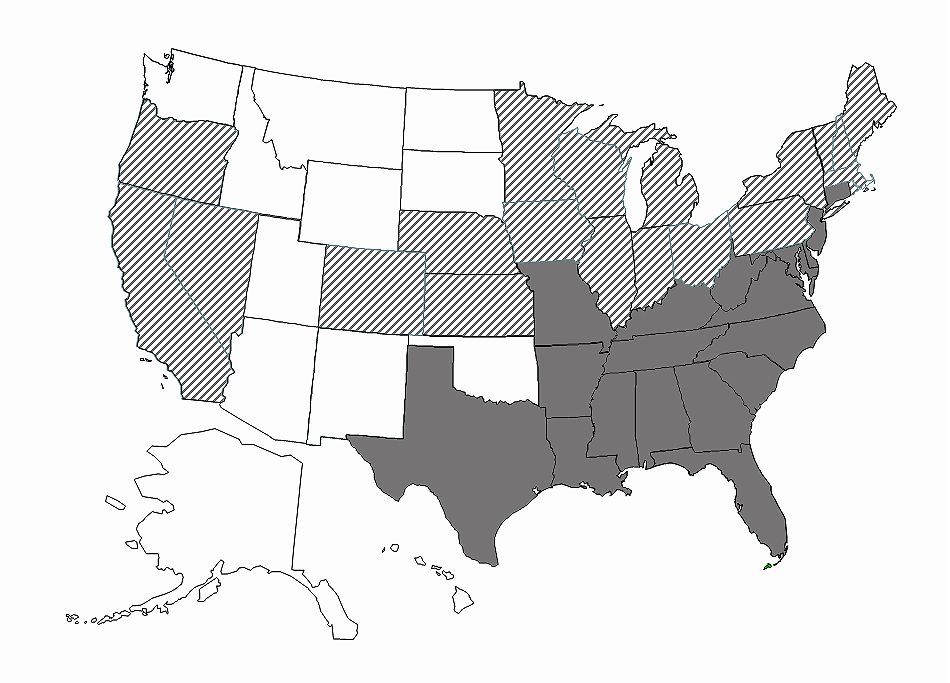
It is certainly true that this map shows a regional concentration of states (in black) carried by Grover Cleveland—the candidate who received the most popular votes nationwide.
However, this same map shows a regional concentration of support for the loser of the national popular vote—Benjamin Harrison.
How is “the genius of the Electoral College” demonstrated by giving the presidency to a regional second-place candidate (Benjamin Harrison), in preference to a regional first-place candidate (Grover Cleveland)?
Moreover, let’s look closer at England’s assertion that Cleveland was the regional candidate in the 1888 election. Cleveland carried two northern states (namely New Jersey and Connecticut), whereas Harrison carried no southern or border states. That is to say, of the two candidates, Harrison did a manifestly poorer job than Cleveland of reaching across the geographic divisions reminiscent of the recently concluded Civil War.
As to the actual history of the situation, Cleveland failed to win the Electoral College in 1888 because he lost one state (New York with 36 electoral votes) by the slender margin of 14,373 popular votes. He lost New York because of his intra-party feud with Tammany Hall.
England’s claims about the “genius” of the Electoral College are incorrect for an additional reason. Indeed, England did not mention that Cleveland ran for President three times and won the same southern states in all three races.
Cleveland won the presidency in 1884 and then lost it in 1888 solely because of narrow margins in one decisive state—New York.
In 1892, he won the presidency, thanks to winning New York and some other states.
If the “genius” of the state-by-state winner-take-all system is praiseworthy for denying Cleveland the presidency in one election (1888), why does England not criticize that same system for handing him the presidency in two other elections (1884 and 1892)?
Moreover, the regional pattern of the presidential election immediately before Cleveland’s three runs (that is, 1880) was almost identical to that of the 1888 election.
In figure 9.8, 1880 Democrat Winfield Hancock’s states are shown in black, and Republican James Garfield’s states are thatched.
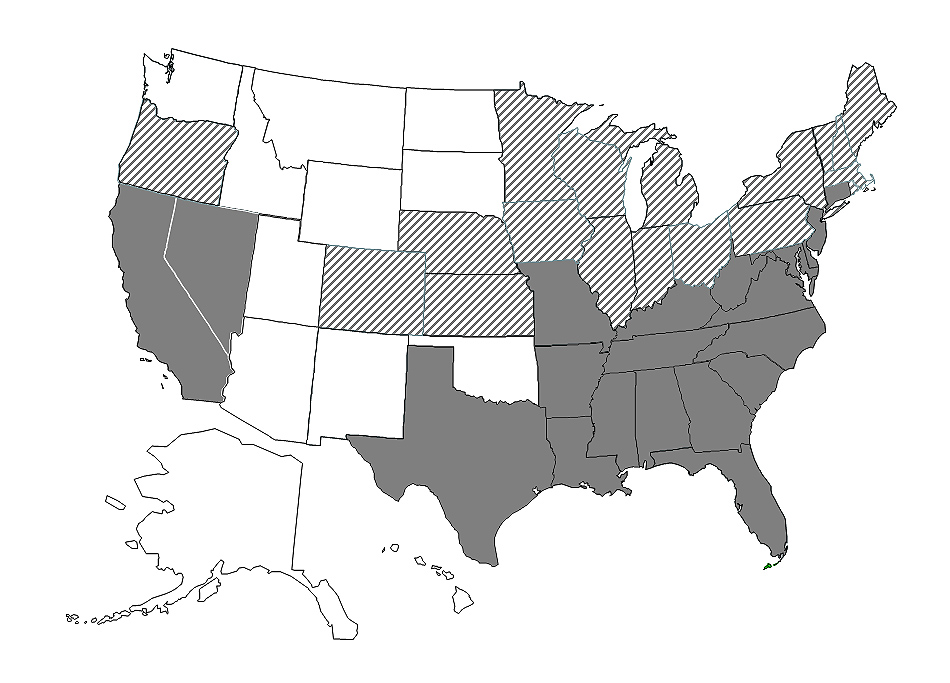
How is Trent England’s claim that “the Electoral College works as a check against regionalism” illustrated by the election in 1880 of Garfield—a manifestly regional candidate?
In fact, most pre-Civil-War elections, starting with the nation’s first competitive election in 1796, exhibited a distinctly regional pattern.
Moreover, most post-Civil-War elections evidenced a regional pattern similar to that of the 1880 and 1888 elections.
In fact, a comparison of the map for the 2012 presidential election with the maps for 1880 and 1888 shows that regionalism was alive and well in the nation’s 57th presidential election.
In figure 9.9, the states that Barack Obama won in 2012 are shown in black, and Republican Mitt Romney’s states are thatched.
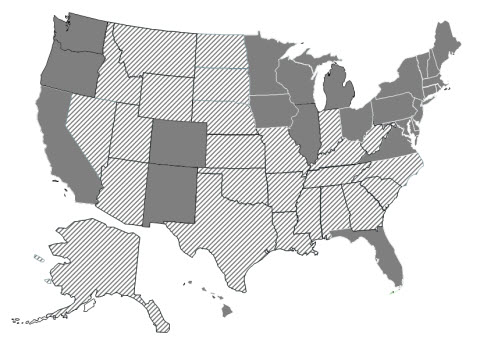
Trent England’s claim that “the Electoral College works as a check against regionalism” was not true during the Gilded Age when Cleveland ran, was not true before the Gilded Age, and is not true today.
Finally, let’s return to England’s claim about radicalism:
“It is the genius of the Electoral College that Grover Cleveland did not win in 1888. The Electoral College works as a check against regionalism and radicalism.”[344]
Does anyone know of any credible historian or political observer who regards Grover Cleveland as a radical?
Footnotes
[343] England, Trent. What Grover learned at (the) Electoral College: American politics are more inclusive, moderate, stable, and nationally unified because of the Electoral College. December 15, 2009. http://www.saveourstates.com/2009/what-grover-learned-at-the-electoral-college/.
[344] Ibid.