- 9.6.1 MYTH: Big cities would dominate a national popular vote for President.
- 9.6.2 MYTH: One major reason for establishing the Electoral College was to prevent candidates from campaigning only in big cities.
9.6.1 MYTH: Big cities would dominate a national popular vote for President.
QUICK ANSWER:
- The 100 biggest cities contain almost one-fifth of the U.S. population (about 65 million people). To put this in perspective, the population of Baton Rouge, Louisiana—the nation’s 100th biggest city—is 225,128.
- Rural America contains one-fifth of the population (about 66 million).
- Under a national popular vote, every vote would be equal throughout the United States. A vote cast in a big city would be no more influential or controlling than a vote cast anywhere else.
David Barton, founder of Wall Builders, in an interview with Conservative Broadcasting Network (CBN) said:
“If you just went to a popular vote—there are 35,000 cities in the United States. Twenty cities have the majority of the vote in America. You could win a presidential campaign by just spending your time in 20 cities—who cares about the other 34,980 cities.”[271] [Emphasis added]
First, these statistics are all wrong. The population of the 20 biggest cities is 331,449,281—only 10.4% of the U.S. population.
In fact, the 100 biggest cities contain only 19.6% of the U.S. population (64,983,448 people out of 331,449,281), according to the 2020 census.[272]
Second, the voters of the 20 biggest cities do not vote unanimously in favor of any candidate.
Barton’s statement is illustrative of numerous similar erroneous statements based on claims that:
- the nation’s big cities are bigger than they actually are;
- rural America is smaller than it actually is; and
- presidential campaigns would ignore any group of voters when every vote is equal and the winner is the candidate who receives the most popular votes.
A look at our country’s actual demographics contradicts these misstatements.
The 100 biggest cities have one-fifth of the U.S. population.
Let’s start with the facts concerning how big the big cities are.
The 100 biggest cities contain 64,983,448 people—19.6% of the U.S. population of 331,449,281, according to the 2020 census.[273]
To put this in perspective, the nation’s 100th biggest city is Baton Rouge, Louisiana (with a population of 225,128).
To put it another way, about 80% of the U.S. population lives in places with populations of less than 225,000.
The nation’s largest city (New York City) has 8,804,190 people and constitutes 2.7% of the nation’s population.
The 10 biggest cities together (New York, Los Angeles, Chicago, Houston, Phoenix, Philadelphia, San Antonio, San Diego, Dallas, and San Jose) constitute 7.9% of the nation’s population.
The 50 biggest cities together constitute 15.3% of the nation’s population. To put this in perspective, the nation’s 50th biggest city is Arlington, Texas (with a population 394,218).
The 100 biggest cities together constitute 19.6% of the nation’s population—that is, almost one in five Americans live in the 100 biggest cities.
Table 9.20 shows the population of the 100 biggest cities.
Table 9.20 Population of the 100 biggest U.S. cities
| Rank | City | Population | |
| 1 | New York, New York | 8,804,190 | Biggest city is 2.7% of U.S. population |
| 2 | Los Angeles, California | 3,893,986 | Top 2 cities are 3.8% of U.S. population |
| 3 | Chicago, Illinois | 2,747,231 | Top 3 cities are 4.7% of U.S. population |
| 4 | Houston, Texas | 2,302,792 | Top 4 cities are 5.4% of U.S. population |
| 5 | Phoenix, Arizona | 1,607,739 | Top 5 cities are 5.8% of U.S. population |
| 6 | Philadelphia, Pennsylvania | 1,603,797 | Top 6 cities are 6.3% of U.S. population |
| 7 | San Antonio, Texas | 1,434,270 | Top 7 cities are 6.8% of U.S. population |
| 8 | San Diego, California | 1,385,922 | Top 8 cities are 7.2% of U.S. population |
| 9 | Dallas, Texas | 1,304,442 | Top 9 cities are 7.6% of U.S. population |
| 10 | San Jose, California | 1,014,545 | Top 10 cities are 7.9% of U.S. population |
| 11 | Austin, Texas | 959,549 | |
| 12 | Jacksonville, Florida | 949,577 | |
| 13 | Fort Worth, Texas | 918,377 | |
| 14 | Columbus, Ohio | 905,672 | |
| 15 | Indianapolis, Indiana | 887,752 | |
| 16 | Charlotte, North Carolina | 874,541 | |
| 17 | San Francisco, California | 873,965 | |
| 18 | Seattle, Washington | 735,157 | |
| 19 | Denver, Colorado | 715,522 | |
| 20 | Washington, District of Columbia | 689,545 | |
| 21 | Nashville-Davidson, Tennessee | 689,504 | |
| 22 | Oklahoma City, Oklahoma | 681,387 | |
| 23 | El Paso, Texas | 678,587 | |
| 24 | Boston, Massachusetts | 676,216 | |
| 25 | Portland, Oregon | 652,089 | Top 25 cities are 11.5% of U.S. population |
| 26 | Las Vegas, Nevada | 641,825 | |
| 27 | Detroit, Michigan | 639,614 | |
| 28 | Louisville-Jefferson, Kentucky | 632,689 | |
| 29 | Memphis, Tennessee | 632,207 | |
| 30 | Baltimore, Maryland | 585,708 | |
| 31 | Milwaukee, Wisconsin | 577,235 | |
| 32 | Albuquerque, New Mexico | 564,563 | |
| 33 | Fresno, California | 542,161 | |
| 34 | Tucson, Arizona | 541,349 | |
| 35 | Sacramento, California | 522,754 | |
| 36 | Kansas City, Missouri | 507,969 | |
| 37 | Mesa, Arizona | 504,500 | |
| 38 | Atlanta, Georgia | 498,602 | |
| 39 | Omaha, Nebraska | 490,627 | |
| 40 | Colorado Springs, Colorado | 479,260 | |
| 41 | Raleigh, North Carolina | 467,592 | |
| 42 | Long Beach, California | 466,302 | |
| 43 | Virginia Beach, Virginia | 459,470 | |
| 44 | Miami, Florida | 442,265 | |
| 45 | Oakland, California | 439,349 | |
| 46 | Minneapolis, Minnesota | 428,403 | |
| 47 | Tulsa, Oklahoma | 412,458 | |
| 48 | Bakersfield, California | 402,907 | |
| 49 | Wichita, Kansas | 397,070 | |
| 50 | Arlington, Texas | 394,218 | Top 50 cities are 15.3% of U.S. population |
| 51 | Aurora, Colorado | 386,241 | |
| 52 | New Orleans, Louisiana | 383,997 | |
| 53 | Tampa, Florida | 382,769 | |
| 54 | Cleveland, Ohio | 373,091 | |
| 55 | Urban Honolulu CDP, Hawaii | 350,943 | |
| 56 | Anaheim, California | 347,015 | |
| 57 | Lexington-Fayette, Kentucky | 322,570 | |
| 58 | Stockton, California | 320,759 | |
| 59 | Corpus Christi, Texas | 317,929 | |
| 60 | Henderson, Nevada | 317,521 | |
| 61 | Riverside, California | 314,347 | |
| 62 | St. Paul, Minnesota | 311,448 | |
| 63 | Newark, New Jersey | 310,876 | |
| 64 | Santa Ana, California | 310,538 | |
| 65 | Cincinnati, Ohio | 310,242 | |
| 66 | Orlando, Florida | 307,674 | |
| 67 | Irvine, California | 305,313 | |
| 68 | Pittsburgh, Pennsylvania | 303,160 | |
| 69 | St. Louis, Missouri | 301,578 | |
| 70 | Greensboro, North Carolina | 297,899 | |
| 71 | Jersey City, New Jersey | 292,412 | |
| 72 | Anchorage, Alaska | 291,247 | |
| 73 | Lincoln, Nebraska | 291,114 | |
| 74 | Plano, Texas | 285,900 | |
| 75 | Durham, North Carolina | 283,547 | |
| 76 | Buffalo, New York | 278,302 | |
| 77 | Chandler, Arizona | 276,330 | |
| 78 | Chula Vista, California | 276,025 | |
| 79 | Toledo, Ohio | 270,726 | |
| 80 | Madison, Wisconsin | 268,414 | |
| 81 | Gilbert Town, Arizona | 268,302 | |
| 82 | Fort Wayne, Indiana | 263,852 | |
| 83 | Reno, Nevada | 263,436 | |
| 84 | North Las Vegas, Nevada | 262,678 | |
| 85 | St. Petersburg, Florida | 258,277 | |
| 86 | Lubbock, Texas | 257,180 | |
| 87 | Irving, Texas | 256,793 | |
| 88 | Laredo, Texas | 255,181 | |
| 89 | Winston-Salem, North Carolina | 249,443 | |
| 90 | Chesapeake, Virginia | 249,422 | |
| 91 | Glendale, Arizona | 248,345 | |
| 92 | Garland, Texas | 246,132 | |
| 93 | Scottsdale, Arizona | 241,488 | |
| 94 | Norfolk, Virginia | 238,005 | |
| 95 | Boise City, Idaho | 235,670 | |
| 96 | Fremont, California | 232,084 | |
| 97 | Santa Clarita, California | 229,213 | |
| 98 | Spokane, Washington | 228,831 | |
| 99 | Richmond, Virginia | 226,610 | |
| 100 | Baton Rouge, Louisiana | 225,128 | Top 100 cities are 19.6% of U.S. population |
| Total for 100 biggest cities | 64,983,448 |
Rural America is one-fifth of the U.S. population.
The population of rural America is 66,300,254 people—20.0% of the U.S. population.[274], [275]
Figure 9.5 shows that rural America has almost the same population as the 100 biggest cities (actually a tad more). Each has about one-fifth of the U.S. population.
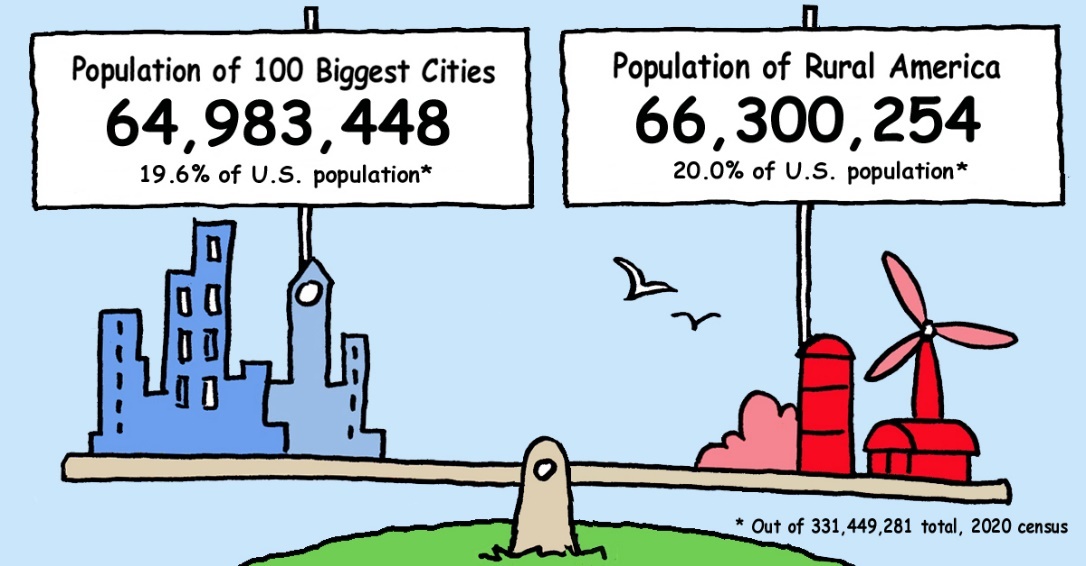
Mike Flanagan—flantoons@btinternet.com
The myth about big cities may stem from the incorrect belief that big cities are bigger than they actually are, and that big cities account for a greater fraction of the nation’s population than they actually do.
It is certainly true that most of the biggest cities in the country have a Democratic majority. However, most exurbs, small towns, and rural areas generate Republican majorities. Suburbs of big cities are usually politically divided.
If big cities controlled the outcome of elections, every Governor and every U.S. Senator in every state with a significant city would be a Democrat. However, innumerable Republicans have won races for Governor and U.S. Senator without ever carrying the biggest city in their respective states.
When presidential candidates campaign to win the electoral votes of a closely divided battleground state, they campaign throughout the state. The big cities do not receive all the attention—much less control the outcome.
Philadelphia, Pittsburgh, Detroit, and Milwaukee certainly have not monopolized the attention of presidential candidates when they have campaigned in the battleground states of Pennsylvania, Michigan, and Wisconsin. Moreover, these cities manifestly do not control the statewide outcomes. In 2016, Hillary Clinton won Philadelphia, Pittsburgh, Detroit, and Milwaukee but did not carry Pennsylvania, Michigan, or Wisconsin.
Even if one makes the far-fetched assumption that a candidate could win 100% of the votes in the nation’s 100 biggest cities, that candidate would have won only 20% of the national popular vote.
A big city that is located in a closely divided state is critically important in presidential races (as are the suburban, ex-urban, and rural parts of that state).
However, big cities that are located in spectator states such as Houston, Chicago, and Seattle are politically irrelevant (as are all other parts of those states).
The current state-by-state winner-take-all system elevates the political importance of a city such as Milwaukee that is located in the battleground state of Wisconsin, while minimizing the importance of a city such as Baltimore that is located in a spectator state such as Maryland (which has the same 10 electoral votes as Wisconsin).
Footnotes
[271] Wishon, Jennifer. 2020. As Blue States Push to Abolish Electoral College, Critics Warn: “You Would Have Violence.” CBN News. March 23, 2020. https://www1.cbn.com/cbnnews/us/2020/march/as-blue-states-push-to-abolish-electoral-college-critics-warn-you-would-have-violence
[272] U.S. Census Bureau. 2021. City and Town Population Totals: 2020-2021. SUB-IP-EST2021-POP. Accessed February 15, 2023. https://www.census.gov/data/tables/time-series/demo/popest/2020s-total-cities-and-towns.html#tables
[273] Ibid.
[274] U.S. Census Bureau. 2023. 2020 Census Urban Areas Facts. February 9, 2023. Accessed February 15, 2023. https://www.census.gov/programs-surveys/geography/guidance/geo-areas/urban-rural/2020-ua-facts.html
[275] U.S. Census Bureau. 2022. 2020 Census Urban-Rural Classification Fact Sheet. https://www.census.gov/content/dam/Census/library/factsheets/2022/dec/2020-census-urban-rural-fact-sheet.pdf
9.6.2 MYTH: One major reason for establishing the Electoral College was to prevent candidates from campaigning only in big cities.
QUICK ANSWER:
- Given the historical fact that 95% of the U.S. population in 1790 lived in places with fewer than 2,500 people, it can be safely said that the Founding Fathers were not concerned about presidential candidates campaigning in big cities.
- If the Founding Fathers were concerned about the political clout of big cities, they were totally derelict in addressing the problem. The U.S. Constitution makes no distinction between a vote cast in a city versus a vote cast anywhere else in a state. Moreover, state winner-take-all laws enacted under the authority of Article II, section 1 of the Constitution do not treat votes cast in a city any differently from votes cast in small towns or rural areas.
Hans von Spakovsky of the Heritage Foundation has stated:
“Amajor reason for establishing the Electoral College in the first place [was] to prevent elections from becoming contests where presidential candidates would simply campaign in big cities for votes.”[276]
In an op-ed entitled “Electoral College Is Evidence of Founders’ Brilliance,” Joseph Mendola wrote:
“In 1787, the Founders were concerned that the popular vote system would give the two largest population enclaves in the country at that time—Philadelphia and New York—the power to choose the president, taking away the voice of farmers and working people in less populous states.”[277] [Emphasis added]
Dave Cooper of Churubusco, Indiana (population 1,796) wrote in the Churubusco News in 2018:
“The founders were very clever when they conceived the idea of the Electoral College. Why, they wrote, should a large metropolitan area like New York City have more influence than a very small rural village?”[278]
According to the 1790 census,[279] the combined population of New York City and Philadelphia was 61,653—a mere 1.6% of the country’s total population of 3,929,214.
Table 9.21 shows that the combined population of the only five cities in the country with a population of over 10,000 was 109,835—a mere 2.8% of the country’s population of 3,929,214 at the time.
Table 9.21 Population of the only five cities in the U.S. with population over 10,000 according to 1790 census
| Rank | City | Population |
| 1 | New York | 33,131 |
| 2 | Philadelphia | 28,522 |
| 3 | Boston | 18,320 |
| 4 | Charleston | 16,359 |
| 5 | Baltimore | 13,503 |
| Total | 109,835 |
Moreover, there were only 24 places with a population over 2,500 in 1790. Their combined population was 201,655—a mere 5% of the country’s population.
In other words, 95% of the country’s population lived in places with fewer than 2,500 people in 1790.
If the Founding Fathers had been concerned about the political clout of big cities, they were derelict in addressing this problem. Indeed, nothing in the U.S. Constitution makes any distinction between a vote cast in a city and a vote cast elsewhere in a state.
Moreover, the winner-take-all method of awarding electoral votes does not treat votes cast in a city any differently from votes cast in small towns or rural areas. All votes are equal inside each state.
While the current system makes a voter in a big city located in a closely divided state (such as Philadelphia, Phoenix, and Milwaukee) very important in presidential elections, it also makes every voter in a small town or rural area important.
Likewise, the current system makes a voter in a big city located in a spectator state (e.g., Chicago, Houston, and New York City) politically irrelevant in presidential elections, and it also renders a voter in a small town or rural area of a spectator state unimportant.
Finally, the Founding Fathers were not concerned that “presidential candidates would campaign in big cities for votes,” because they weren’t concerned with candidates campaigning anywhere.
Instead, they envisioned the Electoral College as an elite deliberative body. John Jay (the presumed author of Federalist No. 64) described the Electoral College in 1788:
“As the select assemblies for choosing the President … will in general be composed of the most enlightened and respectable citizens, there is reason to presume that their attention and their votes will be directed to those men only who have become the most distinguished by their abilities and virtues.”[280] [Emphasis added]
Alexander Hamilton (the presumed author of Federalist No. 68) wrote in 1788:
“[T]he immediate election should be made by men most capable of analyzing the qualities adapted to the station, and acting under circumstances favorable to deliberation, and to a judicious combination of all the reasons and inducements which were proper to govern their choice. A small number of persons, selected by their fellow-citizens from the general mass, will be most likely to possess the information and discernment requisite to such complicated investigations.”[281] [Emphasis added]
Moreover, the Founding Fathers were divided (and, accordingly, the Constitution is silent) as to whether the voters should even be allowed to vote for these aristocratic presidential electors.
The 1787 Constitutional Convention left that question to the states. Only six of the 10 states that participated in the nation’s first presidential election in 1789 allowed their voters to vote for the state’s presidential electors.
Footnotes
[276] Von Spakovsky, Hans. Protecting Electoral College from popular vote. Washington Times. October 26, 2011.
[277] Mendola, Joseph. 2018. Electoral College is evidence of Founders’ brilliance. Concord Monitor. July 25, 2018. https://www.concordmonitor.com/Working-people-rule-18933239
[278] Cooper, Dave. 2018. State Electoral College? Churubusco News. December 5, 2018. https://www.kpcnews.com/article_b0f22275-71be-583e-bc99-c993326e230f.html
[279] See 1790 Census: Whole Number of Persons within the Districts of the U.S. 1793. https://www.census.gov/programs-surveys/decennial-census/decade/decennial-publications.1790.html
[280] The powers of the senate. Independent Journal. March 5, 1788. Federalist No. 64.
[281] Publius. The mode of electing the President. Independent Journal. March 12, 1788. Federalist No. 68.